
Saudi SASO Mandates Arabic UI & Local Pen Testing for Smart Locks from June 2026
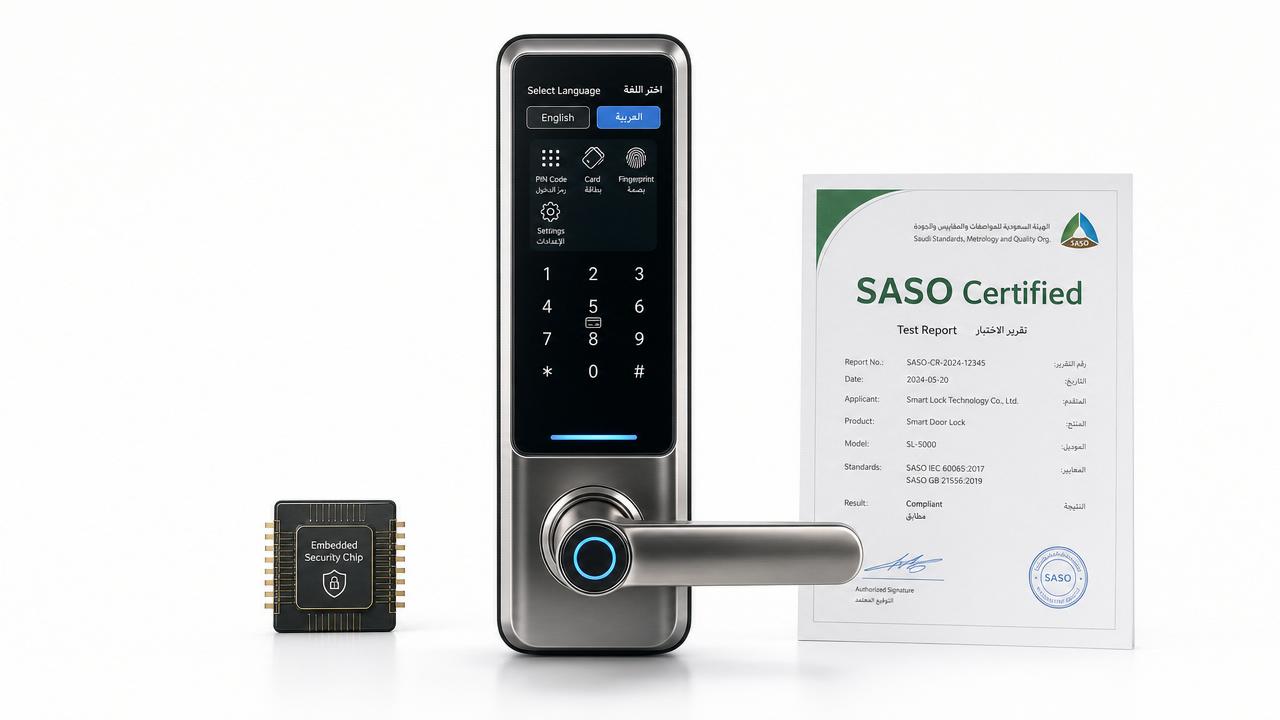
Saudi Arabia’s Standards, Metrology and Quality Organization (SASO) will enforce new technical regulations for imported smart locks effective 1 June 2026. The rule requires built-in Arabic-language user interfaces and completion of penetration testing at designated laboratories in Riyadh. Exporters and manufacturers serving the Gulf smart lock market — particularly those in digital access control, IoT hardware, and consumer electronics — must now reassess compliance timelines, certification pathways, and product localization strategies.
Event Overview
Effective 1 June 2026, SASO’s updated technical regulation mandates that all imported digital locks — including fingerprint-, NFC-, Bluetooth-, and AI vision-based models — must feature a pre-installed Arabic user interface and undergo penetration testing at SASO-authorized laboratories in Riyadh. Certification must be completed prior to customs clearance; failure to comply may result in shipment delays or rejection. Chinese exporters are advised to allocate a minimum of 45 days for the full certification process.
Industries Affected
Direct Exporters & Trading Companies
These entities face immediate operational impact as the requirement applies at the point of import. Non-compliant shipments risk being held at Saudi ports, triggering storage fees, resubmission delays, or forced return. Since SASO does not recognize foreign lab reports for this regulation, third-party export agents cannot bypass the local testing step.
Smart Lock Manufacturers (OEM/ODM)
Manufacturers supplying white-label or branded smart locks to Gulf markets must revise firmware development roadmaps to embed Arabic UI by default — not as an optional language toggle. This affects UI/UX design cycles, firmware version control, and regional SKU segmentation. Products currently shipped with English-only or multi-language UIs (without guaranteed Arabic rendering) do not meet the mandate.
Supply Chain & Certification Service Providers
Logistics and conformity assessment firms supporting smart lock exports must now verify SASO-recognized lab capacity in Riyadh, confirm lead times for penetration testing slots, and align documentation workflows (e.g., test reports, Arabic UI verification logs, firmware hashes) with SASO’s submission requirements. Delays in lab scheduling — already observed during peak certification periods — could compress overall compliance windows.
Key Considerations and Recommended Actions
Monitor official SASO guidance on Arabic UI implementation standards
While the regulation confirms Arabic UI is mandatory, SASO has not yet published detailed specifications (e.g., character set support, right-to-left layout validation, voice prompt localization). Exporters should track SASO’s official portal and registered notifications for updates before finalizing firmware builds.
Confirm lab accreditation status and booking availability in Riyadh
Only labs authorized by SASO for digital lock penetration testing are accepted. Current public listings show limited capacity. Companies should initiate lab engagement no later than 60 days before planned shipment dates — especially for products requiring iterative firmware retesting after UI integration.
Separate regulatory signal from operational readiness
The 1 June 2026 date is definitive, but enforcement scope (e.g., grandfathering of existing stock, transitional arrangements for pending shipments) remains unconfirmed. Until SASO issues formal transitional guidance, treating the deadline as non-negotiable for all new consignments is the prudent approach.
Adjust procurement and firmware release planning
Manufacturers should treat Arabic UI integration as a hard dependency for any smart lock model destined for Saudi Arabia. This includes revising BOMs (if UI assets require additional memory), updating QA checklists, and coordinating with firmware vendors to ensure Arabic font rendering and input method compatibility are validated pre-certification.
Editorial Perspective / Industry Observation
Observably, this regulation reflects SASO’s broader shift toward localized cybersecurity governance — moving beyond functional safety to include linguistic accessibility and region-specific threat modeling. Analysis shows it is less a one-off product requirement and more an early indicator of how Gulf regulators may treat embedded software in connected physical devices. From an industry perspective, it signals growing divergence between GCC conformity frameworks and international standards (e.g., ISO/IEC 27001 or NIST SP 800-115), necessitating dedicated regional compliance tracks rather than global harmonization shortcuts. It is currently best understood as an enforceable requirement — not merely a policy signal — given its clear effective date, defined scope, and binding customs linkage.
This regulation marks a material escalation in localization expectations for smart home and access control hardware entering Saudi Arabia. Its significance lies not only in the Arabic UI mandate but in the coupling of language support with mandatory local security validation — a combination that increases time-to-market, engineering overhead, and certification cost. For stakeholders, it underscores that ‘GCC-ready’ can no longer be assumed from CE or FCC compliance alone. A calibrated, timeline-driven, lab-coordinated response — beginning well before Q2 2026 — is now operationally necessary.
Source: Saudi Standards, Metrology and Quality Organization (SASO) official announcement. Note: Transitional provisions, detailed Arabic UI technical criteria, and updated lab accreditation lists remain pending publication and are subject to ongoing monitoring.
Industry Briefing
Get the top 5 industry headlines delivered to your inbox every morning.