
Smart Locks for High-Security Commercial Buildings: What to Check Before Specifying
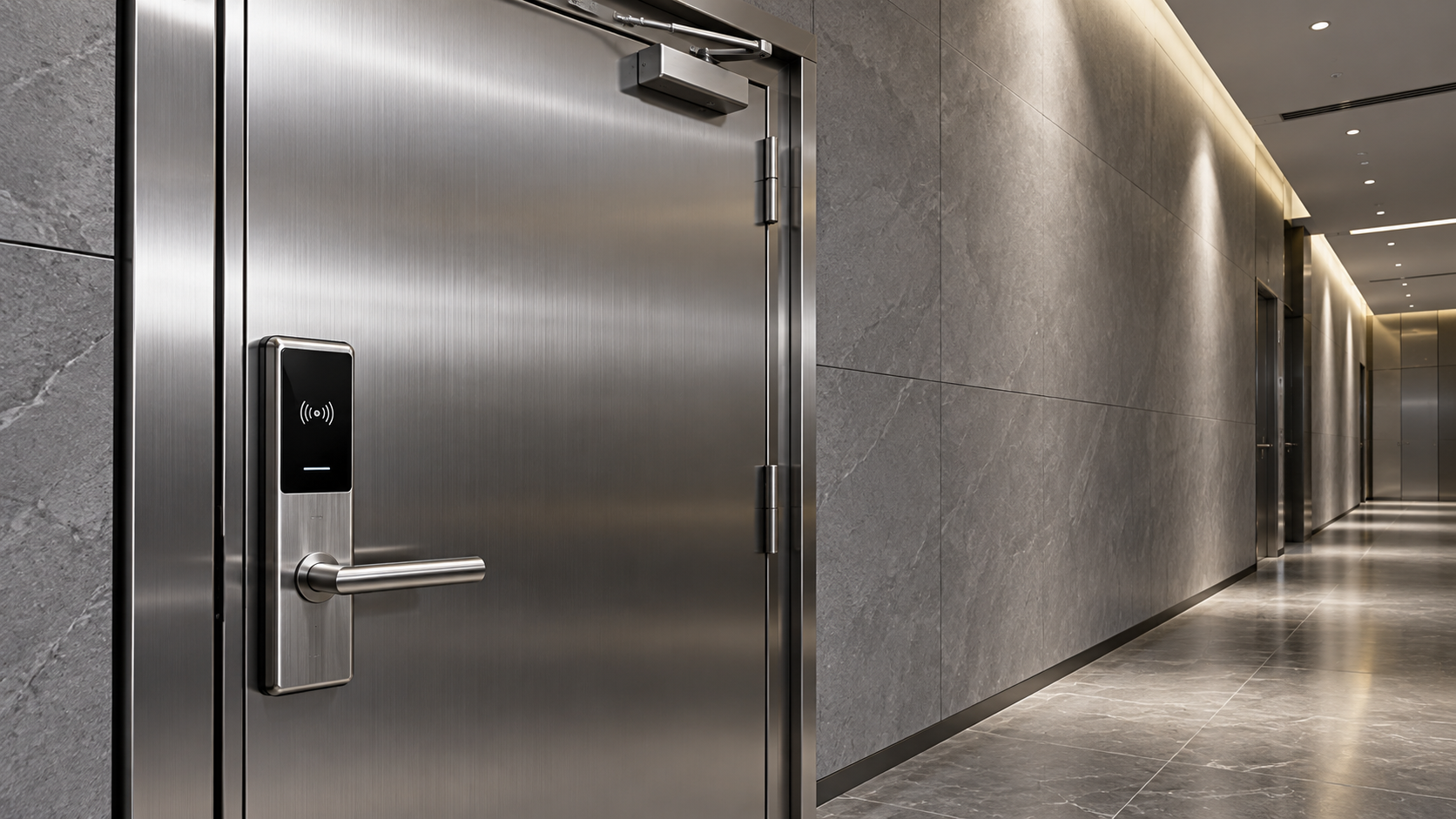
For high-security commercial buildings, a smart lock should enter the specification only when the team can explain how the complete opening resists attack, permits lawful escape, and behaves when supporting services fail. Credential convenience and remote administration matter, but neither compensates for an unsuitable door assembly or an access decision that depends on an unavailable cloud service.
The strongest specification starts with a door-by-door security and operating model. A perimeter entrance, a server room, and an office suite may share an access-control platform while requiring different locking hardware, monitoring, and failure behavior. Evaluating smart locks for high-security commercial buildings therefore means checking the installed system against defined threats and operating conditions, then requesting evidence for the exact configuration being proposed.
Establish what each opening must protect—and how people must leave
“High security” is too broad to serve as a performance requirement. Identify whether the concern is forced entry, stolen credentials, insider misuse, unauthorized remote administration, or access during an outage. Also establish how long a door may remain unsecured, how quickly access must be revoked, and whether security personnel can respond to an alarm. These decisions determine which features have practical value.
A lock can verify a credential without preventing someone from following an authorized person through the doorway. Where tailgating is a material threat, the design may need controlled entry arrangements, surveillance, or staffed procedures. Adding stronger credential technology alone will leave that exposure largely intact.
Assess the entire opening: door leaf, frame, hinges, strike, glazing, closer, latch engagement, and accessible wiring. A strong lock fitted to a weak frame cannot deliver its advertised resistance. Door alignment also affects security; an access-control system may report a successful locking command even when the latch has not engaged.
Request independent test or certification evidence that identifies the applicable standard, hardware category, and exact model. Where ANSI/BHMA grades are specified, identify the relevant product standard alongside the grade. A grade applies within a defined category and test scope; it should not become shorthand for a complete security assessment.
Check whether the evidence covers the proposed trim, cylinder, strike, power arrangement, and installation conditions. An approval for one configuration does not automatically establish the performance of every related variant. For fire-rated openings, verify that the hardware and any proposed modifications are compatible with the assembly’s listing and installation requirements.
Resolve egress before selecting the locking architecture. Occupancy, door location, fire protection arrangements, and the adopted code determine which locking configurations are permitted. An escape route, a controlled stair door, and a restricted equipment room can have different requirements. Review the intended arrangement with the responsible design professional and authority having jurisdiction.
Fail-safe and fail-secure describe behavior on loss of power; they do not, by themselves, establish whether occupants can exit. Some fail-secure arrangements preserve mechanical free egress while keeping the entry side locked. Other electrically locked arrangements depend on specified release devices and interfaces. Document entry security and exit operation separately so that the specification cannot be satisfied by an ambiguous statement such as “unlocks in an emergency.”
Make failure behavior a selection criterion
A connected lock’s suitability becomes clearer when the network disappears. Depending on the architecture, access decisions may occur inside the lock, at a local controller, or through a remote service. Each arrangement creates different dependencies. Require a diagram showing where credentials, permissions, schedules, and event records reside, along with the services needed for normal operation.
A locally cached credential can preserve access during a network outage, but the same cache may delay revocation. A cloud-managed system may continue operating locally, although remote changes and event visibility can stop. Neither behavior should be inferred from the words “offline capable.” Specify which functions must continue and how long the resulting delay is acceptable.
Ask suppliers to describe the following conditions separately:
- Loss of external connectivity: Which authorized users retain access, and which administrative functions become unavailable?
- Loss of the local network or controller: Can each affected opening still make access decisions and support required exit operation?
- Loss of mains power: What powers the lock, controller, reader, and network equipment, and what happens when backup power is exhausted?
- Low or depleted lock batteries: Who receives the warning, how is it escalated, and how can authorized staff recover access?
- Service restoration: How are permissions, clocks, and buffered events reconciled, and how are unsuccessful updates reported?
Battery-life claims need an operating context. Traffic volume, radio activity, temperature, mechanical resistance, and reporting frequency can affect replacement intervals. Request the assumptions behind the estimate and assess the maintenance workload across the installed estate. A replacement process that is manageable for a few doors may become difficult across several buildings.
For powered installations, calculate backup requirements for the complete access path. Keeping a lock energized will not preserve remote authorization if its controller or network switch has lost power. Confirm that backup-power monitoring reaches the people responsible for responding.
Recovery arrangements deserve the same scrutiny as normal access. A mechanical override can support continuity, but it also creates a separate key-control obligation and may provide different audit visibility. Temporary credentials, emergency keys, and service access should have named custodians, controlled issue procedures, and a clear method of withdrawing access after use.
Translate these requirements into witnessed acceptance tests. Disconnect the relevant network segment, interrupt power under controlled conditions, revoke a credential during an outage, and restore service. Observe the physical door as well as the management screen. Written descriptions are useful evidence; demonstrations establish whether the delivered configuration behaves as specified.
Evaluate the credential and management system as one security boundary
An encrypted credential does not secure every part of an access-control system. The reader connection, controller, management application, administrator accounts, mobile devices, and update process each create opportunities for compromise. Request a security architecture that explains these boundaries and the protection applied at each one.
For cards and mobile credentials, establish how authenticity is checked and what prevents copying, replay, or use after revocation. A system that relies only on reading an unprotected static identifier offers different assurance from one that performs cryptographic authentication. Mobile access also requires a lost-device process and a clear explanation of whether unlocking depends on possession of the phone, device authentication, or an additional user action.
Reader-to-controller communication warrants explicit attention. Legacy Wiegand connections lack the encrypted, authenticated channel available with OSDP Secure Channel. However, support for OSDP does not establish that Secure Channel is enabled or correctly commissioned. Specify the required operating mode, secure key provisioning, and how the installed configuration will be verified.
Claims such as “AES encryption” reveal little without context. Ask what data is protected, where encryption terminates, how keys are generated and stored, and how compromised keys can be replaced. Shared default secrets or uncontrolled enrollment procedures can undermine otherwise sound cryptography.
The management platform can grant access across many doors, making administrator privileges particularly consequential. Require role-based permissions, multifactor authentication for privileged access, and records of changes to users, access groups, schedules, and system settings. Determine whether installers or support personnel retain access after handover and how temporary support sessions are authorized and recorded.
Firmware support should be a procurement requirement with a defined commercial commitment. Request the supported service period, vulnerability-reporting process, update authentication method, and procedure for deploying urgent fixes. Establish how updates affect door operation, how failed installations recover, and whether unsupported components can be replaced without rebuilding the whole system.
Independent cybersecurity assessments can strengthen the evidence, provided their scope is clear. An assessment of a cloud portal may exclude the lock firmware or mobile application. Hardware durability certification likewise does not demonstrate resistance to account takeover. Review which components and versions were assessed, what limitations were recorded, and whether material findings were resolved.
Require integration evidence and a practical handover
Compatibility is often the point where an apparently suitable product becomes difficult to specify. “Integrates with existing access control” may mean native control, periodic data exchange, a third-party connector, or little more than a shared dashboard. Ask the supplier to map the proposed functions to the exact platform version and interface.
The most useful demonstration follows an identity through its working life: create a user, assign limited access, change a schedule, suspend the user, and remove the credential. Check how quickly each change reaches every relevant door, including devices that have been offline. Identify which system owns the authoritative record and how conflicting changes are handled.
Event reporting needs similar precision. “Access granted,” “door opened,” and “door secured” describe different events. A valid credential does not prove that the door opened, and a locking command does not prove that it latched. Determine which states the installed sensors can actually observe and which states the software merely infers.
For investigation and monitoring, specify time synchronization, event retention, export access, and behavior when local storage fills. Establish whether logs distinguish administrative changes, forced openings, doors held open, communication failures, and override use. Where monitoring depends on an external security platform, demonstrate that events arrive with usable identities, timestamps, and door references.
Commercial terms affect technical viability over the building’s operating life. Review which functions require subscriptions, whether service expiry changes local operation, and whether access records and configuration data can be exported in a usable form. Include the cost and effort of replacement credentials, batteries, gateways, software support, commissioning, and security updates. The purchase price alone does not describe the commitment.
Before approval, assemble a concise evidence package: an opening schedule, applicable hardware certifications, an egress and release sequence, a failure-behavior matrix, a security architecture, an integration demonstration, and lifecycle support terms. Tie unresolved items to specific doors or functions so that broad supplier assurances cannot conceal a critical exception.
A pilot should include the building’s difficult conditions: a busy entrance, an opening with challenging connectivity, a restricted room, and the relevant emergency interfaces. Set acceptance criteria before installation and record the delivered firmware, configuration, and dependencies. Approval is defensible when the selected system can demonstrate the required security and exit behavior, recover predictably from failures, and remain supportable by the team that will operate it.
Industry Briefing
Get the top 5 industry headlines delivered to your inbox every morning.