
EU Adds Mandatory UV Test for CE-Marked PC Panels
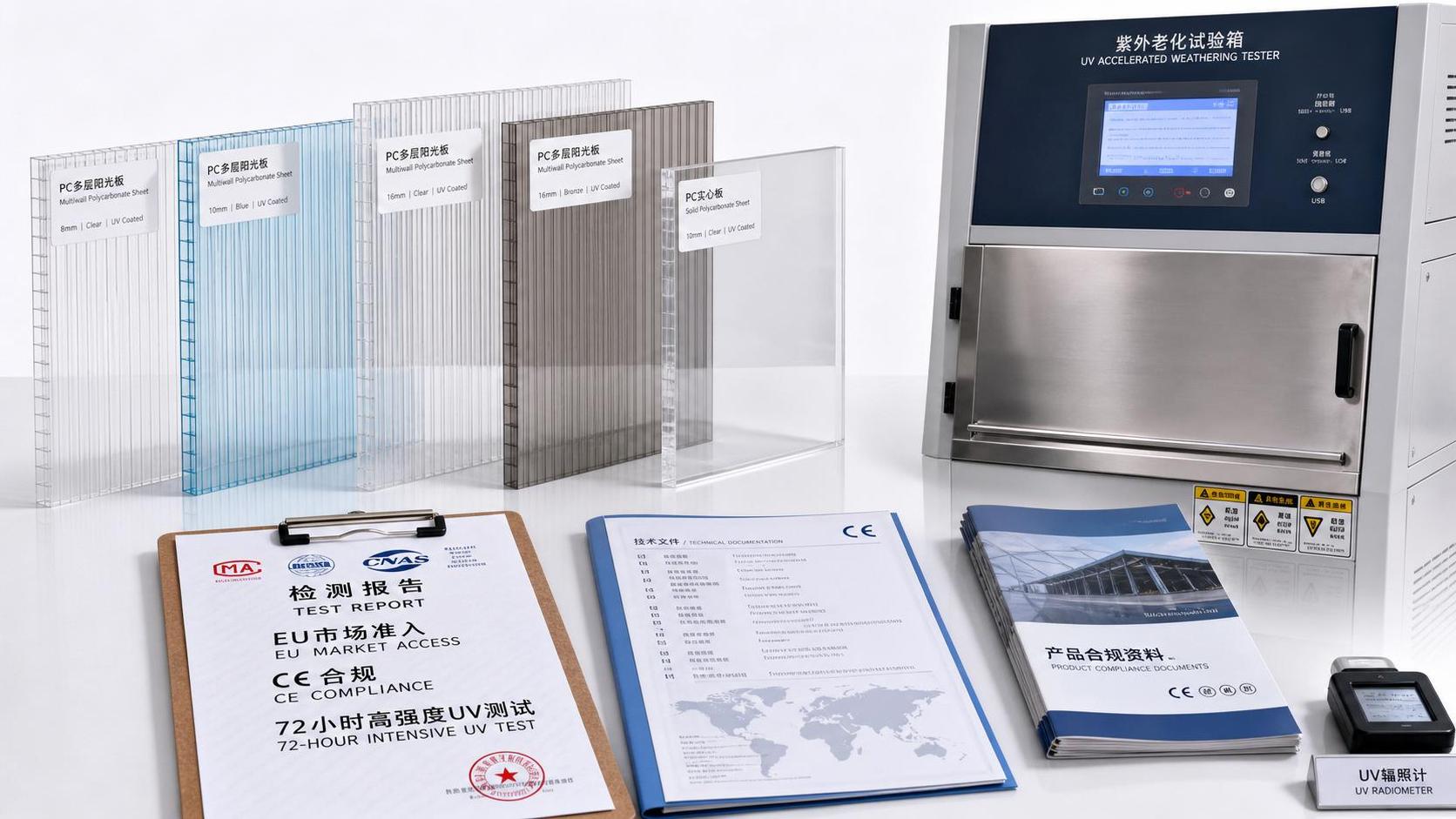
On June 20, 2026, a compliance change takes effect for PC sheets used in exterior wall, roofing, and daylighting applications entering the EU market. Under Notice 2026/1127 revising the CE construction products framework, PC panels including multiwall sheets and solid sheets must pass a 72-hour high-intensity UV exposure test under ISO 4892-3:2023 and be supported by a third-party laboratory report. This matters not only to exporters of wall panels, canopies, and greenhouse systems, but also to manufacturers, buyers, certification teams, and delivery planners because CE market access will now depend on a more specific durability testing requirement.
What the rule change confirms from June 20
The confirmed change is limited but operationally significant. According to the provided notice summary, the CE construction products rules are revised through Notice 2026/1127, effective June 20, 2026. From that date, all PC sheet products used for exterior walls, roofs, and daylighting systems must meet the ISO 4892-3:2023 requirement for 72 hours of high-intensity UV irradiation testing. The products covered include PC multiwall sheets and solid PC sheets. The same summary also states that a third-party laboratory report must be submitted, and products that do not meet the requirement cannot bear the CE mark for entry into the EU market.
Where the impact is likely to appear first
Export shipments face a stricter document threshold
From an industry perspective, exporters are likely to feel the change first because CE access is directly tied to whether the covered PC sheets can be supported by compliant UV aging test evidence. The practical impact is not only on product performance claims, but also on shipment readiness, technical file preparation, and the ability to clear customer acceptance checks tied to CE marking.
Manufacturing and specification alignment become more sensitive
Analysis shows that manufacturers of PC sheets and system suppliers using those sheets in wall, canopy, or greenhouse applications may need to pay closer attention to whether existing product specifications and internal quality documentation align with the new mandatory UV test item. The issue is not simply whether a product is described as UV resistant, but whether that claim is supported in the exact form now required for CE-related market entry.
Procurement teams may need earlier compliance screening
Buyers and sourcing teams involved in covered applications may also be affected because the rule change introduces a more explicit precondition for procurement decisions. What deserves closer attention is whether supplier qualification, bid documents, and purchase orders now need to reference the ISO 4892-3:2023 test requirement and the availability of a third-party laboratory report, especially where delivery commitments depend on CE-marked material.
Testing and certification support functions gain a larger role
For testing service providers, certification coordinators, and compliance support teams, the change signals a more visible role in transaction timing and market access. Observably, once third-party reporting becomes a mandatory part of CE entry for the covered products, the quality and completeness of test records, report matching, and supporting technical files may become a more active checkpoint in commercial execution.
What companies should review now
Check product scope against actual end use
Companies should first review whether their PC sheets are used in exterior wall, roofing, or daylighting systems covered by the stated rule change. This is a basic but important compliance screen because the requirement is tied to product use within those applications rather than to a broad product label alone.
Verify the test basis and report readiness
Analysis shows that the immediate practical question is whether relevant products already have test evidence under ISO 4892-3:2023 for 72 hours of high-intensity UV irradiation and whether that evidence is supported by a third-party laboratory report. If the available documentation follows another basis or is incomplete, companies may need to reassess document readiness before export or delivery commitments are finalized.
Recheck technical files and tender materials
What deserves closer attention is the consistency between product declarations, technical documents, tender submissions, and customer-facing compliance statements. Where CE marking is part of the sales condition, any mismatch between product scope, test basis, and report support may create avoidable friction in approval, contracting, or handover stages.
Watch for execution details beyond the headline rule
The provided information confirms the new mandatory test item and reporting requirement, but it does not set out fuller execution details. For that reason, companies should keep watching for further official wording, market interpretation, customer specification updates, and any changes in how certification and acceptance documents are requested in practice.
Why this reads as an execution signal, not just a policy headline
Observably, this development is more appropriate to understand as a market-access execution signal than as a general policy discussion. The reason is straightforward: the requirement is tied to a named test standard, a defined exposure condition, a third-party reporting obligation, and the consequence of losing CE marking access if the requirement is not met. At the same time, analysis shows that the full commercial effect still depends on how certification practice, buyer documentation checks, and procurement language evolve after the effective date. That is why the industry still needs to watch implementation details rather than assume every operational outcome in advance.
How the market may need to interpret this change
In practical terms, this update points to a narrower but firmer compliance threshold for covered PC sheet products entering the EU market. It does not by itself prove how quickly every buyer, supplier, or service provider will adjust, but it clearly raises the importance of UV aging evidence within CE-related trade for wall panels, canopies, and greenhouse systems. The most balanced reading at this stage is that the rule change is already a landed compliance requirement, while the pace and consistency of market execution still merit continued observation.
Basis of this article and what still needs verification
This article is generated from the user-provided news title, event date, and event summary. For events of this kind, relevant source types usually include official notices, regulator publications, customs or trade authority updates, industry association communications, standard organization documents, and reporting by authoritative trade media. No specific official source link was provided in the input, so the exact official publication path still needs to be continuously verified. It also remains necessary to monitor any later detail on implementation wording, certification practice, tender document changes, industry feedback, and how companies execute the requirement in actual export and delivery processes.
Industry Briefing
Get the top 5 industry headlines delivered to your inbox every morning.