
Residential Building Materials Standards: Fire Tests for Composite Wall Panels
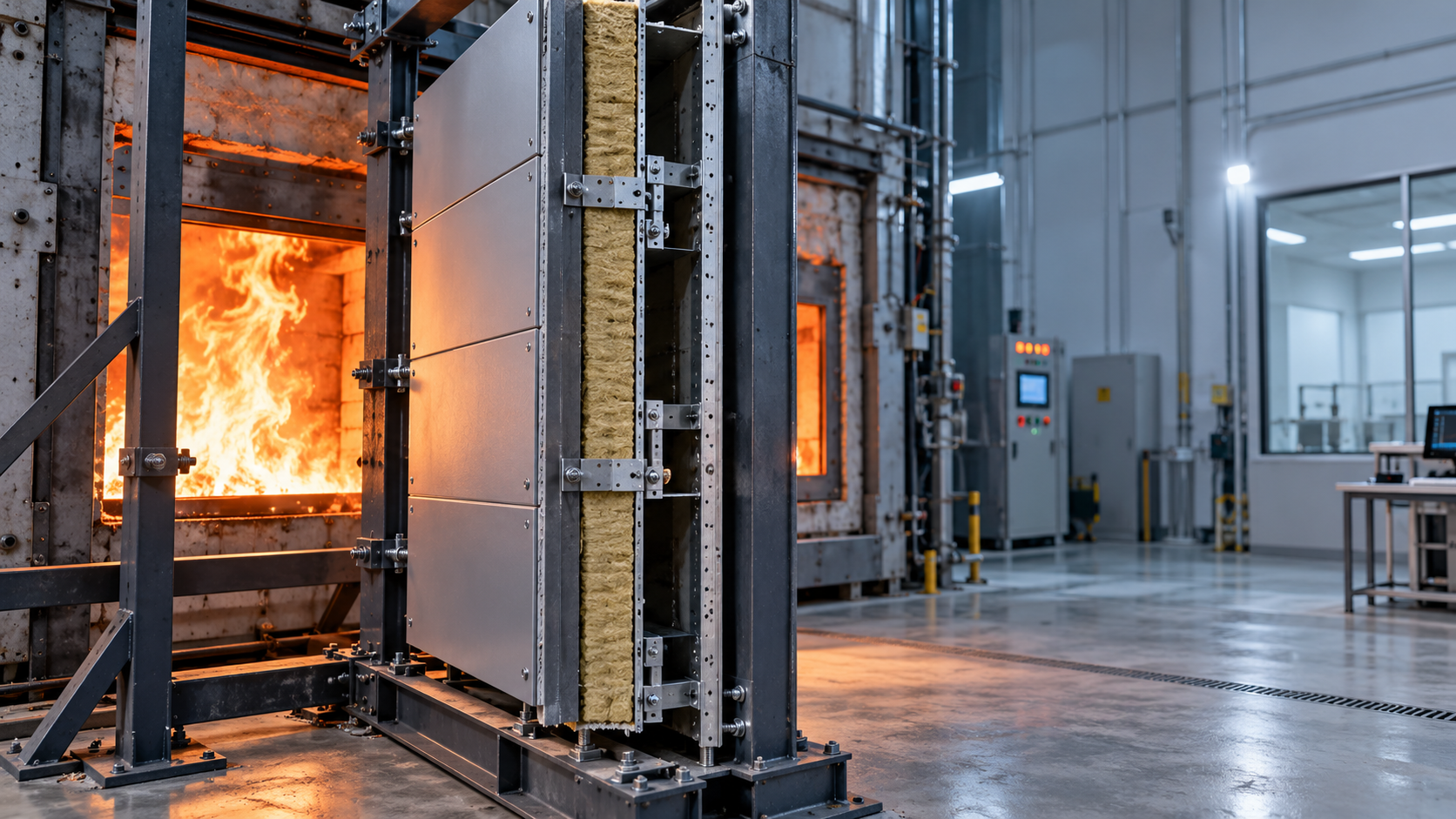
A composite wall panel arrives for review with a “Class A” fire statement, but the proposed residential installation includes a ventilated cavity, combustible insulation, and joints that do not appear in the supporting report. The immediate question is not whether the panel has passed a fire test. It is whether the evidence demonstrates the performance required for that wall, in that building, under the applicable residential building materials standards. Accepting the label alone can leave critical approval gaps unresolved.
Evaluate three separate questions: how the product contributes to fire, whether the wall maintains its required fire resistance, and whether an exterior wall assembly limits fire propagation where that assessment is required. Reaction-to-fire classifications, fire-resistance ratings, and façade propagation tests are not interchangeable. Establish the governing code requirements first, then match each requirement to evidence covering the proposed materials and installation.
Define the wall’s role before selecting the test evidence
“Composite wall panel” describes a construction format, not a single fire-performance category. It may mean a metal-faced sandwich panel, a decorative laminate bonded to a substrate, an insulated structural panel, or a rainscreen cassette with a composite core. The same product can face different requirements when used as an interior finish, external cladding, or part of a fire-resisting wall.
Start the assessment with a short description of the proposed use. Record the jurisdiction, adopted code edition, residential occupancy classification, building height, construction type, and whether the wall is loadbearing. Identify any required fire separation, exposure direction, exterior-wall restrictions, and cavity-barrier provisions. Local amendments and project-specific approval conditions can change the evidence needed.
The applicable code might permit a material through a prescriptive route, require a tested assembly, or allow an approved alternative method. Do not assume every composite panel requires every test discussed below. Equally, a material permitted in a low-rise dwelling may not be acceptable in a taller residential building or in a wall close to a property boundary.
Separate the three fire-performance questions
These frameworks belong to different regulatory systems. A result from one system does not automatically satisfy another jurisdiction’s requirements. Where imported products carry unfamiliar classifications, seek an accepted compliance route rather than translating labels by resemblance.
Reaction to fire: interpret the classification precisely
ASTM E84 and UL 723 report surface-burning characteristics, including flame-spread and smoke-developed indices. An associated “Class A” designation generally refers to a code classification based on those results; it does not mean that the panel is noncombustible or that a wall containing it has an hourly fire-resistance rating.
Check how the specimen was mounted, which face was exposed, and whether the report addresses the relevant substrate, thickness, and product configuration. Composite materials can behave differently when a protective facing remains intact than when edges, joints, or cores become exposed.
Under the European framework, EN 13501-1 classifies reaction to fire using results from the applicable tests. For many wall products, EN 13823 and EN ISO 11925-2 form part of the evidence; other methods apply according to the class sought. Read the complete classification, including smoke and flaming-droplet designations where applicable, together with its field of application. A classification established on a specified substrate or with a defined air gap is not necessarily valid for unrestricted installation.
Fire resistance: the assembly carries the rating
ASTM E119 and UL 263 evaluate building elements under standard fire exposure. European resistance testing uses methods appropriate to the element, such as EN 1364-1 for non-loadbearing walls or EN 1365-1 for loadbearing walls, with classification under EN 13501-2. Performance criteria can include integrity, insulation, and loadbearing capacity, depending on the system and required classification.
A panel brochure stating “fire resistant” cannot replace an assembly listing, classification, or accepted assessment. The evidence must cover relevant framing, panel orientation, fixings, joints, insulation, and exposure conditions. A rating established for a non-loadbearing partition does not establish the structural fire performance of a loadbearing wall.
Exterior panels need a separate propagation decision
An exterior wall may satisfy an interior surface-burning requirement and still require assembly-scale fire-propagation evidence. Cavities, insulation layers, membranes, and connections can create fire paths that a small specimen or tunnel test does not represent.
NFPA 285 evaluates fire-propagation characteristics of exterior wall assemblies containing combustible components under its specified exposure. Whether it is required depends on the adopted code, wall construction, materials, and applicable exceptions. Review the actual tested or accepted assembly configuration rather than treating “NFPA 285 compliant” as an unrestricted product property.
In regulatory systems that recognize it, BS 8414 provides large-scale façade test methods; assessment may use BR 135 criteria where applicable. A test result is not, by itself, permission to use combustible materials wherever separate regulations prohibit or restrict them. Confirm that the proposed compliance route remains permitted for the building category and jurisdiction.
Do not treat assembly tests as interchangeable. Different exposures, specimen geometries, measurements, and acceptance criteria prevent a simple conversion between NFPA 285 and BS 8414 evidence.
Core materials and installation details can change the conclusion
The core deserves scrutiny, but its trade description is insufficient. Polymer, mineral-filled polymer, mineral-wool, and other cores can differ substantially in composition and fire behavior. Terms such as “fire-retardant,” “mineral core,” or “FR grade” do not establish a standardized performance level without supporting evidence.
Obtain the exact product designation and a traceable description of the tested construction. Relevant variables can include core formulation, density, thickness, facing material, adhesive, coating, and manufacturing location. A core test may help explain material behavior, but it does not replace evidence for the finished composite or installed assembly.
Where the code requires noncombustibility or limited combustibility, confirm the prescribed definitions and accepted evidence. ASTM E136 and European methods such as EN ISO 1182 or EN ISO 1716 address different aspects within their respective frameworks. Passing a surface-burning test is not a substitute for meeting a separate noncombustibility requirement.
Installation details often determine whether otherwise relevant evidence can be used:
- Joints and exposed edges: Check joint width, sealants, gaskets, edge closures, and whether site cutting exposes the core.
- Cavities and barriers: Compare cavity depth, ventilation arrangement, barrier locations, and interfaces with compartment boundaries.
- Fixings and supports: Confirm fastener type, spacing, support material, and restraint conditions against the supporting evidence.
- Openings and interfaces: Examine window heads, jambs, sills, corners, and transitions where fire can enter concealed layers.
- Additional wall layers: Verify insulation, sheathing, membranes, and substrates. A change behind the panel can affect assembly performance.
Penetrations and perimeter joints also require their own appropriate firestop or joint-system evidence where they cross rated construction. The wall rating alone does not qualify an untested service penetration.
Build an evidence package that can support approval
A certificate or summary page is useful for identifying a product, but it may omit specimen details and limitations. Request the underlying test report, classification report, listing, or approved assessment appropriate to the compliance route. Verify the issuing organization, report identifier, test standard and edition, product identity, and any conditions attached to the conclusion.
Laboratory accreditation should cover the relevant testing activity. Accreditation, product certification, and regulatory approval perform different functions: an accredited test report does not automatically establish ongoing production conformity or approval for every application.
For each requirement, record the proposed construction beside the supporting evidence. Include the tested configuration, permitted variations, and unresolved differences. This makes a substitution visible before it becomes embedded in procurement or construction drawings.
- Confirm the requirement. Identify the code provision, classification, rating, or approved alternative route that must be satisfied.
- Verify product identity. Reconcile panel names, codes, dimensions, and composition across reports, specifications, and supply documents.
- Compare the assembly. Mark differences in substrates, cavities, insulation, joints, fixings, and openings.
- Check the scope of permitted variation. Use the report’s field of application, listing limitations, or a recognized assessment route.
- Close material gaps. Obtain appropriate additional evidence or revise the design before recording acceptance.
Report age alone does not determine validity. More important questions are whether the product has changed, whether the adopted rules accept the test basis, and whether a listing or certification remains current where required. An older report for an unchanged product may remain relevant; a recent report for a different formulation may not.
Handle substitutions without assuming “better” means equivalent
A proposed replacement may have a lower flame-spread index, a thicker metal facing, or a core described as less combustible. None of those facts automatically preserves an existing assembly rating or propagation result. Changes can affect joint opening, thermal movement, adhesive failure, or exposure of concealed combustible layers.
First determine whether the variation falls within an explicitly permitted range. If it does not, seek an assessment through a route accepted by the authority having jurisdiction. Depending on the regulatory system, that may involve a qualified fire engineer, an accredited laboratory, a certification body, or additional testing. An engineering assessment should explain its evidence base, assumptions, and limitations; it should not merely repeat a manufacturer’s assurance.
Record the decision in terms that the construction team can enforce: approved panel designation, wall build-up, installation details, evidence references, and prohibited substitutions. Where a critical variation remains unsupported, state the consequence directly—for example, “the submitted evidence does not cover the proposed cavity insulation.” That identifies the approval gap without claiming that the assembly has either passed or failed a test it has not undergone.
Industry Briefing
Get the top 5 industry headlines delivered to your inbox every morning.