
UAE ESMA Tightens EPD Rule for Natural Stone Imports
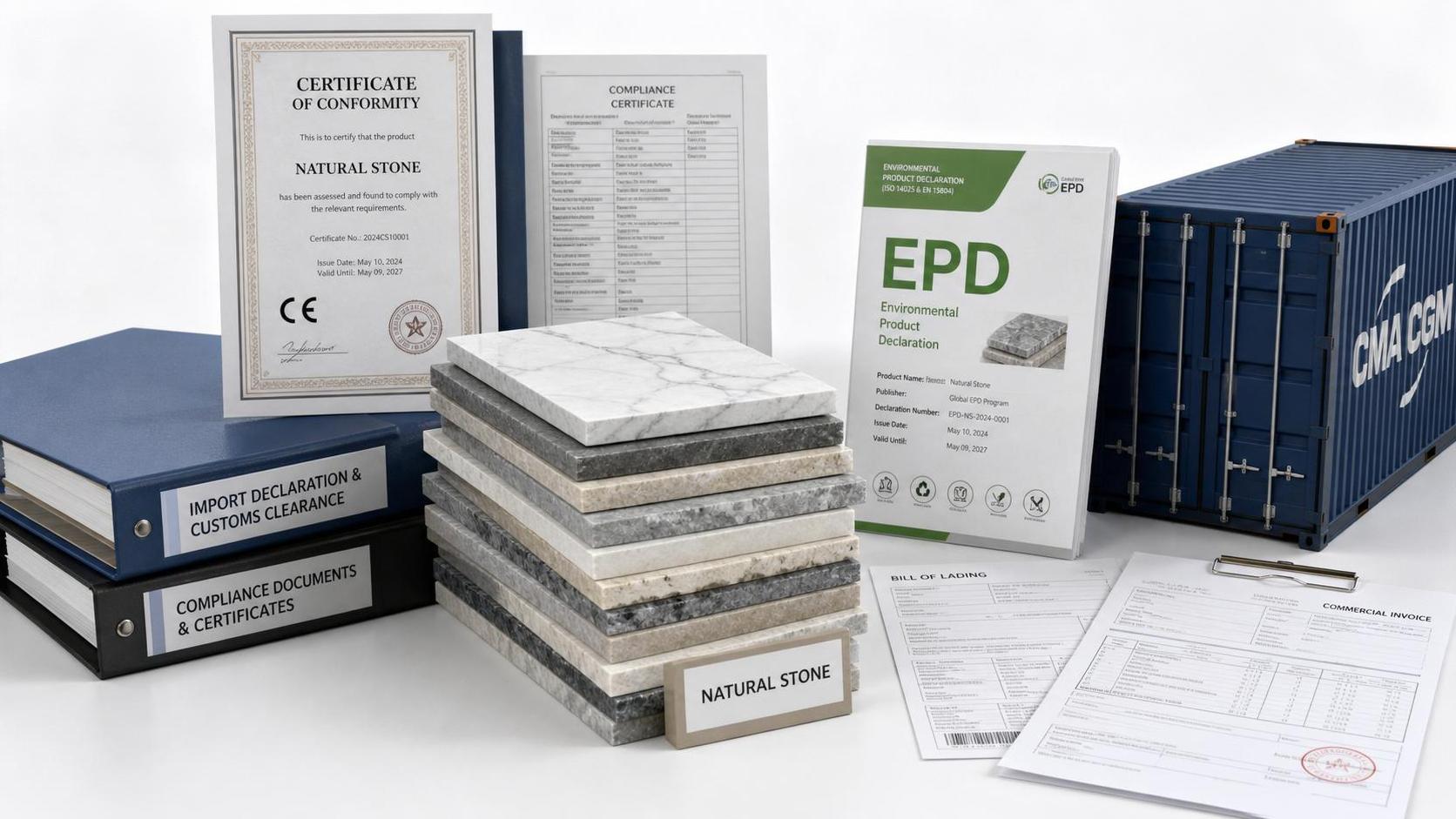
On July 4, 2026, the UAE’s Emirates Authority for Standardization and Metrology (ESMA) updated its Green Building Materials Import Protocol, introducing a new compliance requirement for Natural Stone imports from October 2026. For importers, suppliers, logistics coordinators, and buyers linked to UAE-bound stone shipments, the update matters because it moves environmental disclosure from a general sustainability issue into a shipment-level import condition, with direct consequences for customs clearance at Jebel Ali Port.
What the updated import rule requires
According to the information provided, ESMA revised the Green Building Materials Import Protocol on July 4, 2026. Under the updated rule, all Natural Stone imports must be accompanied, starting in October 2026, by an Environmental Product Declaration (EPD) registered under the International EPD System.
The required EPD must cover three core indicators: global warming potential (GWP), water consumption, and carbon emissions from the transport stage. The same information also states that shipments submitted without the required EPD will be held at Jebel Ali Port in Dubai and will incur an additional compliance handling fee.
Where the immediate pressure will be felt
Import trade activity will face a documentation checkpoint
From an industry perspective, direct importers are likely to feel the earliest impact because the rule is tied to cargo entry rather than only to downstream product marketing. The main pressure point is document readiness before shipment arrival. What deserves closer attention is whether existing import routines already include a process for matching each Natural Stone shipment with an International EPD System-registered declaration.
Upstream suppliers may become part of the compliance timeline
Analysis shows that exporters and upstream stone suppliers connected to the UAE market may also be affected, even though the formal import obligation applies at entry. If a shipment cannot be supported by the required EPD, the commercial impact may appear in order confirmation, shipping preparation, and document coordination. For suppliers, the issue is less about abstract sustainability positioning and more about whether product documentation can support delivery into the UAE from October 2026 onward.
Logistics and port-facing service providers may see execution risk increase
Observably, supply chain service providers involved in customs filing, freight coordination, and port handling may need to watch for a higher risk of delay where EPD documentation is missing or incomplete. The rule explicitly links non-compliance to cargo detention at Jebel Ali Port and additional handling fees, which means the operational effect may appear in clearance schedules, demurrage-related exposure, and customer communication around delivery timing.
Buyers and project-side procurement teams may need earlier checks
For procurement teams purchasing Natural Stone for UAE delivery, the practical issue may shift upstream into vendor qualification and pre-shipment review. Analysis shows that buyers may need to verify earlier in the purchasing cycle whether the required EPD exists and whether it covers the specified indicators, because a missing declaration can affect actual receipt of goods rather than only post-delivery reporting.
What companies should monitor before October 2026
Whether follow-up guidance changes the execution details
What deserves closer attention is whether any later official wording clarifies implementation details around document format, submission timing, or product matching. The current information confirms the requirement, the three mandatory indicators, the October 2026 start point, and the consequence of non-submission, but businesses should continue monitoring whether additional procedural guidance emerges.
The distinction between having an EPD and having the right EPD
From an industry perspective, companies should focus not only on the existence of an environmental declaration, but specifically on whether it is registered under the International EPD System and whether it includes GWP, water consumption, and transport-stage carbon emissions. In practice, this is a document scope issue as much as a document availability issue.
Shipment planning and document timing
Analysis shows that the narrow window between the July 4, 2026 update and the October 2026 enforcement point makes timing a practical concern. Importers and suppliers should pay close attention to how EPD preparation, validation, and shipment scheduling interact, especially where cargo is already being planned for late 2026 delivery.
Contract and customer communication risks
Observably, the stated consequence of detention at Jebel Ali Port and additional compliance handling charges creates a need for clearer allocation of documentation responsibility. Companies involved in cross-border stone trade may need to review how they communicate compliance expectations with suppliers, logistics partners, and buyers so that document gaps do not first appear when goods are already in transit or at port.
Why this reads as more than a routine paperwork update
Analysis shows that this development is better understood as a targeted compliance signal rather than a purely administrative adjustment. The requirement is narrow in scope based on the information provided, applying to Natural Stone imports and specifying three environmental indicators. At the same time, because the rule is attached to import clearance and backed by detention and fees, it carries immediate commercial relevance.
It is more appropriate to understand this as both a short-term operational change and a longer-term policy signal. The short-term element is clear: companies shipping Natural Stone into the UAE need to prepare for an October 2026 documentation threshold. The longer-term signal is that environmental product data is being treated as part of market access discipline, not only as a voluntary sustainability reference. That broader interpretation remains an observation and should continue to be tested against later official implementation and any further rule development.
How to read the policy at this stage
At this stage, the update should be read as a concrete compliance requirement with immediate implications for Natural Stone shipments into the UAE, while also serving as a policy signal worth continued monitoring. The confirmed facts are limited but commercially meaningful: an October 2026 start date, a mandatory International EPD System-registered EPD, three required indicators, and a stated penalty path through port detention and added handling fees. For the industry, the sensible conclusion is neither to overstate market transformation nor to treat the change as routine paperwork.
Basis of this article and points for continued verification
This article is based on the user-provided news title, event date, and event summary. For this type of industry update, relevant source categories typically include official notices, standards authority publications, industry association updates, company compliance communications, and reporting based on standard-setting documents. A specific official source link was not provided in the input, so the exact published document path still requires ongoing verification. Further monitoring should focus on any additional ESMA clarification regarding implementation procedures, document submission expectations, and any later changes to the protocol text.
Industry Briefing
Get the top 5 industry headlines delivered to your inbox every morning.