
China Tile Export Price Index Up 4.2% in Early June
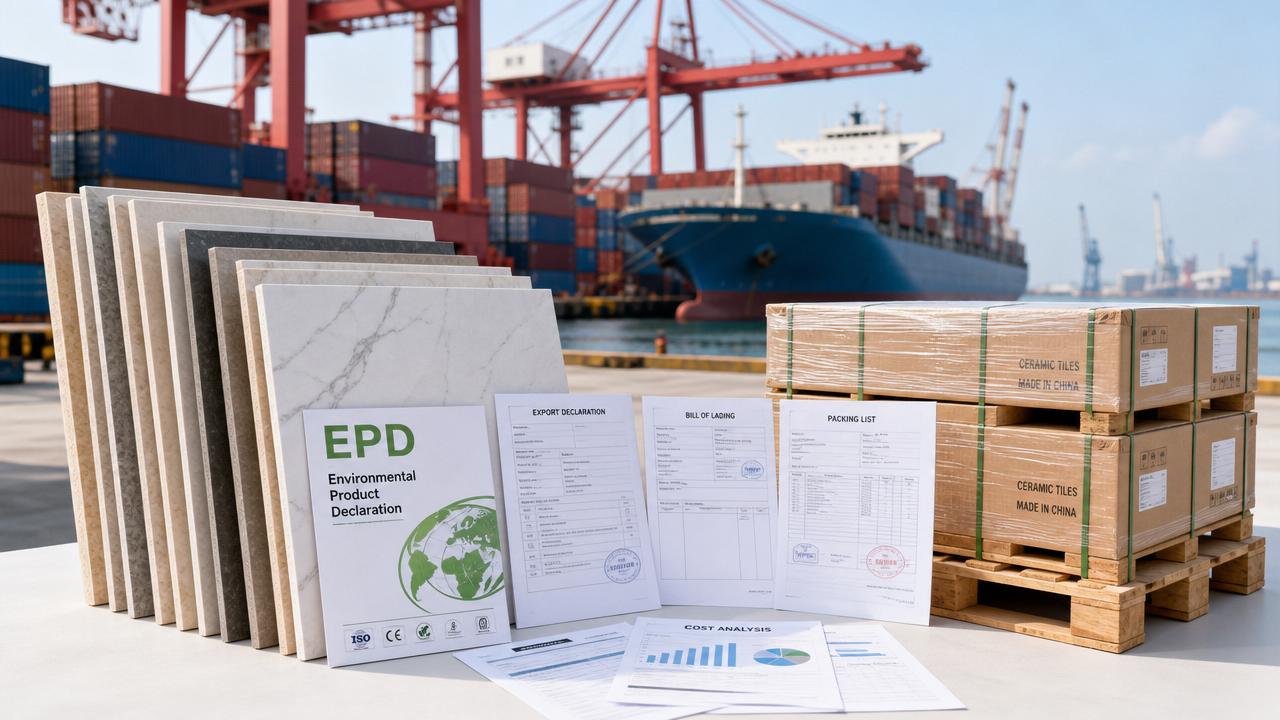
From June 1 to June 7, 2026, the GIAM-CPI composite export price index for Chinese ceramic tiles rose 4.2% from the previous period, drawing attention across export trade, compliance documentation, shipping, and downstream distribution. The move matters not only because pricing increased within a single week, but because the increase was linked to two concrete pressures at the same time: new green surcharges in Southeast Asia for glazed tiles without EPD documentation, and tighter vessel capacity at US West Coast ports that pushed freight costs higher.
What Changed in the First Week of June
According to monitoring by the GIAM Global Building Materials Intelligence Center, China’s composite ceramic tile export price index increased 4.2% in the first week of June 2026. The reported reasons were twofold. First, Vietnam and Thailand imposed an additional 5% to 8% green surcharge on glazed tiles that did not provide an Environmental Product Declaration, or EPD. Second, average berth waiting time at the Port of Los Angeles rose to 11.2 days, contributing to a 12% increase in ocean freight costs. The price increase has already been passed through to terminal wholesale prices in the Philippines and Malaysia.
Where the Pressure Is Likely to Appear First
Exporters face immediate pricing and documentation pressure
From an industry perspective, direct trading companies are likely to feel the impact first because the reported change combines compliance-related cost pressure with freight-related cost pressure. The most exposed business links are quotation management, product classification, and document readiness for glazed tile shipments tied to markets applying the new surcharge rules.
Manufacturers may need to watch product-market matching more closely
Analysis shows that ceramic tile manufacturers serving export channels may be affected through order allocation and product mix decisions, especially where glazed tile exports are involved. What deserves closer attention is whether specific shipments require EPD support before pricing and dispatch arrangements are finalized.
Distributors and wholesalers in Southeast Asia are already seeing pass-through effects
The confirmed transmission to wholesale prices in the Philippines and Malaysia indicates that downstream channel participants are not insulated from upstream export and logistics changes. For distributors, the main concern is margin management and the timing of replenishment under a higher landed-cost environment.
Logistics and supply chain service providers need to track delivery risk
For freight forwarders and other supply chain service providers, the reported 11.2-day average berth waiting time at Los Angeles points to operational pressure around booking, transit predictability, and client communication. Observably, even when the initial trigger is not a pure demand change, delivery schedules and transport budgeting can still become more difficult to manage.
What Companies Should Watch Now
EPD-related documentation readiness
Companies dealing in glazed tile exports should pay close attention to whether product files and transaction documents align with market requirements where green surcharges now apply. Analysis shows that the practical issue is not only the existence of a rule, but whether documentation can support shipment execution without added cost.
Differences between market rules and commercial execution
What deserves closer attention is the gap between a policy trigger and its effect in day-to-day trade. Businesses may need to distinguish between markets directly applying the surcharge, markets already showing price transmission, and markets where the impact is still indirect.
Freight budgeting and lead-time communication
The rise in shipping costs linked to port congestion suggests that exporters, buyers, and service providers should watch freight quotations and delivery commitments more closely. In practical terms, this affects booking cycles, cost pass-through discussions, and customer communication around delivery timing.
Priority products and destination-market exposure
Observably, the issue is most relevant for glazed tile business tied to Southeast Asian destinations mentioned in the reported development, as well as shipments influenced by tightening capacity on US West Coast routes. Companies with exposure to these links may need to review which orders are most sensitive to compliance gaps or transport volatility.
Why This Signal Deserves Continued Attention
Analysis shows that this development should not be read as a simple one-week price fluctuation alone. It reflects the interaction of two different forces: market access conditions tied to environmental documentation, and logistics cost pressure tied to port-side congestion. At the same time, it is more appropriate to understand this as an industry signal that still requires observation rather than as a fully settled long-term trend. The current facts confirm price movement and cost transmission, but the durability and breadth of the impact still depend on how these pressures evolve in subsequent weeks.
How to Read the Current Move
For the ceramic tile export chain, the immediate significance lies in the fact that compliance and logistics are affecting prices simultaneously. That makes this update relevant not only for exporters, but also for manufacturers, distributors, and logistics partners that need to manage cost visibility and delivery expectations. From an industry perspective, this is best understood as a short-term market move with broader structural implications worth tracking, especially around EPD-related requirements and freight-side constraints.
Basis of This Article
This article is based on the user-provided news title, event timeframe, and event summary concerning the GIAM-CPI ceramic tile export price index movement between June 1 and June 7, 2026. For this type of industry update, commonly relevant source categories may include official notices, company disclosures, trade association updates, authoritative media reporting, and standards-related documents. No specific official source link was provided in the input, so further verification remains necessary. If follow-up monitoring continues, the key points to watch are whether the surcharge rules change in scope, whether freight pressure persists, and whether further price transmission appears in additional markets or trade links.
Industry Briefing
Get the top 5 industry headlines delivered to your inbox every morning.