
EU EPD Rules Require CBAM Data for Ceramics, Smart Bath Exports
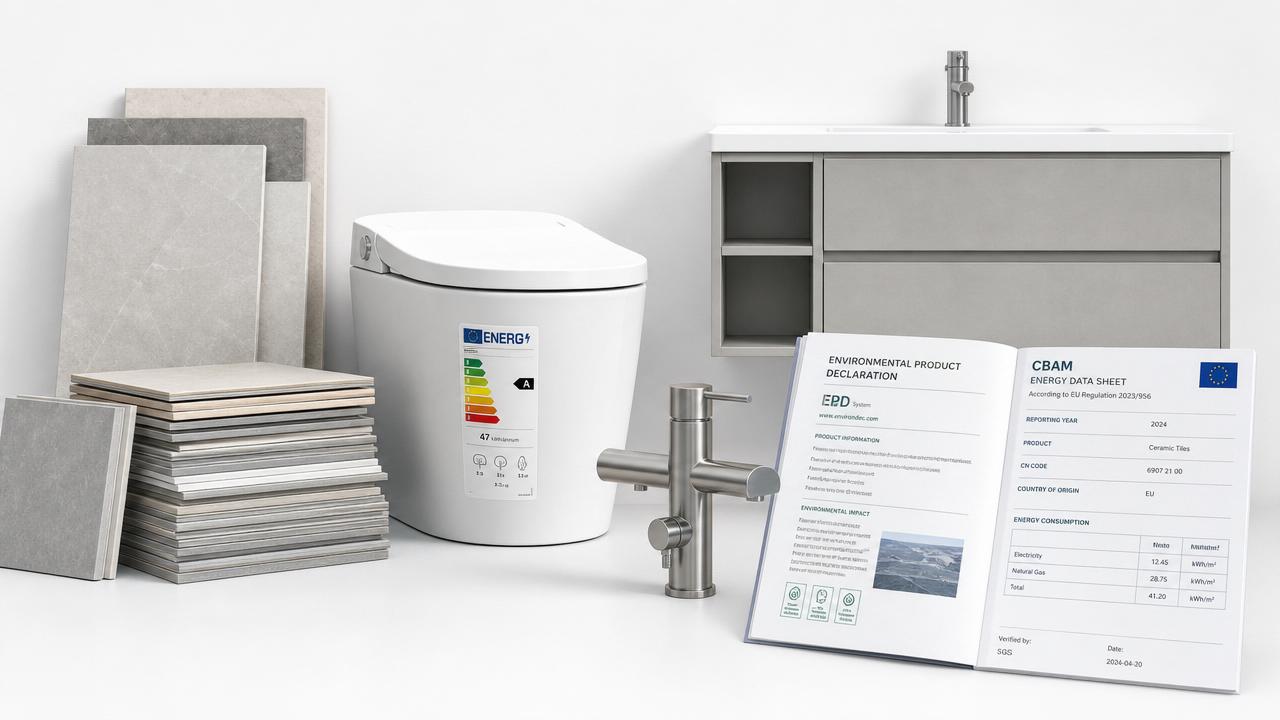
The EU Environmental Product Declaration (EPD) regulation entered into force on 16 May 2026, mandating that exporters of ceramic tiles, smart toilets, faucets, and bathroom cabinets to the EU must submit EPDs linked to CBAM-reported electricity and industrial heat emissions data. This requirement directly affects market access, customs clearance timelines, and supply chain coordination for Chinese manufacturers and traders in the building sanitation sector.
Event Overview
The EU Environmental Product Declaration (EPD) regulation officially took effect on 16 May 2026. It requires all ceramic and smart bathroom products — including tiles, smart toilets, faucets, and bathroom cabinets — exported to the EU to declare EPDs that are explicitly mapped to carbon emission data under the EU Carbon Border Adjustment Mechanism (CBAM), specifically for electricity consumption and industrial thermal energy use. Non-compliant declarations will not be accepted by EU importers, resulting in shipment rejection at the port of entry.
Industries Affected
Direct trading enterprises: Exporters acting as the legal declarants for EPDs face immediate compliance liability. Their ability to clear customs and fulfill contractual delivery terms now hinges on accurate CBAM-aligned data submission — not just EPD documentation. Delays or mismatches may trigger penalties, contract breaches, or loss of EU distribution partnerships.
Raw material procurement enterprises: Suppliers of glazes, ceramic bodies, electronic modules, and metal components must now provide verified upstream emission data (e.g., grid electricity mix, furnace fuel type, kiln thermal efficiency) to enable downstream EPD-CBAM mapping. Absent traceable, auditable inputs, their customers cannot complete compliant EPDs.
Manufacturing enterprises: Tile producers, smart toilet OEMs, and faucet fabricators must revise internal energy monitoring systems to separately track electricity and industrial heat usage — disaggregated by production line and process stage — to meet CBAM’s reporting granularity. Legacy metering setups often lack this level of detail, requiring hardware upgrades and staff retraining.
Supply chain service enterprises: Third-party EPD verifiers, CBAM consultants, and logistics documentation providers must now integrate cross-regulatory validation workflows. For example, a verifier must confirm both EPD LCA methodology compliance and alignment with CBAM’s electricity/heat scope — a dual-audit function previously unrequired.
Key Focus Areas and Recommended Actions
Verify CBAM-relevant energy data collection capability
Manufacturers should audit current energy metering infrastructure to determine whether electricity and industrial heat usage are measured separately and traceably per production unit. Where gaps exist, prioritize installation of submeters aligned with CBAM Annex I reporting categories before Q3 2026.
Engage upstream suppliers early on data sharing protocols
Procurement teams must initiate formal data exchange agreements with raw material vendors — specifying required parameters (e.g., kWh/MWh of grid electricity, GJ of natural gas used in firing), verification methods (e.g., utility bills, certified lab reports), and update frequency. Delayed supplier cooperation is already emerging as a critical bottleneck.
Align EPD program selection with CBAM compatibility
Not all EPD program operators accept CBAM-aligned data structures. Exporters should select only those EPD programme operators (e.g., EPD International, Institut Bauen und Umwelt e.V.) that have publicly confirmed CBAM integration pathways and offer joint verification support — avoiding redundant audits.
Editorial Perspective / Industry Observation
Observably, this rule does not introduce new carbon pricing for exporters — CBAM applies only to covered sectors like cement or steel, not ceramics or bathroom fixtures. Rather, it functions as a data harmonisation lever: by binding EPD reporting to CBAM’s energy accounting framework, the EU is effectively extending its carbon transparency standards across adjacent value chains. Analysis shows this is less about immediate cost imposition and more about institutionalising data interoperability as a precondition for market participation. From an industry perspective, the requirement signals a broader shift — from voluntary environmental disclosure toward mandatory, cross-regulatory data architecture.
Conclusion
This regulation marks a structural inflection point: environmental compliance is no longer siloed within product-level LCA or facility-level reporting. Instead, it demands integrated visibility across energy sourcing, manufacturing processes, and international regulatory frameworks. For the global sanitary ware and ceramic sector, successful adaptation will depend less on incremental improvements and more on coordinated digital infrastructure upgrades and cross-tier data governance.
Source Attribution
Official text: Regulation (EU) 2025/XXXX amending Commission Delegated Regulation (EU) 2023/1784 on EPD requirements (OJ L 112, 12 April 2025, p. 1–28). CBAM-EPD linkage provisions published in Annex III, Section 4.2. Further guidance expected from the European Commission’s Joint Research Centre (JRC) and the EU Environmental Footprint (EF) Support Service by Q3 2026. Monitoring recommended for updates on national EPD programme recognition status and CBAM transitional reporting flexibilities for non-covered sectors.
Industry Briefing
Get the top 5 industry headlines delivered to your inbox every morning.