
UL 60730-2-9:2026 for Smart Bath Cabinets Takes Effect June 1
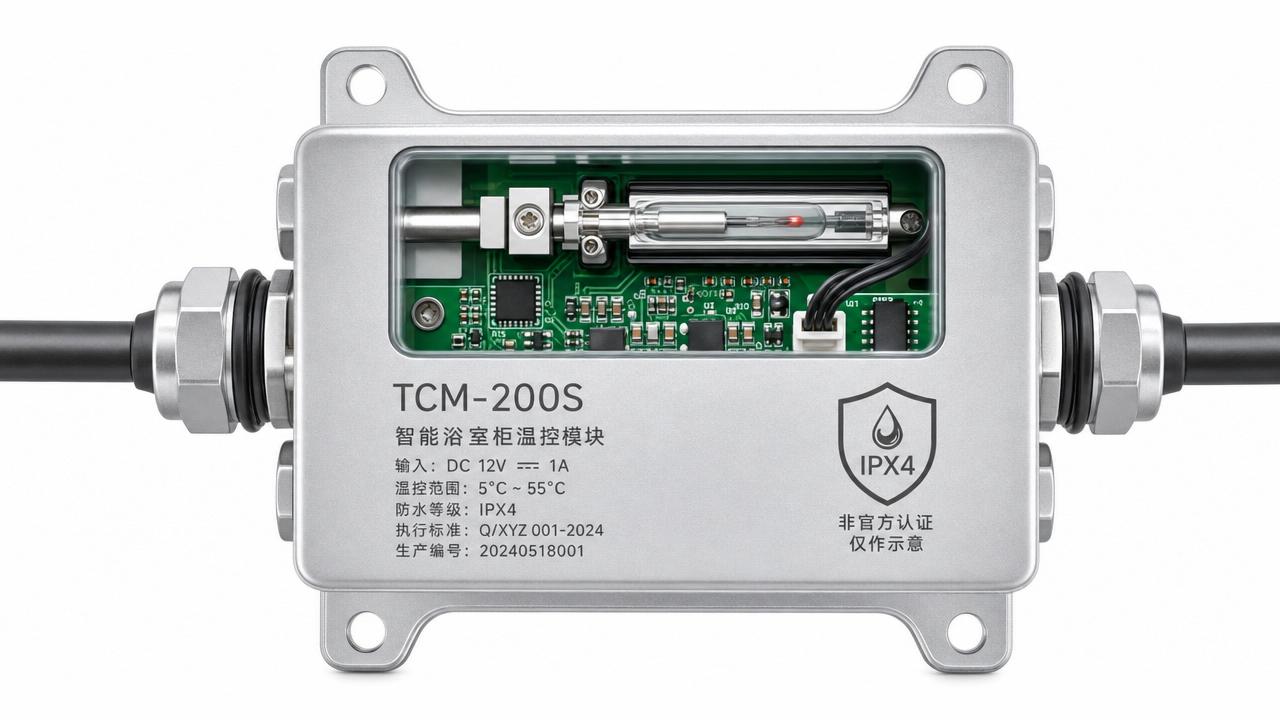
U.S. UL 60730-2-9:2026 — a new safety standard for smart bath cabinet temperature control modules — takes effect on June 1, 2026, imposing mandatory independent certification requirements on Chinese OEMs exporting to the U.S. market. The rule directly impacts manufacturers of mirror cabinets, thermostatic bath cabinets, and LED-integrated smart storage cabinets, raising compliance thresholds for electrical safety in humid, high-risk bathroom environments.
Event Overview
UL published Automatic Electrical Controls — Part 2-9: Particular Requirements for Temperature Sensing Controls for Use in Bathrooms (UL 60730-2-9:2026) on May 13, 2026. The standard explicitly defines "temperature retention deviation exceeding ±3°C after power loss" as a critical nonconformance. It further mandates that all temperature control modules used in Smart Cabinets exported to the U.S. — including mirror cabinets, thermostatic bath cabinets, and LED smart storage cabinets — must obtain standalone UL certification. Certification of the end product alone is no longer acceptable as coverage for the module.
Industries Affected
Direct Exporters (OEM/ODM Trading Firms)
These firms face immediate certification liability: under the new rule, customs clearance and U.S. market access now hinge on documentary proof of module-level UL certification. Noncompliant shipments risk detention, rework, or rejection by U.S. importers — with no grandfathering for existing stock or pending orders placed before June 1, 2026.
Raw Material & Component Suppliers
Suppliers of thermistors, microcontrollers, relay assemblies, and PCBs used in temperature control modules must now provide traceable, UL-recognized component data (e.g., UL Recognized Component File numbers) to support downstream certification. Their technical documentation — especially thermal drift specs, fault-mode behavior under power interruption, and humidity resistance test reports — becomes critical input for module-level evaluation.
Contract Manufacturers & Module Assemblers
Manufacturers integrating temperature control modules into cabinets must separate module design, testing, and certification from final assembly. This requires dedicated engineering resources for UL 60730-2-9-specific validation (e.g., 72-hour damp heat tests, thermal shock cycling, and post-power-loss hold-time verification), as well as updated quality control checkpoints aligned with UL’s Annex D test protocols.
Supply Chain Service Providers (Testing Labs, Certification Consultants, Logistics Compliance Agents)
Third-party labs with UL-authorized status for UL 60730-2-9 testing are experiencing surging demand; lead times for module certification have extended to 10–14 weeks. Certification consultants are now required to advise not only on conformity but also on modular architecture design — e.g., whether firmware-controlled hysteresis loops or hardware-based thermal cutoffs better satisfy the ±3°C hold requirement. Logistics agents must verify UL certificate validity and scope alignment (e.g., confirming the certified module model number matches the BOM exactly) prior to shipment release.
Key Focus Areas and Recommended Actions
Verify Module-Level Certification Scope Immediately
Exporters must audit current supply chain documentation to confirm whether any previously certified modules were assessed under UL 60730-2-9:2026 — not earlier editions or generic UL 60730-1. Certificates referencing "UL 60730-1 + Supplement SB" or "UL 60730-2-8" do not satisfy the new requirement.
Redesign Power-Loss Thermal Behavior
Modules relying solely on software-based temperature hold algorithms — without passive thermal mass or backup power buffering — are unlikely to meet the ±3°C deviation limit after power interruption. Engineering teams should prioritize hardware-assisted thermal inertia solutions (e.g., phase-change material integration or calibrated thermal shunts) and validate performance across ambient temperatures from 10°C to 40°C.
Update Technical Documentation for UL Review
UL now requires submission of full module schematics, bill-of-materials with component certifications, firmware flowcharts covering fault states, and test reports for Annex D Clause 12 (post-power-loss temperature stability). All documents must be in English and include traceable revision control.
Editorial Perspective / Industry Observation
Observably, UL 60730-2-9:2026 signals a structural shift — away from treating bathroom electronics as low-risk consumer accessories and toward classifying them as safety-critical environmental control systems. Analysis shows this aligns with rising U.S. litigation trends involving bathroom appliance thermal failures, particularly in rental and senior-living facilities. From an industry perspective, the regulation may accelerate consolidation among Chinese module suppliers: smaller assemblers lacking UL engagement capacity will likely exit the U.S.-bound segment, while vertically integrated OEMs with in-house compliance teams gain competitive leverage. Current more critical than certification timing is architectural readiness — i.e., whether legacy module designs can be retrofitted or require full redesign.
Conclusion
This regulation does not merely add a compliance step; it redefines responsibility boundaries across the smart bath cabinet value chain. For global exporters, UL 60730-2-9:2026 serves as a precedent for how evolving safety expectations — driven by real-world failure modes, not theoretical risk — increasingly target subsystems rather than finished goods. A rational conclusion is that regulatory agility — not just certification acquisition — will determine long-term market access viability.
Source Attribution
Official publication: UL Standards & Engagement, UL 60730-2-9:2026, released May 13, 2026. Status: Active as of June 1, 2026.
Additional reference: UL White Paper "Thermal Safety in Humid Environments" (2025 Edition), Section 4.2.
Note: UL has indicated that interpretation guidance for Clause 12.3.2 (temperature hold tolerance methodology) remains under review; stakeholders should monitor UL’s Standards News bulletin for updates through Q3 2026.
Industry Briefing
Get the top 5 industry headlines delivered to your inbox every morning.