
Vietnam Enforces Dual VCRS 2.0 Certification for Smart Bathroom Cabinets
VIETNAM ENFORCES DUAL VCRS 2.0 CERTIFICATION FOR SMART BATHROOM CABINETS
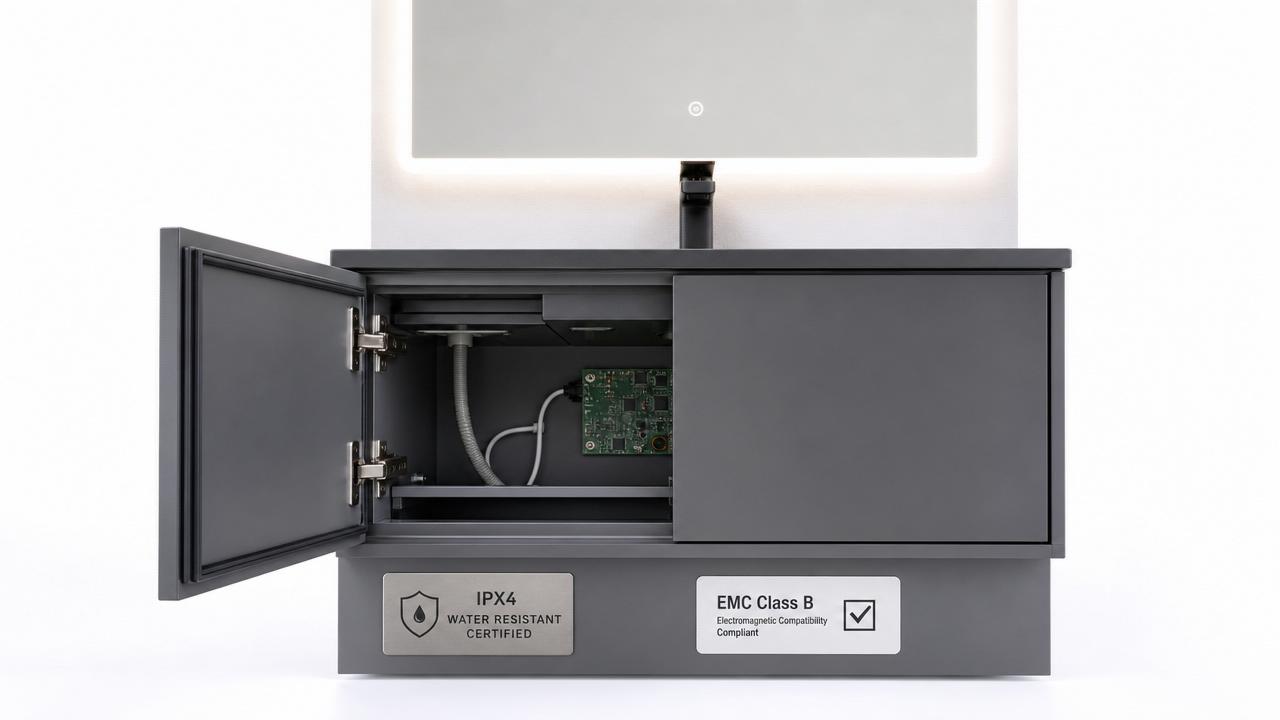
Vietnam’s new regulatory requirement for smart bathroom cabinets—mandating dual electromagnetic compatibility (EMC) Class B and IPX4 moisture resistance certification under the updated Vietnam Conformity Registration Scheme (VCRS) 2.0—takes effect on 1 July 2026. Announced by the General Department of Standards, Metrology and Quality (STAMEQ) on 11 May 2025, the rule targets a rapidly growing segment of smart home products entering the Vietnamese market. Its narrow 50-day transition window and strict laboratory accreditation requirements signal a significant tightening of market access conditions for exporters and domestic suppliers alike.
Event Overview
On 11 May 2025, STAMEQ published the implementing guidelines for VCRS 2.0, specifying that all imported smart bathroom cabinets—including LED mirror cabinets, motorized height-adjustable cabinets, and motion-sensing illuminated cabinets—must obtain both EMC Class B compliance and IPX4-rated moisture resistance certification. Test reports must be issued exclusively by laboratories accredited by STAMEQ. The regulation enters into force on 1 July 2026, with no extension beyond the stipulated 50-day transition period.
Industries Affected
Direct trading enterprises: Exporters and importers face immediate operational pressure due to the dual-certification requirement and the restriction to STAMEQ-accredited labs. Pre-shipment verification now demands coordinated timing across testing, documentation, and customs clearance—increasing lead times and administrative overhead. Non-compliant shipments risk rejection at Vietnamese ports after the effective date.
Raw material procurement enterprises: Suppliers of PCBs, low-voltage drivers, sealed actuators, and moisture-resistant housing materials may see revised specification requests from downstream clients. Demand for certified components—especially those pre-validated for IPX4 sealing integrity and EMC shielding—may rise, but procurement teams must now verify not only component specs but also traceability to STAMEQ-recognized test data.
Manufacturing enterprises: OEM/ODM facilities producing smart bathroom cabinets must revise design-for-compliance practices. This includes integrating shielded wiring, conformal-coated circuitry, gasketed enclosures, and Class B–compliant switching power supplies. Re-validation cycles for existing models are likely required, and pilot production runs may need retesting if minor revisions occur post-certification.
Supply chain service enterprises: Logistics providers, conformity assessment consultants, and technical documentation agencies must update service offerings to include VCRS 2.0-specific gap analysis, lab coordination, and STAMEQ submission support. Those lacking familiarity with Vietnam’s domestic accreditation framework—or relying on third-country test reports—risk delivering non-actionable advice or delayed submissions.
Key Considerations and Recommended Actions
Confirm laboratory accreditation status before initiating testing
Testing must be conducted at laboratories formally listed in STAMEQ’s latest approved registry—not merely ISO/IEC 17025-accredited labs. Enterprises should verify current listing status directly via STAMEQ’s public database, as inclusion is subject to periodic review and revocation.
Validate product scope against VCRS 2.0’s functional definition
The regulation explicitly covers devices with integrated electronics enabling illumination control, height adjustment, or sensing functionality—even if powered via low-voltage DC. Products marketed as ‘smart’ or ‘connected’ but lacking active electronic control logic may fall outside scope; however, classification hinges on actual functionality, not labeling alone.
Allocate buffer time for report translation and STAMEQ submission review
All test reports must be submitted in Vietnamese, with technical annexes retaining original-language units and notation. STAMEQ’s review cycle for registration dossiers is currently averaging 12–18 working days; enterprises should factor this into their transition planning, especially given the hard deadline of 1 July 2026.
Review warranty and liability clauses in OEM agreements
Where manufacturing is outsourced, contractual terms must clarify responsibility for certification renewal, design change notifications, and recall obligations arising from non-conformance. Recent STAMEQ enforcement guidance indicates that both importer and manufacturer may be held jointly liable for post-market non-compliance.
Editorial Perspective / Industry Observation
Observably, VCRS 2.0 reflects Vietnam’s broader shift toward aligning technical regulations with ASEAN harmonization goals—particularly in smart home product safety—while retaining national control over conformity assessment infrastructure. Analysis shows this is less about protectionism and more about building domestic testing capacity: STAMEQ has invested in upgrading six regional labs since 2023, and the lab-accreditation clause serves as both a quality gate and a catalyst for local lab development. From an industry perspective, the compressed timeline suggests urgency around consumer safety incidents involving water-exposed electronics—a concern echoed in recent technical bulletins from Vietnam’s National Center for Product Quality Inspection.
Conclusion
This regulation marks a structural inflection point—not merely a procedural update—for smart bathroom cabinet stakeholders targeting Vietnam. It elevates technical due diligence from a commercial formality to a core supply chain competency. A rational interpretation is that compliance will increasingly differentiate market-ready players from those reliant on legacy export pathways. Success will hinge less on meeting minimum thresholds and more on embedding regulatory intelligence into R&D, sourcing, and quality governance systems.
Source Attribution
Official source: Vietnam General Department of Standards, Metrology and Quality (STAMEQ), Circular No. 17/2025/TT-BKHCN, dated 11 May 2025, implementing VCRS 2.0 for smart bathroom cabinets. Full text available at www.stameq.gov.vn.
Note: STAMEQ has indicated that the list of accredited laboratories will be updated quarterly; current version effective as of 1 June 2025. Ongoing monitoring of revision notices and enforcement circulars is advised.
Industry Briefing
Get the top 5 industry headlines delivered to your inbox every morning.