
Ningbo-Zhoushan Port Joins Global Green Shipping Corridor, Accelerating Carbon Footprint Management for Building Materials Exports
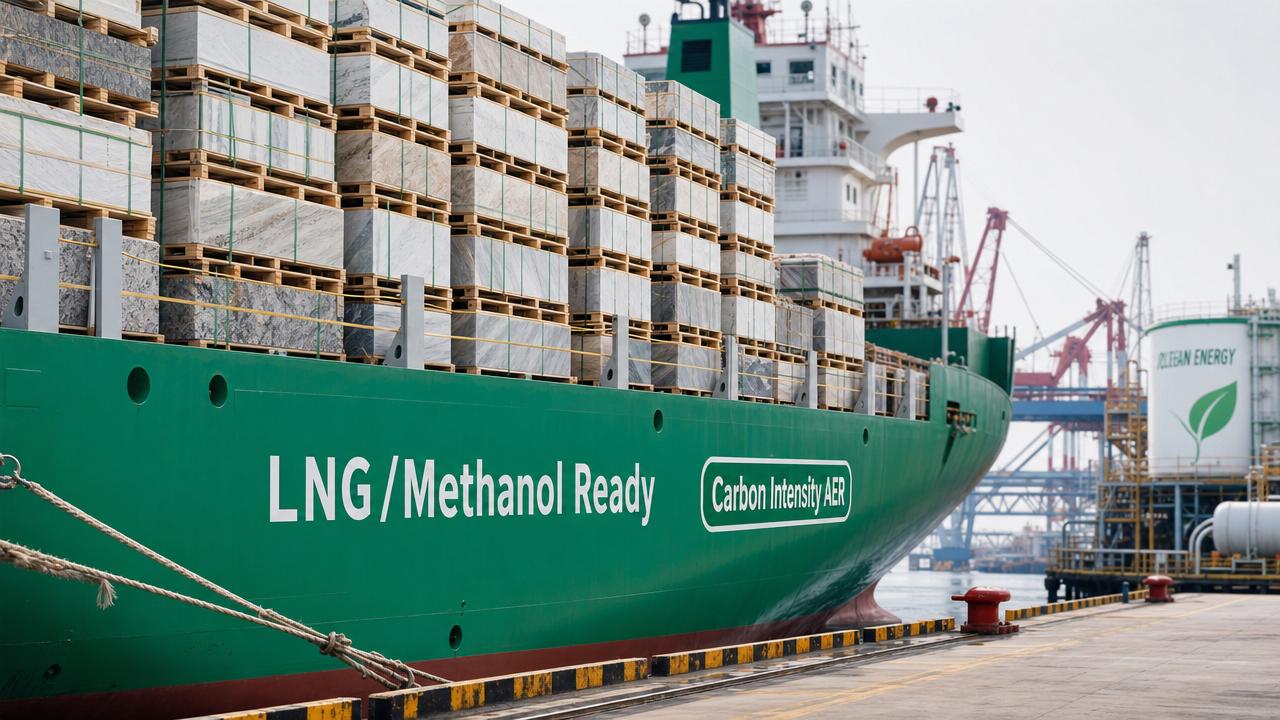
On May 27, 2026, Ningbo-Zhoushan Port signed a Green Shipping Corridor Initiative with five major international ports—including the Port of Valencia (Spain) and the HAROPA Alliance (France)—marking a pivotal step toward decarbonizing maritime logistics for high-volume-weight export commodities such as tiles, ceramics, and natural stone. This agreement directly impacts exporters supplying EU and Nordic markets, where compliance with extended CBAM reporting requirements and ESG procurement clauses is now contingent on verifiable transport-phase emissions data.
Confirmed Agreement Terms and Implementation Timeline
On May 27, 2026, Ningbo-Zhoushan Port, together with the Port of Valencia, HAROPA Alliance, and three other unnamed international ports, jointly endorsed the Green Shipping Corridor Initiative. The signatories committed to mandatory disclosure of LNG and methanol fuel blending ratios—and public grading of carbon intensity (AER) for container vessels operating on designated corridor routes—effective from January 1, 2027. These transparency requirements will extend beyond vessel operations to cover the full export logistics chain for building materials, requiring exporters of tiles & ceramics and natural stone to develop validated transport-stage carbon emission calculation models and obtain third-party verification reports prior to shipment.
Impact Across Supply Chain Roles
Direct Exporters
Exporters handling high-volume-weight cargoes face immediate operational implications: they must now integrate transport-related emissions quantification into pre-shipment planning. This affects quotation accuracy, contract terms (especially ESG-linked penalty clauses), and documentation readiness for EU customs and distributor audits.
Raw Material Suppliers
Suppliers providing bulk raw materials (e.g., clay, quartz, marble blocks) may be asked to disclose upstream transport emissions or provide supporting data for downstream carbon modeling—particularly when integrated into vertically aligned export groups or certified sustainability programs.
Manufacturers and Processors
Tile, ceramic, and natural stone manufacturers must align internal environmental management systems with new external reporting demands. Their production scheduling, packaging decisions (e.g., palletization density affecting container utilization), and logistics partner selection now influence AER outcomes and associated classification tiers.
Logistics and Freight Forwarding Providers
Supply chain service providers—including NVOCCs, multimodal operators, and port agents—must upgrade data collection capabilities to capture vessel-specific fuel mix, voyage distance, and cargo weight distribution. Their ability to deliver auditable, ISO 14064-compliant transport emissions records will become a competitive differentiator.
Key Compliance Priorities for Exporters
Develop Transport-Specific Carbon Calculation Models
Exporters must adopt or adapt GHG Protocol-compliant methodologies—aligned with IMO’s updated AER framework—to quantify emissions across marine leg(s), including auxiliary power use and port calls. Model assumptions (e.g., default fuel emission factors vs. actual blend data) require explicit documentation.
Secure Third-Party Verification Ahead of Shipment
Reports must be issued by accreditation bodies recognized under ISO/IEC 17029 or equivalent schemes. Verification scope must explicitly cover transport-phase boundaries as defined in the corridor initiative—not just factory gate emissions.
Align Documentation with EU CBAM Extension and Nordic ESG Procurement Clauses
Exporters must ensure that verified transport emissions data are embedded in commercial invoices, packing lists, and sustainability declarations—structured to meet both CBAM’s upcoming indirect emissions reporting phase and procurement requirements from major Nordic distributors (e.g., criteria on Scope 3 Category 4 data).
Industry Observation: From Voluntary Alignment to Operational Necessity
Analysis shows this initiative signals a structural shift: green shipping corridors are no longer pilot frameworks but binding operational benchmarks for key trade lanes. What deserves closer attention is the cascading effect on supply chain lead times—model development, data integration, and verification cycles may extend pre-shipment preparation by 4–6 weeks. From an industry perspective, early adopters gaining AER classification advantages (e.g., Tier 1 status) could secure preferential berthing, reduced port dues, and enhanced access to ESG-linked trade finance—yet these benefits hinge on standardized data interoperability, which remains under development.
Strategic Implication for the Building Materials Sector
This agreement formalizes carbon accountability across the maritime logistics segment—a previously opaque part of export carbon footprints. It does not introduce new legislation, but it operationalizes existing regulatory expectations (CBAM, CSRD, Nordic ESG standards) through port-led enforcement mechanisms. For the sector, the core implication lies in shifting carbon management from a corporate reporting exercise to an embedded, transaction-level requirement—where logistics choices directly affect market access and commercial competitiveness.
Source Information and Verification Notes
This article is based solely on the user-provided title, event date (May 27, 2026), and event summary. Specific official source links were not provided in the input and should be verified continuously. Stakeholders are advised to monitor forthcoming technical guidelines from the International Maritime Organization (IMO), updates to the EU’s CBAM transitional reporting templates, and implementation notices from participating ports—including Ningbo-Zhoushan Port and HAROPA Alliance—regarding data submission formats, verification protocols, and AER classification thresholds.
Industry Briefing
Get the top 5 industry headlines delivered to your inbox every morning.