
What to Evaluate When Sourcing Private Label Bathtubs for Your Brand
What to Evaluate When Sourcing Private Label Bathtubs for Your Brand
Sourcing private label bathtubs is often treated as a product comparison exercise: review a catalogue, request quotations, select a finish, and negotiate the lowest possible unit price. That approach can work for a short-run opportunity, but it is rarely enough for a brand that intends to build a stable bathroom range. A bathtub is a large-format, high-visibility product with meaningful freight exposure, installation dependencies, and a high cost of failure once it reaches a customer or project site.
For procurement teams, the relevant question is not simply, “Which supplier can make this tub?” It is, “Which supplier can repeatedly deliver a product that fits our market, our channel, our quality position, and our margin model?” The answer depends on material performance, production control, packaging, compliance documentation, customization discipline, and the supplier’s ability to communicate clearly when something goes wrong.
Private label bathtubs can give distributors, retailers, hospitality suppliers, and bathroom brands more control over assortment and positioning. They can also create expensive exposure when product specifications are vague or when the supplier relationship is built around a sample rather than a repeatable production standard.
Start With the Commercial Role of the Product
Before sending an RFQ, define what the bathtub must do in the range. A freestanding centerpiece for premium residential renovations should not be sourced under the same assumptions as a compact alcove model intended for volume housing, or a durable unit for serviced apartments. Design appeal matters in every category, but the commercial priorities differ.
For example, a premium brand may accept a higher landed cost for a distinctive silhouette, refined surface quality, coordinated waste components, and stronger packaging presentation. A project-focused buyer may place more weight on dimensional consistency, installation practicality, replenishment capacity, and the availability of replacement parts. In an online channel, damage risk, package dimensions, and the clarity of installation instructions can matter as much as the bath itself.
This early positioning work prevents a familiar mistake: benchmarking suppliers against a price target that was set without considering the intended selling price, warranty exposure, logistics model, and expected return rate. The cheapest ex-works quotation may be commercially weaker than a higher quote that reduces breakage, rework, and customer-service cost.
Material Choice Is a Performance and Cost Decision
Material is one of the first specifications to clarify because it influences weight, thermal feel, repairability, surface appearance, tooling needs, shipping cost, and perceived value. Common bathtub constructions include acrylic-based products with reinforcement, solid-surface or composite products, enameled steel, cast iron, and mineral or resin-based materials. Each can be appropriate, but each requires a different evaluation method.
For acrylic tubs, procurement should look beyond the label “acrylic.” Questions should cover the sheet quality, forming consistency, reinforcement method, base support, surface finish, and whether the bath remains adequately rigid under expected use. A visually attractive sample does not confirm that all production units will have equivalent thickness distribution after thermoforming or consistent reinforcement around high-stress areas.
Solid-surface and composite tubs can support a more substantial visual and tactile position, but they may introduce different handling requirements. Buyers should understand surface repair procedures, color consistency between batches, tolerance expectations, and how the material behaves during transport and installation. A product that can be repaired professionally may offer an advantage, but only if the local service network has the tools and instructions to do so.
Weight deserves special attention. A heavier bathtub may signal solidity to the end user, yet it affects container loading, warehouse handling, delivery labor, and site access. In upper-floor renovation projects, the practical issue may not be the retail appeal of a heavy tub but whether installers can move it safely through a finished building. Product selection should reflect those real conditions rather than a generic “premium equals heavier” assumption.
Assess the Manufacturer, Not Just the Sample
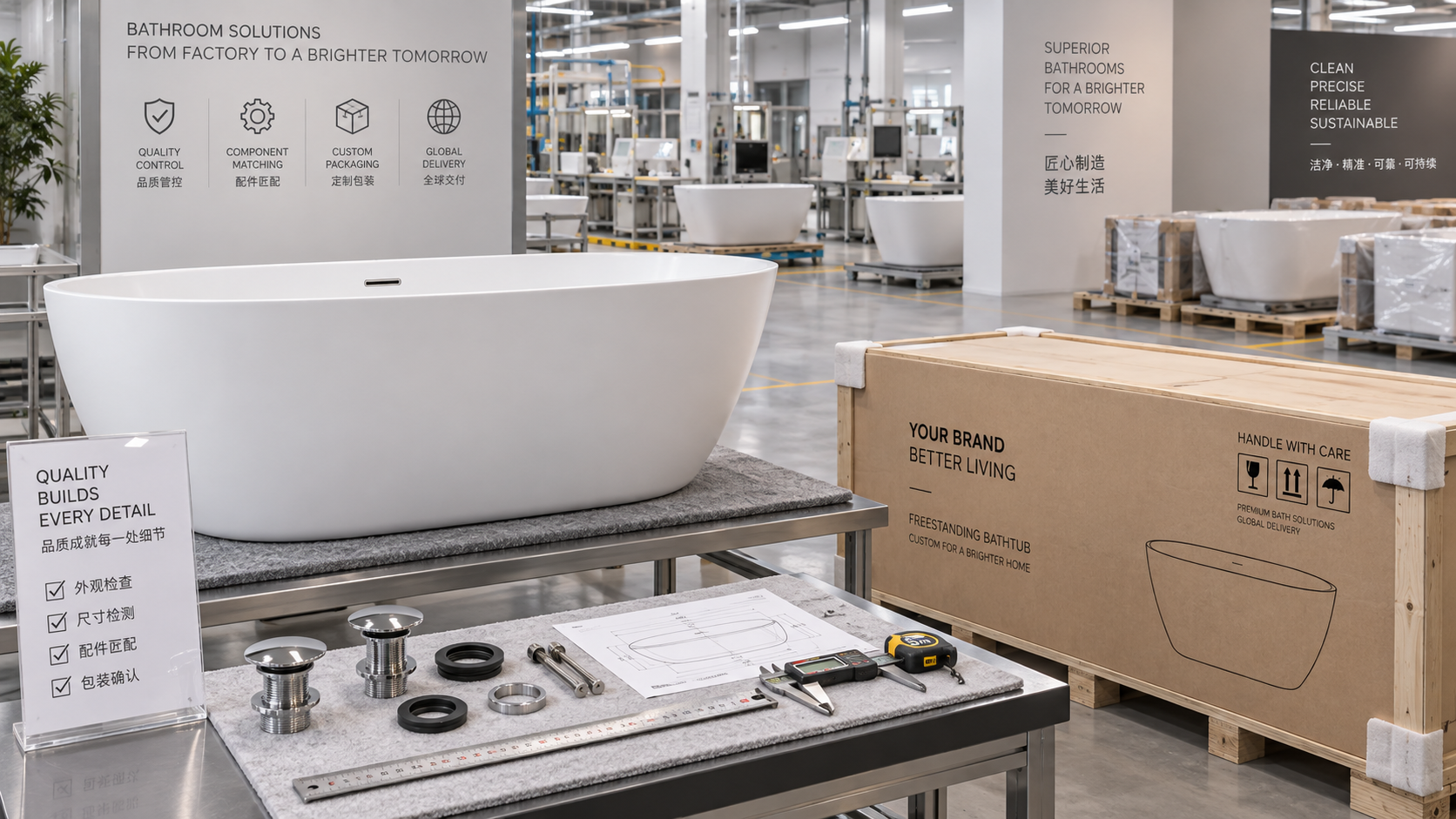
A sample tells you what a supplier can produce once under controlled attention. It does not automatically reveal how the factory manages variation across multiple production runs. When evaluating bathtub manufacturers, buyers should ask for a practical view of the production process: incoming material checks, forming or casting controls, trimming and finishing stages, drainage-hole positioning, assembly, final inspection, and packing.
The most useful supplier discussions are specific. Rather than asking whether a factory has “strict quality control,” ask how it checks dimensions, how it identifies cosmetic defects, what happens to non-conforming products, and how inspection records are linked to batches. Clarify whether every unit is visually inspected, whether water-retention or drainage testing is part of the normal process, and how the factory manages changes to raw materials, molds, or outsourced components.
Factory capability also includes engineering depth. If your range requires a new size, modified backrest angle, different overflow arrangement, integrated skirt, special color, or branded packaging, determine who owns the technical review. A supplier that merely accepts every requested change without discussing mold implications, drainage geometry, packaging impact, or lead time is not necessarily being flexible; it may be leaving risk unresolved until production.
What should be documented before a production order?
The commercial agreement should be supported by a controlled specification package, not just a product photograph and a reference sample. At a minimum, it should address approved drawings, key dimensions and tolerances where relevant, material description, finish and color reference, drain and overflow configuration, included accessories, logo application, packaging method, labels, inspection criteria, and any target-market documentation required for sale.
It is also wise to state which sample controls the appearance standard. “White” is not a sufficient finish definition when a retailer expects visual consistency between bathroom fixtures ordered months apart. Matte surfaces, colored baths, metallic trim, and textured exterior finishes require particular attention because perceived variation can be more noticeable than it is on a basic gloss-white model.
Compliance Must Be Mapped to the Selling Market
Compliance is not a box to tick after the purchase order is issued. Requirements can differ by country, region, customer type, and installation context. Product standards, plumbing rules, labeling obligations, chemical restrictions, fire-related requirements for adjacent materials, and documentation expectations may all need review depending on the market.
A manufacturer’s statement that it “exports globally” should trigger further questions rather than settle the matter. Ask which documents are available for the exact model and material being sourced, who is responsible for maintaining them, and whether test evidence or declarations apply to the proposed configuration rather than a superficially similar product. Changes to drain kits, coatings, adhesives, packaging inks, or electrical accessories in a whirlpool model can affect the relevant documentation.
Procurement should involve local compliance specialists, import teams, or project consultants early where requirements are uncertain. The cost of checking a requirement before tooling or mass production is usually much lower than dealing with a delayed shipment, relabeling exercise, or a product that cannot be installed as intended.
Calculate Landed Cost, Not Factory Price
Bathtubs are especially vulnerable to misleading price comparisons because their physical volume is large relative to their unit value. Ex-works price is only one part of the buying decision. A useful cost model should include product cost, tooling or development charges, export packing, inland transport, freight, insurance where applicable, duties and taxes, port or destination handling, warehousing, local delivery, inspection, expected damage exposure, and the cost of replacement stock.
Container utilization should be reviewed by the actual packaged dimensions, not by product dimensions alone. Packaging that is too light can increase damage. Packaging that is oversized may protect the product but reduce loading efficiency enough to distort landed cost. The right answer depends on route conditions, handling points, product material, and whether deliveries go to a warehouse, a retailer, or directly to a construction site.
Payment terms and currency exposure also deserve attention. A low unit price can become less attractive if it requires a large deposit, a long inventory commitment, or purchasing in a currency that is difficult for the buyer to manage. Procurement, finance, and product teams should examine the same cost model rather than optimizing separate pieces of the transaction.
Customization Should Support the Range, Not Complicate It
Private label does not always require a fully new bathtub design. In many cases, brand differentiation comes from a disciplined combination of proven product architecture, selected dimensions, coordinated waste and overflow finishes, exterior color options, packaging, instructions, and merchandising assets. This can be more manageable than launching a completely new mold before market demand is understood.
A custom mold may be justified when the shape itself is central to the brand proposition or when a project requirement cannot be met by existing designs. But it should be evaluated as a long-term commitment. Buyers need clarity on tooling ownership, maintenance, storage, modification rights, exclusivity boundaries, and what happens if production volumes fall below expectations. These details are often more consequential than the initial tooling quotation.
Avoid excessive SKU fragmentation. A range with many nearly identical sizes, finishes, drain options, and packaging variations can be difficult to forecast and expensive to replenish. A tighter assortment with clear customer logic is usually easier to manage and gives the supplier a better chance to maintain stable production planning.
Treat Packaging and Delivery as Part of Product Quality
A bathtub can pass final inspection and still fail commercially if it arrives scratched, cracked, distorted, or missing a critical fitting. Packaging review should therefore be part of supplier qualification. Ask for packing specifications, photographs of packed units, stacking instructions, pallet or crate details where used, barcode placement, handling marks, and a clear method for matching accessories to the correct bathtub model.
For e-commerce or multi-stage distribution, consider how a damaged product will be identified and processed. Is the outer package sufficient for warehouse handling? Can the product be inspected without destroying the packaging? Are replacement drain covers, leveling feet, or overflow components available separately? These operational details rarely appear in a showroom sample, but they shape the real cost of ownership.
Build a Supplier Relationship Around Evidence
The strongest sourcing decisions combine design judgment with documented operational evidence. Request samples, but also review drawings, packaging records, inspection criteria, lead-time assumptions, and the supplier’s response to technical questions. If possible, assess a pre-production sample before the first substantial run, particularly when branding, finishes, accessories, or packaging differ from the standard factory product.
A practical supplier scorecard can help avoid decisions driven by a single impressive meeting or an unusually low first quotation. Weight the criteria according to your business model: construction quality, technical responsiveness, compliance readiness, commercial terms, logistics capability, customization discipline, and after-sales support. The goal is not to find a perfect supplier. It is to identify the risks you can manage and those you should not accept.
At GIAM, the bathtub category is best understood as part of a wider sanitary-space system, where materials, water management, interior design expectations, trade conditions, and project delivery realities intersect. Its Strategic Intelligence Center tracks the forces shaping building materials and smart kitchen-and-bath markets, including the growing attention given to material performance, resource-conscious design, and global supply-chain changes. For buyers, that broader perspective is useful: a bathtub specification should fit not only a factory capability, but also the evolving expectations of the market where the brand will be sold.
Before committing to a supplier, confirm the final target-market requirements, the approved product and packaging specifications, the full landed-cost model, and the process for handling defects after shipment. Those four checks will usually reveal far more about the viability of private label bathtubs than a unit-price comparison alone.
Industry Briefing
Get the top 5 industry headlines delivered to your inbox every morning.