
OEM Shower Set Factory Checklist: How to Compare Quality, MOQ, and Lead Time
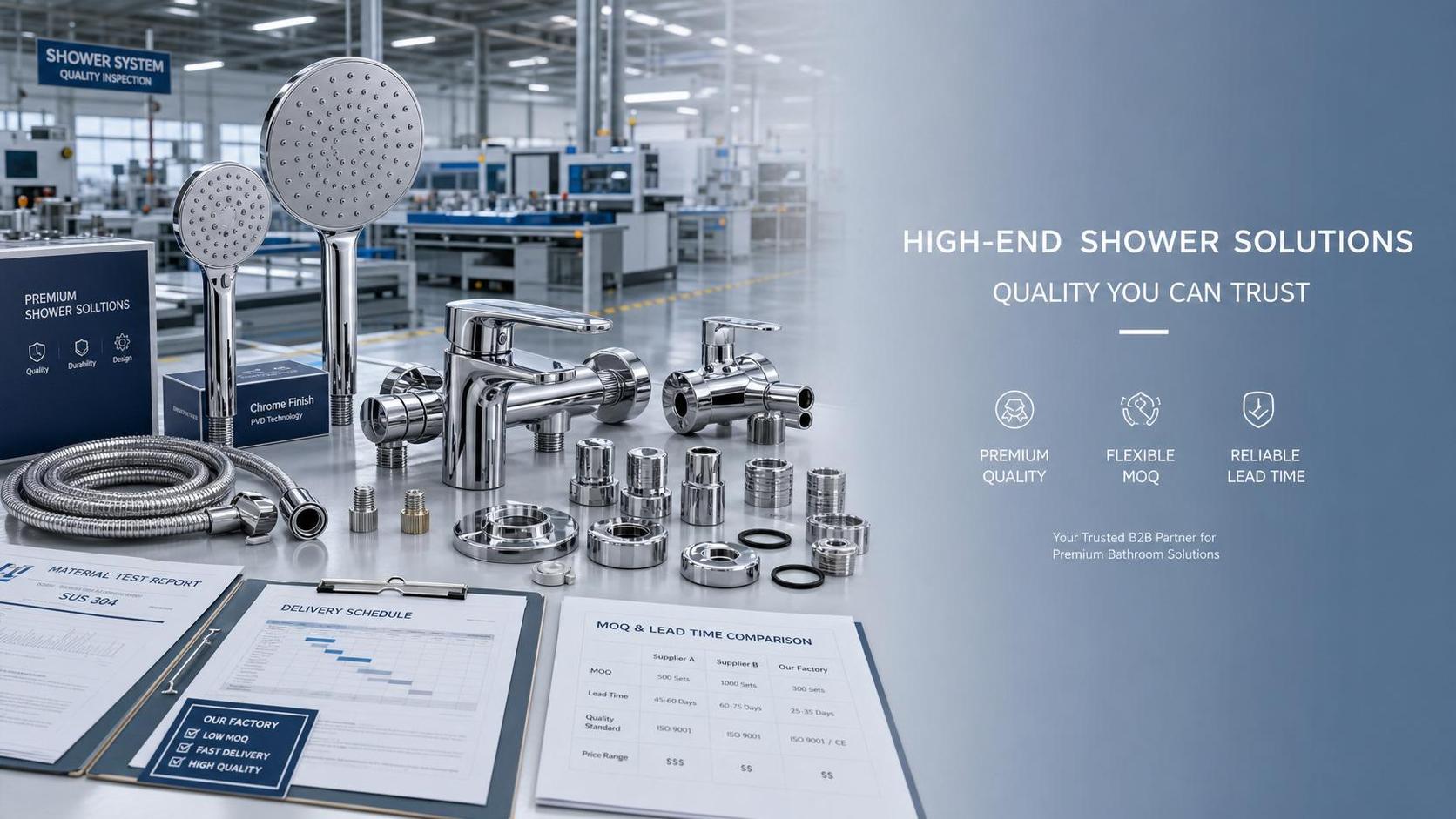
OEM Shower Set Factory Checklist: How to Compare Quality, MOQ, and Lead Time
Choosing the right OEM shower set factory can directly affect product quality, sourcing costs, and delivery reliability.
Price still matters, but it is rarely the full story.
A lower quote can hide unstable plating, weak cartridges, or long production queues.
That is why comparing an OEM shower set factory needs a practical checklist.
In real sourcing work, three issues drive most decisions: quality, MOQ, and lead time.
When these three align, the supply relationship becomes easier to scale.
When they do not, even a promising supplier can become a long-term cost risk.
Why the Right OEM Shower Set Factory Matters
An OEM shower set factory does more than assemble visible parts.
It controls casting quality, machining tolerance, finishing consistency, sealing performance, and packaging protection.
These factors shape customer satisfaction and after-sales cost.
For project buyers, the impact is even wider.
A delayed shower set shipment can affect installation schedules, final inspections, and payment milestones.
A quality claim can also damage trust across a wider sanitary ware program.
Start with Manufacturing Quality
Quality should be the first filter when screening an OEM shower set factory.
If quality control is weak, good pricing will not protect the total landed cost.
1. Check Core Material Standards
Start with the body material of the shower mixer and main fittings.
Ask whether the factory uses brass, stainless steel, or zinc alloy for each component.
Do not accept a vague statement like “standard material.”
Request clear specifications for lead content, wall thickness, and corrosion resistance.
A capable OEM shower set factory should provide material reports without hesitation.
2. Review Surface Finishing Performance
Finish quality affects both appearance and durability.
Chrome, brushed nickel, matte black, and PVD colors need different process control.
Ask for salt spray test data, adhesion results, and coating thickness records.
An experienced OEM shower set factory should also explain how it prevents color variation between batches.
3. Confirm Cartridge and Water Control Reliability
The cartridge is one of the most critical hidden parts.
A good-looking shower set can still fail early if the cartridge is inconsistent.
Check the cartridge brand, life cycle testing, and leak test standard.
Also review diverter performance, thermostatic stability, and hose connection sealing.
This is where one OEM shower set factory often separates itself from another.
4. Audit the Quality Control Process
Documents matter, but process visibility matters more.
Ask how the OEM shower set factory handles incoming inspection, in-line checks, and final testing.
Useful questions include:
- Is every set pressure tested before packing?
- How are defect categories defined?
- What is the AQL standard for shipment release?
- How are rework and root cause records managed?
Compare MOQ with Real Purchasing Flexibility
MOQ is often treated as a simple number, but it should be analyzed by structure.
A low MOQ from one OEM shower set factory may still be inflexible in practice.
A higher MOQ from another supplier may support better SKU combinations and lower risk.
1. Break Down MOQ by Component
Ask whether MOQ applies to the full set, finish color, logo, packaging, or each accessory.
This point is especially important for custom shower heads, hand showers, and slide bars.
A transparent OEM shower set factory will explain where MOQ comes from and which parts can be shared.
2. Ask About Mixed Orders
Mixed orders are useful when testing new markets or managing multiple channels.
Some suppliers accept mixed models in one container but keep one finish only.
Others allow mixed finishes but only after sample approval and deposit confirmation.
The better OEM shower set factory will define these rules early, not after quotation approval.
3. Evaluate Tooling and Packaging Thresholds
Custom branding often changes the MOQ picture.
Private label cartons, foam inserts, laser logos, and new molds can all raise volume commitments.
Ask for a separate MOQ table covering standard products and customized versions.
This makes factory comparison more accurate and easier to budget.
Lead Time Is a Stability Question, Not Just a Date
Many suppliers can promise a fast date.
Fewer can deliver that date consistently across peak seasons and custom orders.
That is why lead time must be reviewed as a system capability.
1. Separate Sample Time from Mass Production Time
A sample can be rushed manually.
Mass production depends on scheduling, material availability, and finishing capacity.
Ask the OEM shower set factory to quote both timelines clearly.
Also confirm whether the clock starts from deposit, drawing approval, or packaging confirmation.
2. Review Bottlenecks Inside the Factory
Lead time problems usually come from a few repeat bottlenecks.
- Plating line congestion
- Cartridge supply delays
- Packaging material shortages
- Manual inspection backlogs
A reliable OEM shower set factory can identify these constraints and explain mitigation plans.
3. Ask for On-Time Delivery Data
Past performance is still one of the best indicators.
Request recent on-time delivery data for similar product categories.
If the factory cannot share exact rates, ask for delay causes from recent months.
A serious OEM shower set factory will have this data ready for review.
Use a Side-by-Side Comparison Table
Once supplier responses are collected, compare them in one working table.
Red Flags That Should Slow the Decision
From recent market changes, a few warning signs appear more often.
- Quotation is fast, but technical answers are vague.
- The OEM shower set factory changes MOQ after packaging discussion.
- Lead time sounds short, but no production calendar is shared.
- Sample quality looks good, but mass production controls are unclear.
- Certification claims are broad, but product-level proof is missing.
These signals do not always mean failure, but they do justify deeper verification.
A Practical Shortlist Method
To simplify evaluation, score each OEM shower set factory across three weighted areas.
- Quality capability: 50%
- MOQ flexibility: 20%
- Lead time stability: 30%
This structure keeps the decision grounded in long-term supply performance.
It also helps explain why the cheapest quote is not always the best sourcing choice.
In many cases, the best OEM shower set factory is the one with fewer hidden variables.
That predictability creates better planning, cleaner launches, and lower claim rates.
Final Takeaway
Choosing an OEM shower set factory should be a structured commercial decision.
Start with product quality, then test MOQ logic, and finally validate lead time stability.
When these three areas are checked together, supplier comparison becomes more objective.
That also means fewer surprises after order confirmation.
For buyers in a competitive sanitary ware market, the right checklist saves more than unit cost.
It protects delivery reliability, brand reputation, and margin over time.
Use this framework to build a tighter shortlist and make each OEM shower set factory comparison easier to defend.
Industry Briefing
Get the top 5 industry headlines delivered to your inbox every morning.