
EU CE Rule Requires Water Safety Reports for Smart Toilets
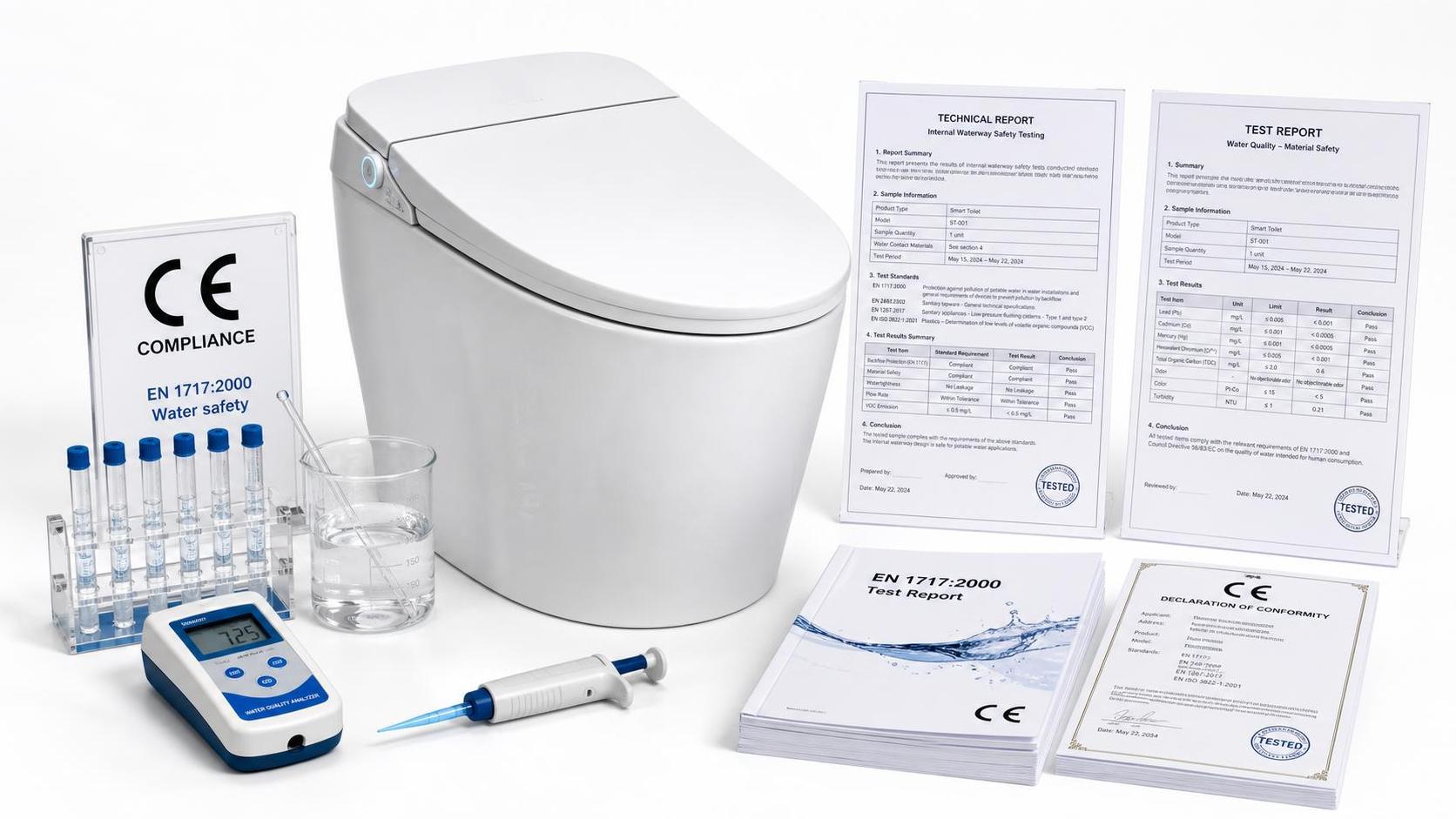
On August 3, 2026, a new CE-related compliance requirement took effect for smart toilets entering the EU market. The change follows the European Commission’s release of Commission Regulation (EU) 2026/1347 on August 2, 2026, and brings an immediate documentation obligation tied to the internal water system of the product. For exporters, importers, testing providers, and procurement teams, the issue is not only regulatory wording but also how quickly technical files, declarations, and shipment documents can be aligned with the new requirement.
What the new requirement now asks for
According to the information provided, the European Commission issued Commission Regulation (EU) 2026/1347 on August 2, 2026. From August 3, 2026, all Smart Toilets placed on the EU market must be accompanied by a water safety test report covering the built-in water circuit system, and that report must be issued by a laboratory accredited to ISO/IEC 17025.
The same information states that the requirement must also be explicitly referenced in the CE Declaration of Conformity. The change directly affects customs clearance document preparation for Chinese exporters, the scheduling of third-party testing, and overall compliance cost. Importers are also required to recheck the completeness of supplier technical documentation.
Where the pressure is likely to appear first
Export documentation moves to the front of the shipment process
From an operational perspective, exporters of smart toilets are likely to feel the impact first in pre-shipment document preparation. The new requirement links market access to a specific test report and to wording in the CE Declaration of Conformity, which means document packages that were previously considered complete may now need revision before goods move.
What deserves closer attention is the interaction between testing lead time, declaration updates, and customs paperwork. If any of those elements are prepared out of sequence, shipment timing may come under pressure.
Importers face a stricter document review burden
For importers, the immediate issue is supplier file completeness. The provided information makes clear that importers need to review whether the technical documentation submitted by suppliers contains the required water safety report and whether the CE Declaration of Conformity clearly reflects that requirement.
This shifts part of the risk review upstream. In practice, importer-side compliance teams and sourcing teams will need to pay closer attention to whether supplier documents are current, internally consistent, and traceable to the product being placed on the market.
Testing and certification workflows may become a timing bottleneck
Analysis shows that third-party testing workflows may become a practical constraint because the new rule refers specifically to a report issued by an ISO/IEC 17025 accredited laboratory. That does not by itself confirm how capacity or turnaround will evolve, but it does indicate that test scheduling and laboratory qualification will become more central to delivery planning.
For certification-related service providers and manufacturers managing CE files, the rule change is likely to increase scrutiny over report availability, report scope, and alignment between test evidence and formal conformity documents.
What companies should review now
Check whether technical files match the new declaration requirement
Companies shipping smart toilets to the EU should review whether their CE documentation set clearly includes the required reference in the Declaration of Conformity. Analysis shows that this is not only a testing question but also a document control issue, because technical files and declarations now need to reflect the same compliance position.
Reassess testing timelines in supply and delivery planning
Observably, testing lead time may now have a more direct effect on shipment readiness. Businesses involved in export scheduling, purchasing, and delivery planning should therefore examine whether laboratory booking, report issuance, and document compilation are being treated as critical path items.
This is especially relevant where orders are already in preparation, because the rule took effect from August 3, 2026 rather than being described as a distant future requirement.
Review supplier qualification and document completeness checks
For importers and procurement teams, one practical focus is supplier review. Based on the provided information, supplier technical documentation can no longer be treated as complete without confirming the presence of the required water safety report and the corresponding declaration language.
Where sourcing depends on multiple factories or document coordinators, businesses may need tighter internal checks to avoid inconsistencies between test reports, product files, and shipment documentation.
Keep watching for execution detail rather than assuming uniform practice
The input does not provide detailed enforcement procedures, customs interpretation, or market-specific implementation guidance. For that reason, companies should avoid assuming that all execution points are already settled. What deserves closer attention is whether later official wording, practical review standards, or buyer-side documentation requests become more specific after the rule takes effect.
Why this looks like an execution signal, not just a policy headline
From an industry perspective, this development is better understood as an immediate compliance signal tied to market entry rather than as a broad policy discussion. The rule is framed around an effective date, a defined product category, a specified type of test evidence, and a documentation requirement inside the CE conformity framework.
At the same time, it is also reasonable to treat the current stage as one that still requires observation. Analysis shows that the confirmed facts establish the obligation itself, but do not yet answer every practical question about review intensity, document interpretation, or how quickly market participants will standardize their workflows around it.
How the market should read this change for now
The most balanced reading is that smart toilet suppliers and EU-facing trade participants are dealing with a rule that has already moved into effect and that directly alters compliance preparation. The core significance lies in the fact that water safety evidence for the internal water circuit is now tied more explicitly to CE-related documentation for this product category.
It is more appropriate to understand this as a landed compliance change with immediate procedural consequences, while still recognizing that the practical enforcement rhythm and market response will need continued observation.
Basis of this article and what still needs verification
This article is based on the user-provided news title, event date, and event summary. It discusses the reported publication of Commission Regulation (EU) 2026/1347, its August 3, 2026 effective application to Smart Toilets entering the EU market, the requirement for an ISO/IEC 17025 laboratory-issued water safety report for the built-in water system, the need to state that element in the CE Declaration of Conformity, and the stated impact on exporter documentation, third-party testing timelines, compliance costs, and importer document review.
For events of this type, relevant source categories typically include official regulatory notices, publications by supervisory authorities, customs or trade-administration information, industry association updates, standardization documents, and reporting by established professional media. No specific official source link was provided in the input, so the exact source link still needs to be verified. Further observation is also needed regarding any detailed implementation wording, certification interpretation, procurement document changes, market feedback, and how companies execute the requirement in practice.
Industry Briefing
Get the top 5 industry headlines delivered to your inbox every morning.