
Smart Bathroom Technology Solutions: What to Prioritize in a Connected Bathroom Project
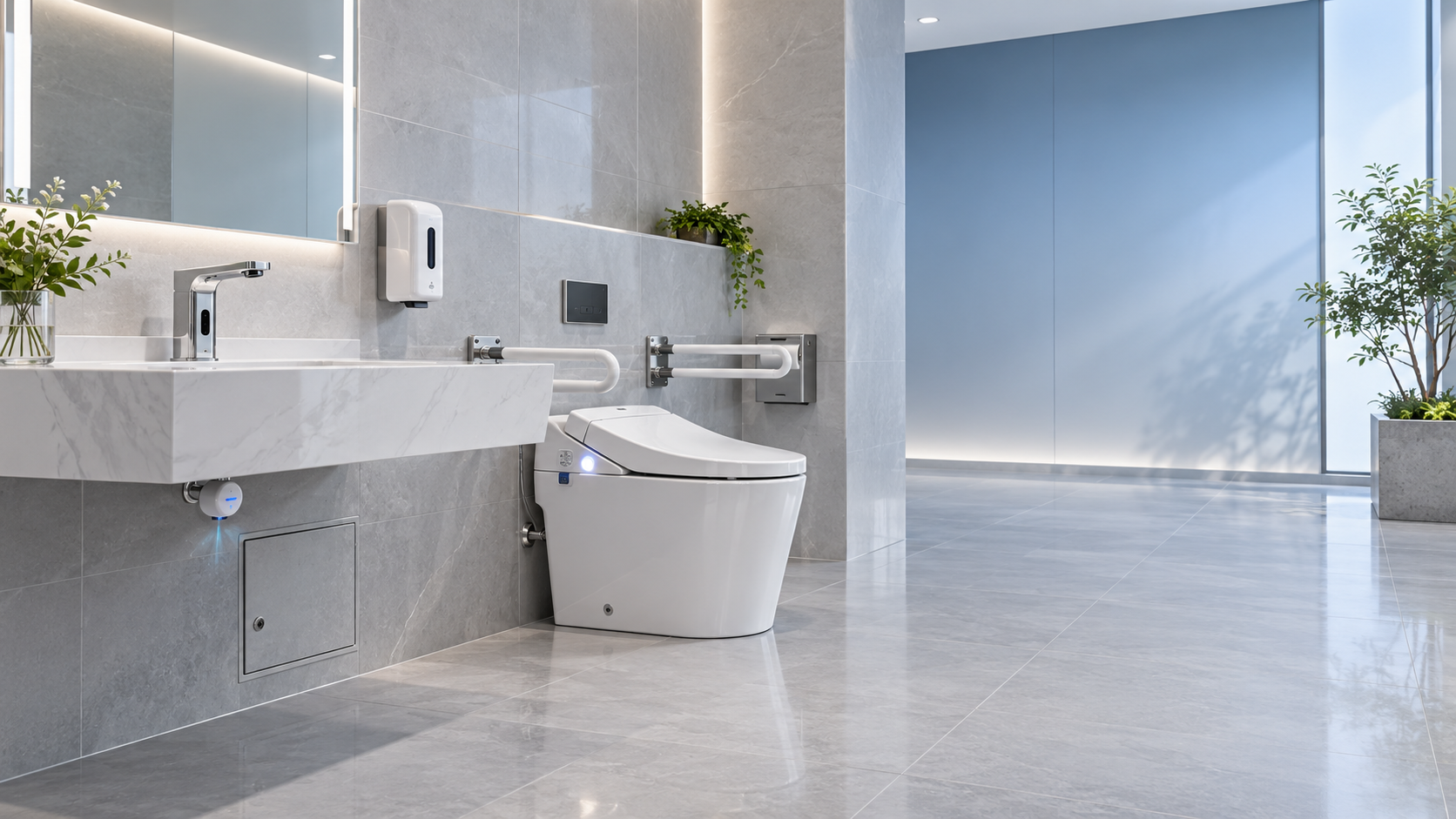
Smart Bathroom Technology Solutions: What to Prioritize in a Connected Bathroom Project
Smart bathroom technology solutions are no longer limited to premium hotel suites or highly visual residential showrooms. They are increasingly part of practical project discussions in offices, healthcare facilities, airports, mixed-use developments, multifamily housing, and public venues. The reason is straightforward: bathrooms consume water and energy, require frequent maintenance, and strongly influence how occupants judge cleanliness, comfort, and accessibility.
For a project manager, however, a connected bathroom is not a collection of impressive devices. It is a coordinated system involving sanitary ware, plumbing, electrical design, controls, finishes, maintenance access, network security, and user behavior. A touchless faucet may look like a simple fixture choice, but its sensor range, power source, water pressure tolerance, service access, and compatibility with the basin geometry can all affect performance after handover.
The most successful connected bathroom projects usually begin with operational priorities rather than a technology wish list. Before selecting products, teams should decide what problem the system is expected to solve: reduce avoidable water loss, improve hygiene, simplify cleaning, support aging users, provide faster fault alerts, or create a differentiated guest experience. That early discipline prevents a common outcome: a bathroom full of connected features that no one can maintain properly.
Start with the Use Case, Not the Device
A smart toilet seat, occupancy sensor, automatic dispenser, or digital shower controller may all be appropriate in the right setting. They are not interchangeable priorities. In a high-traffic transport hub, durability, rapid cleaning, vandal resistance, and clear fault notification may matter more than personalization. In an upscale residential project, temperature settings, ambient lighting, heated seats, and app-based preferences may have a stronger role. In a care environment, the emphasis shifts toward hygiene, anti-scald protection, intuitive controls, and accessibility.
This distinction becomes especially important when the design team works across several bathroom types. A connected solution for the public restroom lobby should not simply be copied into staff washrooms, accessible cubicles, shower rooms, or private apartments. Each space has a different duty cycle, user expectation, cleaning regime, and tolerance for downtime.
A useful project brief identifies three layers of need:
- Non-negotiable functions: safety, water control, hygiene, accessibility, and regulatory compliance.
- Operational functions: leak alerts, consumable monitoring, remote status visibility, cleaning support, and maintenance diagnostics.
- Experience functions: comfort settings, lighting scenes, digital interfaces, automatic lids, and user personalization.
When budgets tighten, the experience layer is usually where compromises should begin—not the components that protect the building, reduce waste, or make daily servicing manageable.
Water Management Is Often the Strongest Business Case
In many connected bathroom projects, the most valuable intelligence is invisible. Leak detection, abnormal flow alerts, pressure monitoring, and automatic shut-off strategies can be more consequential than a sophisticated user interface. A slow leak behind a wall, below a vanity, or near a concealed cistern may not be noticed until finishes, adjacent rooms, or ceiling assemblies have already been affected.
That does not mean every fixture needs its own complex monitoring package. The appropriate level of granularity depends on the building type, the plumbing layout, the cost of disruption, and the facilities team’s ability to respond. In a large commercial development, monitoring at zone or branch level may provide useful visibility without creating an unmanageable volume of alerts. In a high-end residence or hospitality suite, more localized sensing may be justified where water damage would be particularly disruptive.
Project teams should be careful with the phrase “water-saving.” A low-flow fixture or timed control can reduce consumption in some use patterns, but poor sensor calibration can produce user frustration, repeated activations, or unnecessary running time. The right question is not whether a fixture is marketed as efficient. It is whether the selected flow rate, activation logic, pressure conditions, and user behavior suit that bathroom environment.
Hydraulic design deserves a place in technology meetings. Sensor-operated fittings can be affected by pressure fluctuations, debris in the water supply, poor filtration, or inconsistent hot-water delivery. If the plumbing system is treated as a separate issue until late in the process, the “smart” layer may be blamed for problems that began with basic infrastructure.
Touchless Fixtures Need Practical Coordination
Touchless faucets, flush plates, soap dispensers, hand dryers, and door controls are often the first technologies considered in hygiene-focused renovations. They can make sense, particularly where many users share facilities. Yet the installation details are less forgiving than they appear in product renderings.
For faucets, the basin profile, spout reach, mounting height, sensor angle, and backsplash material all influence detection reliability and splash control. Highly reflective surfaces, deep basins, unusual countertop arrangements, or a poorly positioned sensor can create inconsistent operation. These issues are best reviewed using actual fixture samples or full-scale mock-ups, not only BIM objects and catalog dimensions.
Power strategy also needs an early decision. Battery-powered products may simplify initial installation, but replacement planning becomes an operational responsibility. Mains-powered fixtures can reduce that routine task, although they require coordinated electrical provision and may create greater consequences if a local power issue occurs. Hybrid arrangements are sometimes available, but the project team should confirm what happens during loss of power, how manual override works, and what maintenance access is required.
The same principle applies to automatic flushing. The technology should support hygiene without causing false activations, excessive flushing, or confusion for users. In public washrooms, a visible and intuitive manual option can still be valuable, particularly where users have different expectations or where sensor reliability is affected by the physical layout.
Do Not Treat Accessibility as an Add-On
A connected bathroom can improve accessibility, but only if technology is selected with real users in mind. Automatic lids, voice functions, illuminated controls, adjustable wash-and-dry functions, and occupancy sensing may help some users. They can also create barriers if controls are poorly located, touch panels lack tactile clarity, automated sequences are difficult to interrupt, or a device assumes that every user has the same mobility and digital confidence.
Accessible bathroom planning still starts with circulation, grab rails, reach ranges, transfer space, door operation, emergency assistance, and local code requirements. Smart features should reinforce those fundamentals. A beautifully integrated wall panel is not helpful if it cannot be reached from a seated position or if its icons are unreadable under typical bathroom lighting.
For projects serving older occupants, visitors, or users with temporary injuries, simplicity often wins. A physical override, an obvious status indicator, and predictable operation can be more valuable than extensive customization. It is also worth considering what happens when Wi-Fi fails, a battery is depleted, or a user does not want to install an app simply to operate a shower.
Integration Should Be Proportionate to the Building
Not every connected fixture needs to report to a central building management system. Over-integration can introduce cost, commissioning delays, cybersecurity exposure, and unclear ownership of data. At the same time, isolated devices can create a fragmented maintenance burden if each one requires a separate dashboard, login, gateway, or service agreement.
The practical middle ground is to identify which information facilities teams can act on. Examples may include leak alarms, abnormal water consumption, device faults, low consumable levels, filter replacement notifications, or washroom occupancy indicators. If a signal does not lead to a defined action, it may not need to be collected centrally.
Cybersecurity should be discussed in the same calm, practical way as electrical protection or valve access. Connected fixtures may collect operational data, and some systems use cloud platforms or remote service tools. Project specifications should clarify network responsibilities, account ownership, update procedures, data retention expectations, and whether the system can operate with restricted connectivity. The right requirements depend on the building’s IT policies and the sensitivity of the information involved.
Specify for Cleaning, Repair, and Replacement
A smart bathroom can look exceptional on opening day and still become difficult to operate six months later if cleaning and maintenance were treated as secondary matters. Bathroom technology sits in a demanding environment: moisture, cleaning chemicals, limescale, frequent use, accidental impact, and sometimes misuse. The specification should therefore address more than visual finish and feature lists.
Ask suppliers and installers direct questions. Can a solenoid, battery pack, sensor module, or control board be replaced without removing a tiled wall? Are spare parts expected to be available locally or through a defined supply channel? What tools are required? Is there a manual flushing or shut-off method? Which cleaning agents should be avoided? These questions are rarely glamorous, but they reveal whether a solution is suitable for the project’s real operating conditions.
Material selection matters here as well. GIAM’s ongoing focus on sanitary spaces, material science, water-saving systems, and the changing relationship between construction infrastructure and interior design reflects a useful reality: smart performance cannot be separated from the physical products around it. A sensor is only one part of the result. Surface durability, drainage, grout detailing, ventilation, concealed access panels, and fixture mounting all shape the long-term experience.
Commissioning Is Where Many Promising Schemes Lose Value
The gap between a specified smart bathroom and a working smart bathroom usually appears during commissioning. Controls need calibration. Water temperatures and pressure conditions must be verified. Sensors need to be tested with the actual basin, lighting, and user positions. Leak alarms should be checked through a defined response process, not merely confirmed as visible on a dashboard.
A staged commissioning plan is particularly helpful when bathrooms are repeated across a large project. Complete a representative sample area early, involve the facilities and cleaning teams, record the issues they identify, then adjust settings or installation details before the wider rollout. This is more efficient than discovering the same sensor alignment or access problem across dozens of completed washrooms.
Handover should include more than product manuals. The operations team needs asset information, warranty contacts, reset procedures, access credentials, maintenance intervals, cleaning guidance, and a clear list of what requires specialist service. If controls are tied into a wider platform, document the point list and the action expected for each meaningful alarm.
Make Technology Earn Its Place
The strongest smart bathroom technology solutions are not necessarily the most connected ones. They are the systems that match the building’s water strategy, user profile, maintenance capability, and finish standard without creating fragile dependencies. A well-chosen leak sensor, a properly commissioned touchless faucet, or an accessible digital shower control can be more useful than an elaborate platform with no clear operational owner.
For project teams, the most reliable path is to assess the bathroom as a working environment rather than a showcase of devices. Bring plumbing, electrical, IT, interiors, facilities, and cleaning stakeholders into the conversation early. Review actual service access. Test key fixtures under realistic conditions. Then choose the level of intelligence the project can support for its full lifecycle—not only at launch.
Industry Briefing
Get the top 5 industry headlines delivered to your inbox every morning.