Are architectural material innovations worth the extra cost?
For finance approvers, the real question is not whether architectural material innovations look impressive, but whether they deliver measurable returns. From lower lifecycle costs and compliance advantages to stronger asset value and market appeal, the right material upgrade can outperform its upfront premium. This article examines how to assess architectural material innovations through a practical cost-benefit lens.
Why a checklist matters when evaluating architectural material innovations
Architectural material innovations often arrive with bold claims, complex specifications, and higher initial pricing. Without a checklist, decisions can drift toward aesthetics, hype, or incomplete technical comparisons.
A structured review makes trade-offs visible. It connects capital cost, maintenance burden, durability, energy performance, code exposure, and user value in one decision framework.
This matters across the broader built environment. GIAM tracks how material science, sanitary systems, and smart space technologies increasingly interact in both residential and commercial assets.
Core checklist: how to judge whether the extra cost is worth it
Use the following checklist to compare architectural material innovations against conventional alternatives. The goal is not to reward novelty, but to identify durable economic advantage.
- Measure lifecycle cost, not just purchase price. Include installation, maintenance, replacement cycles, cleaning needs, downtime risk, and disposal costs over the asset’s expected service life.
- Verify performance with test data. Request third-party certification, fire ratings, moisture resistance, thermal values, acoustic results, antimicrobial claims, and real project case evidence.
- Check compatibility with adjacent systems. Some architectural material innovations underperform when paired with unsuitable substrates, waterproofing layers, hardware, or smart control components.
- Calculate operational savings realistically. Estimate energy reduction, water efficiency, lower repair frequency, and labor savings using local climate, occupancy patterns, and usage intensity.
- Assess compliance value early. Materials that support green building credits, health standards, or tighter energy codes can reduce redesign risk and speed approvals.
- Review supply chain resilience. Premium products lose value if lead times are unstable, regional service is weak, or spare parts remain difficult to source.
- Compare expected service life with the holding period. A long-life premium material may not pay back if the asset will be repositioned or sold quickly.
- Estimate effect on rent, occupancy, or sales velocity. In many markets, visible material quality improves buyer trust, tenant appeal, and premium positioning.
- Examine installation complexity. Some architectural material innovations save money in use but demand specialist labor, tighter tolerances, or longer commissioning time.
- Test warranty strength and accountability. A premium claim needs clear coverage terms, local technical support, and defined remedies for premature failure.
A simple decision formula
A practical approach is to compare the upfront premium with quantifiable benefits over a fixed period. Use net savings, risk reduction, and residual value together, not separately.
If the premium is small but the material reduces energy demand, cleaning labor, defect exposure, and replacement frequency, the case for architectural material innovations strengthens quickly.
Where architectural material innovations deliver the strongest value
High-traffic commercial interiors
Airports, hospitality venues, offices, retail centers, and healthcare-adjacent spaces often justify better surfaces, coatings, and assemblies because wear rates are intense and maintenance visibility is high.
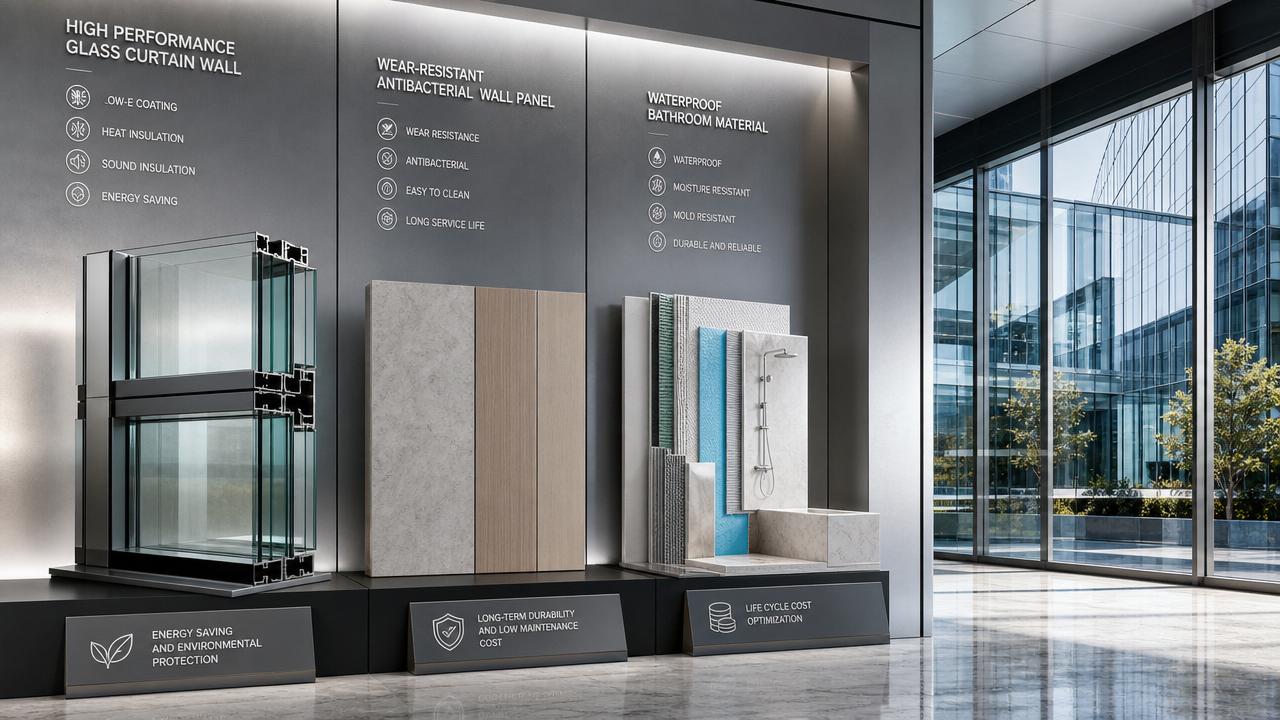
In these settings, architectural material innovations can reduce staining, abrasion, microbial growth, and repair intervals. The result is lower service disruption and more stable presentation quality.
Moisture-prone sanitary and wet areas
Bathrooms, washrooms, kitchens, and utility zones are ideal areas for selective upgrades. Water exposure accelerates failure in conventional finishes, sealants, joints, and backing systems.
When architectural material innovations improve waterproofing reliability, hygiene performance, and cleaning efficiency, they often produce measurable lifecycle savings despite a higher first cost.
Energy-sensitive envelopes
Facade materials, insulation systems, glazing packages, and reflective surfaces deserve close financial review. These categories influence heating, cooling, condensation control, and long-term code compliance.
In markets facing stricter carbon regulation, architectural material innovations tied to envelope performance may support both operating savings and future asset resilience.
Residential projects targeting premium differentiation
In housing, not every upgrade needs a breakthrough product. Yet visible, tactile, and health-related materials can shape buyer perception more strongly than hidden cost additions.
Architectural material innovations with low-VOC profiles, antibacterial performance, water-saving integration, or smart hardware compatibility can support stronger marketability and brand trust.
Commonly overlooked risks when comparing options
Ignoring maintenance reality
A premium surface may have excellent lab results but still require specialized cleaning products or procedures. That can quietly raise operating costs and weaken the investment case.
Overestimating payback speed
Some architectural material innovations create value slowly through durability and risk reduction. If the review model assumes immediate savings, it may distort the true economics.
Treating certifications as full proof
Certifications matter, but they do not replace field compatibility checks. Performance can decline when site conditions, workmanship, or neighboring products differ from test assumptions.
Missing replacement and retrofit constraints
Some advanced materials are excellent in new construction yet expensive to patch, match, or retrofit later. Future serviceability should be part of any premium evaluation.
Neglecting tariff and sourcing volatility
GIAM’s market tracking repeatedly shows that trade policy, logistics bottlenecks, and energy costs can alter the value equation of imported architectural material innovations.
Practical execution steps for a stronger decision
- Build a side-by-side matrix covering capex, service life, maintenance cycles, compliance support, embodied impact, operating savings, and projected residual value.
- Ask for project-specific mockups or pilot installations, especially where finish quality, moisture exposure, acoustics, or user touchpoints strongly affect outcomes.
- Model best-case, base-case, and stressed scenarios. This reveals whether architectural material innovations remain attractive under slower occupancy or rising labor costs.
- Document assumptions clearly, including cleaning frequency, replacement intervals, and energy prices, so the approval process rests on transparent evidence.
- Prioritize selective upgrades. Concentrate budget on envelope elements, sanitary zones, and high-contact surfaces where technical performance directly affects lifecycle economics.
When the premium usually makes sense
The extra cost is often justified when the material solves a recurring failure point, supports stricter compliance, lowers operating effort, or protects a high-visibility asset position.
When caution is better
Be careful when benefits are mostly aesthetic, service support is unclear, or savings depend on ideal conditions unlikely to occur in the actual project environment.
Conclusion and next action
So, are architectural material innovations worth the extra cost? Often yes, but only when they are tested against lifecycle value, operational fit, compliance impact, and asset strategy.
The most effective next step is to review one pending material decision using a structured matrix. Compare the premium against quantifiable savings, risk reduction, and market upside.
In a market shaped by greener standards, smarter spaces, and tighter performance expectations, disciplined evaluation turns architectural material innovations from a cost concern into a strategic advantage.
Industry Briefing
Get the top 5 industry headlines delivered to your inbox every morning.