
Building Materials in Southeast Asia: What Buyers Should Compare Before Sourcing
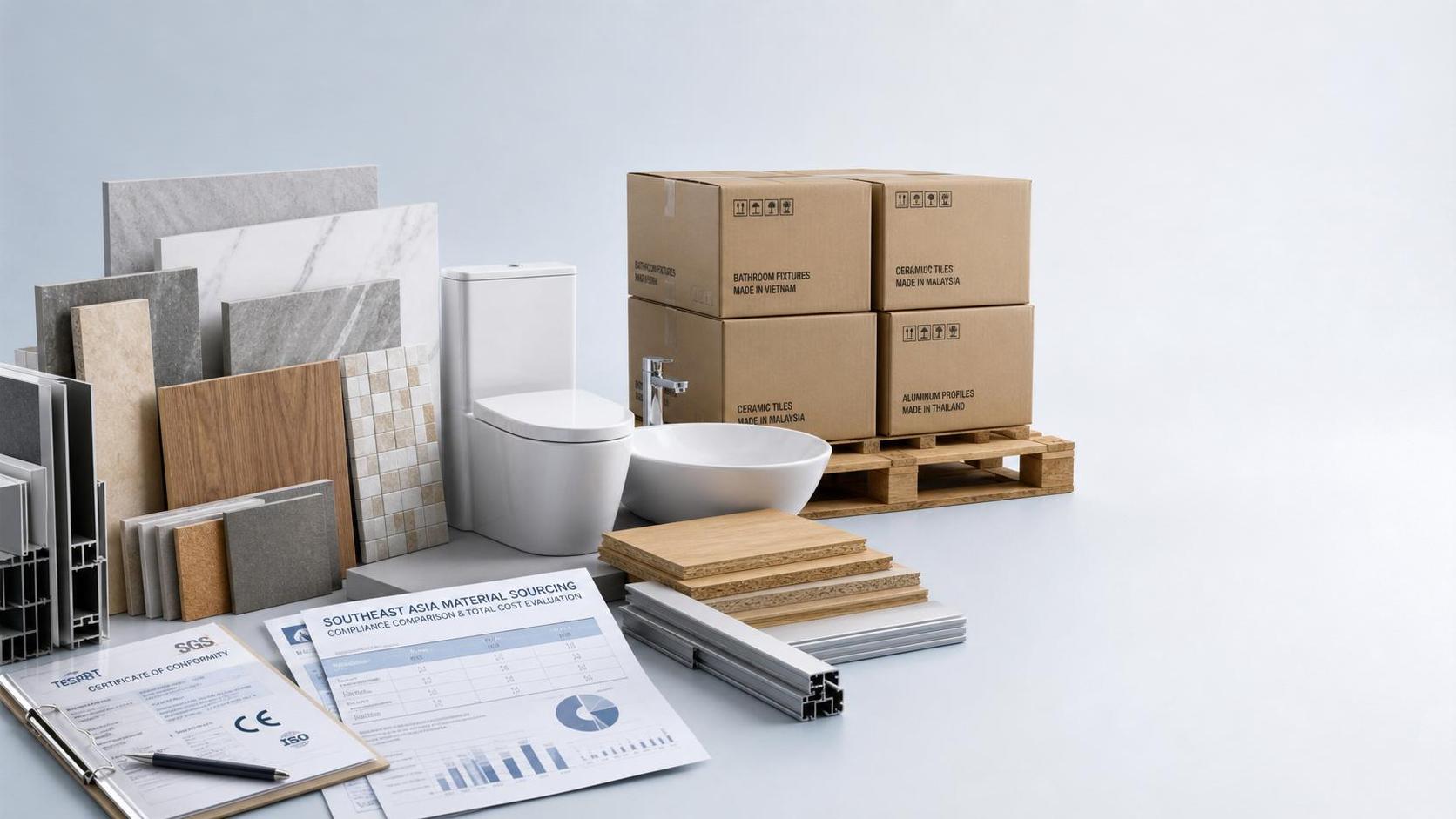
Building Materials in Southeast Asia: What Buyers Should Compare Before Sourcing
Sourcing building materials Southeast Asia offers strong cost and supply advantages.
But price alone rarely decides whether a purchase performs well on site.
A cheaper quote can become expensive once delays, compliance gaps, or uneven quality appear.
That is why procurement teams need a structured comparison before selecting regional suppliers.
Across Southeast Asia, manufacturing depth varies by category, country, and export readiness.
Tiles, sanitary ware, engineered wood, aluminum systems, and smart fixtures all follow different sourcing logic.
In practical buying decisions, the best supplier is often the one with the fewest surprises.
This guide breaks down what to compare before sourcing building materials Southeast Asia for cost-sensitive projects.
Start with category fit, not country headlines
Many sourcing plans begin with a country shortlist.
That is useful, but category strength matters more than general market reputation.
For example, one market may lead in ceramic tiles, while another performs better in metal profiles or sanitary products.
The right comparison starts with product type, performance requirements, and target project segment.
Low-rise housing, hospitality renovation, and premium mixed-use projects rarely need the same supplier profile.
- Map each material category to the countries with proven export volume.
- Check whether the supplier serves domestic only, regional only, or global project markets.
- Compare specialization in commercial, residential, or specification-driven orders.
- Review whether product lines match standard, mid-market, or premium positioning.
When sourcing building materials Southeast Asia, broad regional knowledge helps, but category-level accuracy saves more money.
Compare compliance early
Compliance should be checked before commercial negotiation gets too far.
This is where many cross-border purchases lose time.
A factory may offer competitive building materials Southeast Asia buyers like on price.
Still, the product may not meet destination testing, fire performance, water efficiency, or chemical emission requirements.
The risk grows in projects involving public buildings, hotels, healthcare spaces, and branded residential developments.
Key documents to compare
- Product test reports from recognized labs
- Factory quality certifications such as ISO-related systems
- Environmental and health declarations where required
- Water, pressure, load, abrasion, or fire ratings by product type
- Export documentation experience for the target country
Do not just ask whether documents exist.
Ask whether they are current, market-specific, and tied to the exact model being quoted.
For building materials Southeast Asia sourcing, document quality often reveals supplier maturity faster than presentations do.
Look beyond unit price to total landed cost
Unit price is visible. Total landed cost is what shapes real margin.
A lower ex-works quote can lose its advantage once freight, duties, packaging loss, and inland transport are included.
This is especially true for heavy or fragile building materials Southeast Asia exporters ship in volume.
Tiles, stone substitutes, sanitary ceramics, and glass-related products can show major logistics variation.
A practical comparison sheet should always include delivered cost per usable unit.
That gives a cleaner view of value when sourcing building materials Southeast Asia across several countries.
Check supply stability and production discipline
The next comparison point is supply stability.
In recent years, material buyers have seen how quickly power costs, raw material access, and shipping disruptions change lead times.
A supplier with attractive pricing but unstable output can damage the full project schedule.
For building materials Southeast Asia procurement, consistency matters more than one-time speed.
Questions worth asking
- What is the normal production lead time by SKU and season?
- How much capacity is reserved for export orders?
- Which raw materials are imported, and how volatile are they?
- How often do color shade or batch differences occur?
- Can the supplier support repeat orders with matching specifications?
This is where factory visit records, audit reports, and order history become useful.
Reliable building materials Southeast Asia sourcing depends on repeatable output, not only attractive samples.
Evaluate performance in real use conditions
Material performance should be compared in the context of actual application.
Catalog specifications are helpful, but they do not always reflect site realities.
Humidity, cleaning chemicals, foot traffic, water pressure, and maintenance behavior all affect product choice.
This is especially relevant when comparing building materials Southeast Asia suppliers serving different climate zones.
- For tiles, compare water absorption, slip resistance, and abrasion class.
- For sanitary products, compare glaze durability, flushing efficiency, and spare parts support.
- For engineered wood, compare moisture behavior, edge swelling, and emission levels.
- For hardware and fittings, compare corrosion resistance and cycle testing results.
Request project references with conditions similar to your own use case.
That makes building materials Southeast Asia comparisons more grounded and easier to defend internally.
Do not overlook service, communication, and claims handling
A supplier relationship is tested when something goes wrong.
Delayed feedback, weak documentation, or unclear replacement rules can erase the benefit of a good starting quote.
In the building materials Southeast Asia market, service quality often differs more than brochures suggest.
Communication discipline is not a soft factor. It is an operating risk variable.
Signs of a stronger supplier
- Clear quotation structure with revision history
- Fast technical answers tied to actual product codes
- Pre-shipment inspection support and defect reporting rules
- Defined warranty language and after-sales contact process
- Stable English communication across sales and operations teams
When sourcing building materials Southeast Asia, service responsiveness often predicts execution quality better than sales promises.
Compare long-term value, not just this shipment
Short-term buying pressure can push decisions toward the lowest immediate cost.
Still, better sourcing decisions usually come from measuring lifetime value.
This includes maintenance frequency, replacement risk, brand fit, and the supplier’s ability to support future phases.
The more standardized the supply relationship becomes, the more cost control improves over time.
That is a strong reason to assess building materials Southeast Asia partners with a wider lens.
A useful decision model can score suppliers across five weighted areas:
- Compliance readiness
- Total landed cost
- Supply consistency
- Application performance
- Service and claims response
That scorecard helps remove bias from supplier discussions.
It also gives management a clearer reason for approving one source over another.
For teams tracking building materials Southeast Asia, intelligence-led comparison is becoming a stronger advantage.
This is where market platforms such as GIAM add value.
By following material science trends, regulatory movement, and commercial demand signals, GIAM helps decision makers compare more than just visible pricing.
That wider view is increasingly important as green materials, smart systems, and specification standards keep evolving.
In real procurement work, the best result usually comes from asking better comparison questions earlier.
Before committing to building materials Southeast Asia suppliers, compare what affects delivery, compliance, and usable value over the full project cycle.
Industry Briefing
Get the top 5 industry headlines delivered to your inbox every morning.