
Choosing Healthcare Material Selection Services for Hospital Fit-Outs
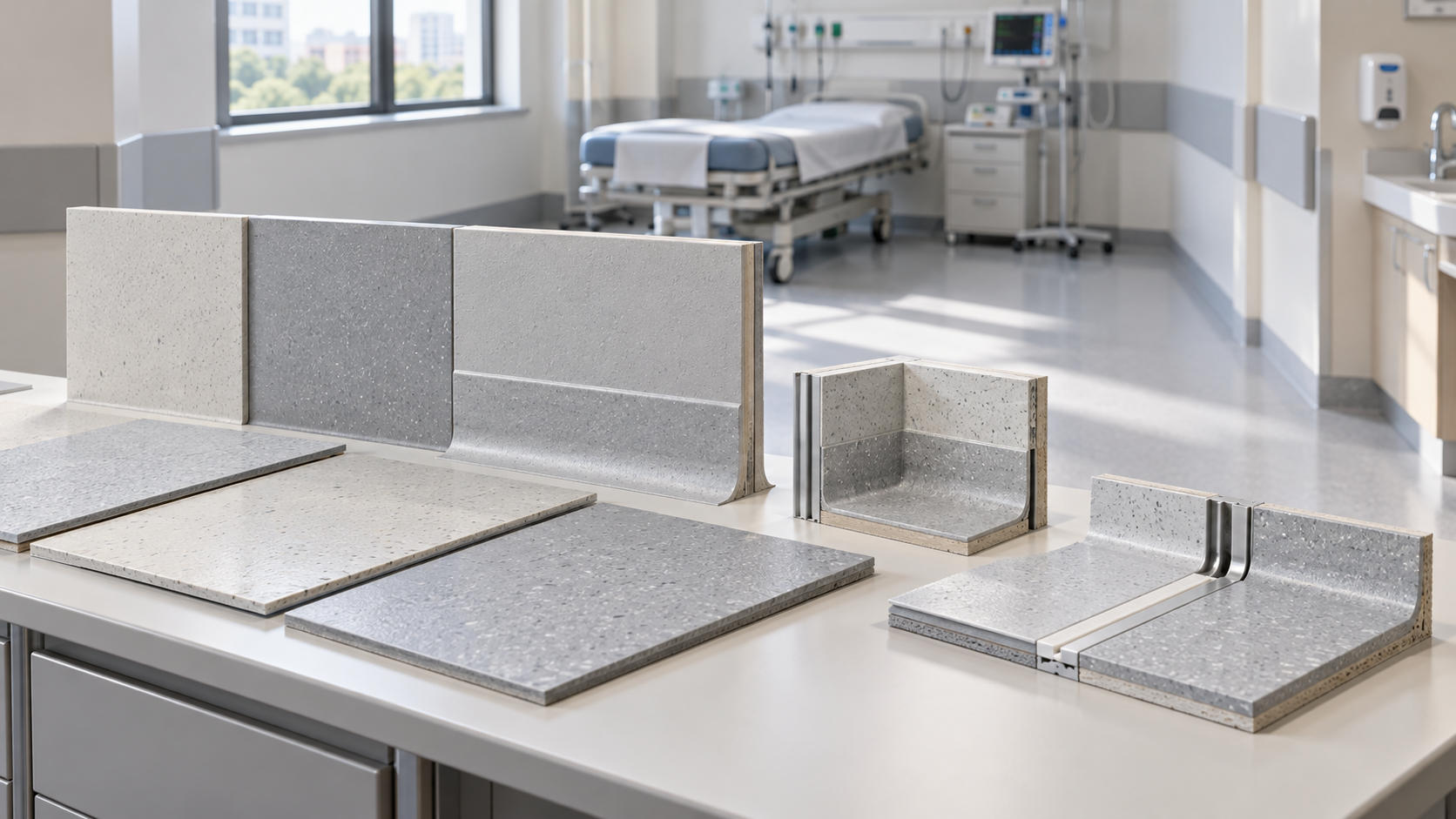
Choose healthcare material selection services by asking how the provider will turn clinical requirements into specifications that procurement can verify, price, and enforce. A useful service should connect material choices to cleaning protocols, installation details, maintenance capacity, and replacement access. Attractive samples and a large supplier network provide limited assurance if the hospital cannot establish how the finished installation will perform.
The value of specialist support is greatest where requirements compete: a refurbished ward that must reopen quickly, a bathroom requiring both slip resistance and practical cleaning, or a treatment area exposed to repeated disinfection. For procurement teams, the central decision is whether the provider can resolve those conflicts with evidence and accountable recommendations. Four areas deserve close examination: the scope of its service, the quality of its technical assessment, its approach to whole-life cost, and its control of substitutions through delivery.
Define the decisions the service must own
Before comparing proposals, establish which decisions remain unresolved. A hospital with an approved materials library may need targeted support for unavailable products or a new clinical use. A major fit-out may require a coordinated schedule covering floors, walls, ceilings, joinery, sanitary fixtures, adhesives, sealants, and their interfaces. These assignments require different levels of effort, and a generic consultancy fee can conceal the difference.
Organize the brief around room use and exposure. A public corridor, patient bathroom, examination room, and utility space do not impose identical demands. The provider should ask who uses each space, what equipment moves through it, how surfaces are cleaned, whether moisture is persistent, and how repairs can be undertaken. Areas with particular clinical or safety requirements need input from the relevant hospital specialists before materials are shortlisted.
A practical appointment should identify deliverables that can support purchasing decisions:
- A room-based requirements schedule linking material performance to intended use.
- A shortlist with reasons for selection, limitations, and acceptable alternatives.
- A document register showing the evidence reviewed and any gaps affecting approval.
- Installation and interface requirements that must enter the construction specification.
- A defined process for samples, mock-ups, substitutions, and final handover information.
Responsibility matters as much as the document list. Identify who recommends a product, who approves its clinical suitability, and who confirms compliance with applicable project requirements. The material adviser should work with the architect, infection prevention team, facilities staff, and relevant engineers. Its appointment should make clear where specialist input is needed and who resolves conflicting requirements.
For sanitary fixtures, for example, a material adviser may assess surface durability and cleaning access, while engineering and water safety specialists assess matters such as system compatibility and operational requirements. A recommendation that crosses these boundaries without coordination can leave procurement with a product that looks suitable on paper but cannot be approved for the intended location.
Test how the provider evaluates evidence
A strong selection process starts with the hospital’s actual operating conditions. Ask shortlisted providers to explain how they would evaluate a floor finish or wall protection system against a representative room brief. Their response should move beyond product descriptions and identify the evidence needed, its limitations, and any additional assessment required before approval.
Cleaning compatibility is a useful test of their approach. “Chemical resistant” is too broad to settle whether a surface suits a hospital’s cleaning regime. The assessment should consider the specified cleaning agents, concentrations, contact times, frequency of use, and relevant manufacturer instructions. Where evidence does not cover the intended exposure, the provider should identify the gap and propose a proportionate way to resolve it.
The same discipline applies to antimicrobial claims. Evidence of activity under defined laboratory conditions does not establish that an installed surface will reduce infections in a hospital. Procurement should expect the adviser to explain what a claim demonstrates, whether it is relevant to the application, and whether it changes the purchasing decision. Cleanability, intact surfaces, accessible joints, and compatibility with established cleaning procedures still require separate assessment.
Slip resistance also needs context. A reported result is useful only when its test method and conditions relate to the proposed location. A finish selected for a dry circulation route may require a different assessment in a shower area exposed to water and cleaning residues. Surface texture must also be considered alongside cleaning effort, wheelchair movement, and the handling of mobile equipment.
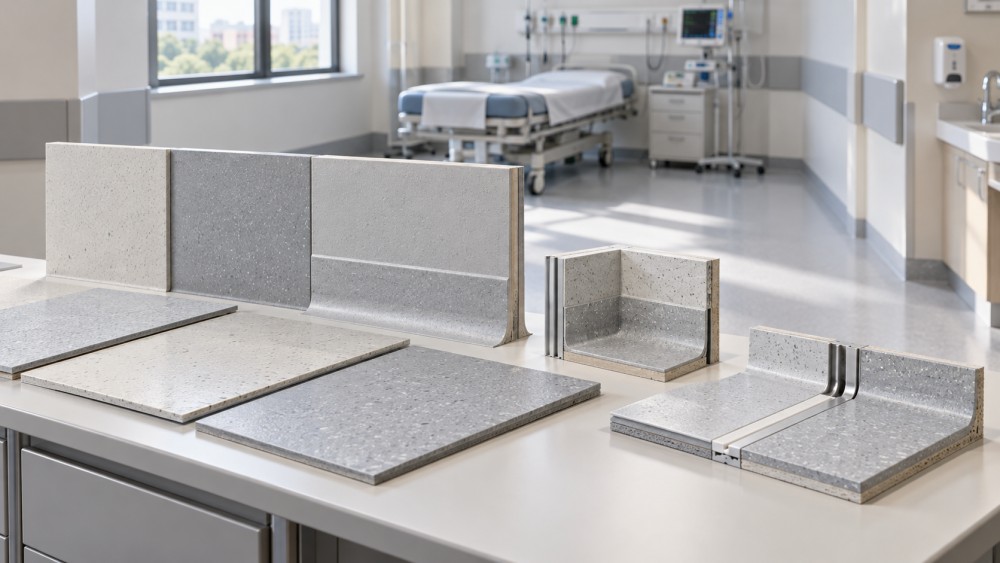
Ask the provider to trace one proposed material from the room requirement through the supporting evidence to the installation detail. This reveals whether its method addresses the complete assembly. A resilient floor finish depends on substrate preparation, moisture conditions, adhesive selection, joint treatment, and transitions. Wall protection depends on junctions, penetrations, impact exposure, and repair methods. Failures at these interfaces can undermine an otherwise suitable product.
Documentation should be specific enough to support that traceability. A certificate for a product family may not establish the performance of every finish, thickness, backing, or installation configuration. Reports should be checked against the exact proposed product and the property being assessed. Relevant fire performance, emissions, accessibility, and other requirements depend on the jurisdiction, building use, and assembly; the provider should identify which requirements apply and where specialist interpretation is necessary.
Samples and mock-ups help answer questions that documents cannot settle. A representative junction can expose awkward cleaning access, vulnerable edges, or conflicts between fixtures and finishes. Where evaluation includes cleaning, the procedure should be agreed with hospital staff and the manufacturer. Visual acceptance alone leaves operational questions unanswered.
A credible adviser will distinguish between a documented requirement, a supported recommendation, and an unresolved assumption. That distinction gives procurement a usable approval trail and prevents tentative choices from becoming fixed specifications without review.
Compare proposals through operational cost and service quality
The lowest consultancy fee may be appropriate for a tightly defined review with few interfaces. It becomes harder to judge when one proposal includes technical coordination and substitution assessment while another ends at a product schedule. Normalize the scope before comparing price, including the number of review stages, site involvement, stakeholder meetings, and support during procurement and installation.
Provider independence also deserves a direct question. Establish whether the service receives supplier commissions, referral payments, or other commercial benefits connected with recommended products. A commercial relationship does not automatically invalidate advice, but procurement needs visibility over it. The provider should be able to explain its selection criteria and assess credible alternatives when the project requires them.
Relevant experience should be demonstrated through reviewable work. Ask for appropriately anonymized examples of a requirements schedule, a material comparison, or a resolved technical query. These reveal more than a portfolio of finished interiors. Look for clear reasoning, recognition of limitations, and evidence that recommendations remained usable when handed to contractors and facilities teams.
Whole-life cost assessments should reflect the hospital’s operating model. Compare purchase and installation costs with cleaning effort, maintenance consumables, repairability, replacement access, and the disruption associated with failure. Where reliable cost inputs are unavailable, a transparent comparison of assumptions and likely consequences is more useful than a precise-looking total.
Consider a floor finish with a lower initial price but a maintenance regime that requires equipment or staffing the hospital does not have. Its apparent saving may disappear once those requirements are included. Conversely, a higher-priced finish may offer little practical benefit in a low-exposure space. The adviser should connect expenditure to the demands of each location.
Repair strategy is especially important in occupied hospitals. Ask whether a damaged section can be repaired locally, what access is needed, whether adjacent areas must close, and how the repair will affect appearance and cleanability. Procurement should also understand the availability of replacement components and the storage implications of holding spare material.
Environmental information belongs in the same decision process. An environmental product declaration can support assessment, but comparisons require compatible scope, assumptions, and declared units. Recycled content or a single environmental attribute cannot establish overall suitability. Durability, maintenance, replacement frequency, and the hospital’s ability to manage the product at end of use all influence its practical environmental value.
Make the service accountable through procurement and installation
A well-supported specification can lose its value when supply changes. Before appointing a provider, ask what happens if the preferred material becomes unavailable, arrives late, or is replaced by a contractor’s proposed equivalent. The answer should include a review process, the evidence required, and a named approval route.
“Equivalent” needs a project-specific meaning. Similar colour, dimensions, and headline performance may conceal differences in cleaning compatibility, installation method, maintenance needs, or repair options. An alternative adhesive, sealant, backing, or fixture component can also change the suitability of the wider assembly. Substitution reviews should revisit the requirements that justified the original selection.
The service proposal should state whether that work is included, how additional reviews are charged, and what response times the team can support. Unlimited informal advice is difficult to manage; a narrowly defined service that excludes foreseeable procurement questions can be equally problematic. Agree a realistic allowance and escalation process before the construction programme becomes dependent on rapid decisions.
Supply assessment should cover more than a quoted delivery date. For critical materials, establish the proposed source, availability assumptions, approval deadlines, and consequences of late replacement. Where alternate products are likely to be needed, assessing them early can reduce rushed decisions. Batch consistency and spare quantities also warrant attention where future repairs must match installed finishes.
Handover provides a final test of service quality. The hospital needs a record of what was installed, including approved substitutions, relevant product identifiers, cleaning instructions, maintenance requirements, and warranty conditions. Generic literature assembled at the end of the project may not describe the actual installation. Clarify who will verify and consolidate this information.
To make the final appointment, give each shortlisted provider the same representative room brief and request a concise explanation of its assessment process. Compare how clearly it identifies missing information, handles competing requirements, defines deliverables, and assigns responsibility. Then check whether its fee and programme support that promised level of involvement.
The strongest candidate will make a difficult purchasing decision easier to defend. Its recommendations should show why a material suits the room, which conditions must hold for it to perform, and what requires reassessment if the product or installation changes. That is the practical standard against which healthcare material selection services should be bought.
Industry Briefing
Get the top 5 industry headlines delivered to your inbox every morning.