
How Industrial Design Intelligence Helps Specify Materials for Durable Interiors
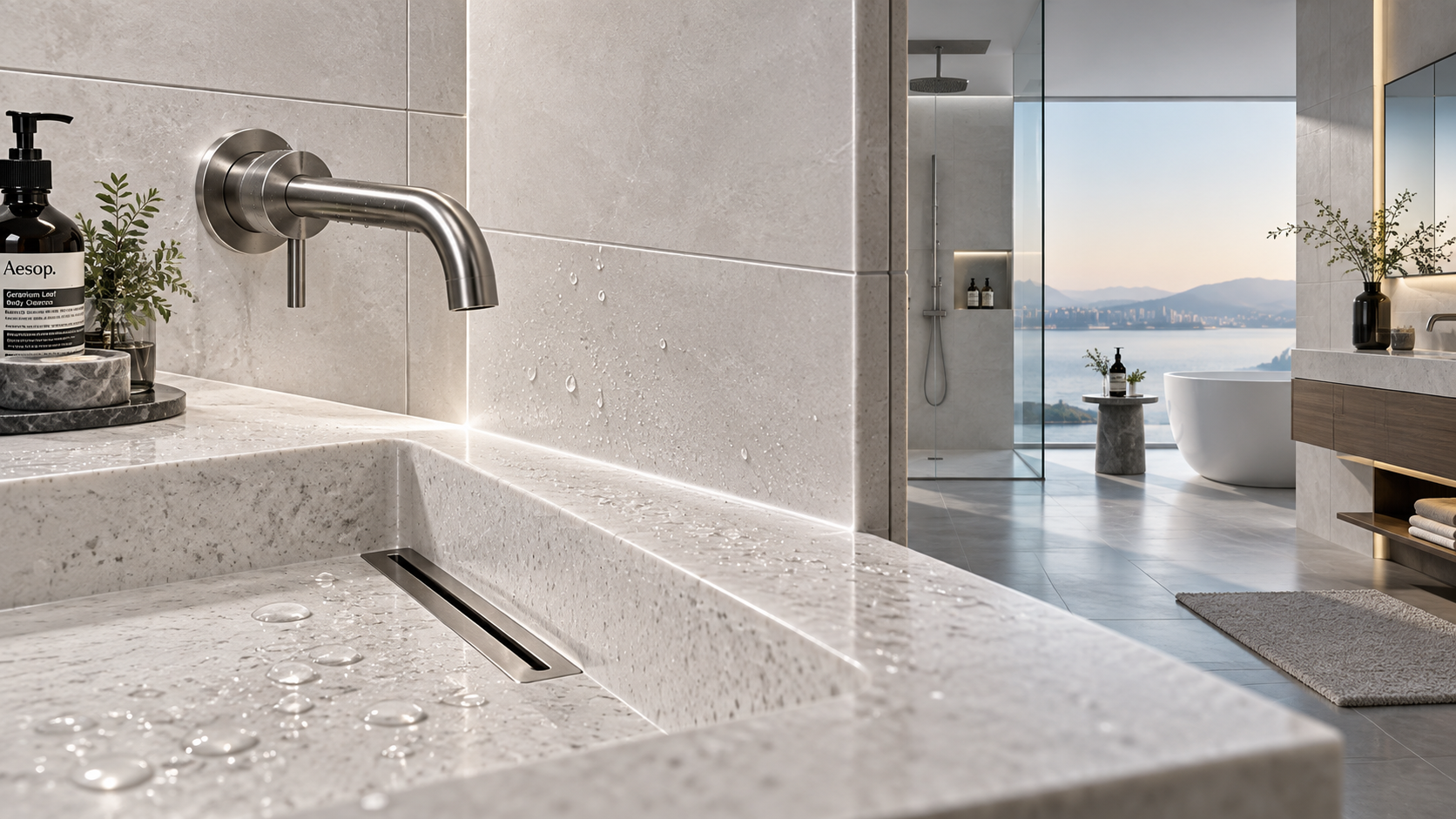
Durable interior specifications begin by defining the failure mode that matters in the actual space. A surface that performs well against dry abrasion may fail early when exposed to repeated cleaning, trapped moisture, thermal cycling, impact at edges, or movement in the supporting substrate. Industrial design intelligence for materials brings these conditions into one decision framework, so a finish is assessed as part of an installed assembly rather than as an isolated sample or a favorable line on a datasheet.
This distinction is especially important where interiors combine high-touch surfaces, wet zones, concealed fixings, smart hardware, and decorative finishes. Material selection must account for appearance retention, cleanability, repairability, compatibility between adjacent layers, and the practical limits of fabrication and installation. The result is a specification that states what must be achieved, how the material will be used, and which conditions invalidate an otherwise acceptable option.
Start with the exposure profile, not the material name
Terms such as porcelain, engineered stone, stainless steel, compact laminate, solid surface, powder-coated aluminum, or moisture-resistant board describe broad material families. They do not establish whether a particular product will remain serviceable in a particular interior. Composition, surface texture, backing, edge treatment, joint design, adhesive selection, and installation quality can change the outcome substantially.
A useful exposure profile separates the forces acting on each surface. A vanity top beside a basin faces water splash, cosmetics, cleaning chemicals, localized impact, and staining at penetrations. A corridor wall panel may receive repeated contact from bags and equipment, but little direct moisture. A kitchen cabinet front can be exposed to fingerprints, grease aerosol, steam, heat near appliances, and frequent wiping. Treating all three as “durable interior finishes” conceals the differences that determine performance.
Industrial design intelligence converts these observations into testable specification questions:
- Where does wear occur: across the open face, at a leading edge, around handles, at a seam, or at a transition to another material?
- Is contact occasional and accidental, or repetitive enough to polish, scratch, discolor, or loosen a finish over time?
- Will moisture remain on the surface briefly, enter a joint, condense behind a panel, or reach the substrate through a penetration?
- Which cleaning agents and cleaning methods are expected, including disinfectants, descalers, abrasive pads, steam, and dwell time?
- Can a damaged component be refinished, locally repaired, or replaced without dismantling the surrounding interior?
These questions expose a common error: selecting a material for its nominal resistance while ignoring the assembly feature where deterioration begins. A dense countertop material, for example, does not prevent damage if the faucet opening is poorly sealed, water reaches an absorbent core below, and swelling forces the surface layer upward. Similarly, a corrosion-resistant metal face can be undermined by incompatible fasteners, inaccessible drainage paths, or residue trapped at folded edges.
Read performance data in relation to construction
Material data should be interpreted as evidence with limits. Abrasion resistance says little about edge chipping. A water absorption value does not describe the behavior of an installed panel with exposed cutouts. Resistance to a particular chemical may apply only after a specified contact period, concentration, temperature, and cleaning procedure. Surface hardness can coexist with brittleness, while a softer material may offer better impact tolerance or easier repair.
The specification therefore needs to distinguish intrinsic material properties from system performance. Intrinsic properties include density, porosity, dimensional movement, hardness, thermal behavior, and chemical composition. System performance includes bond strength, joint movement capacity, backing stability, moisture control, anchoring, fabrication tolerances, and access for maintenance.
Performance claims also need a reference condition. A sample tested flat in a controlled setting is not equivalent to an installed surface subjected to uneven support, field-cut penetrations, variable adhesive coverage, and repeated movement at joints. Where a performance declaration is important to acceptance, the specification should identify the relevant specimen condition, exposure method, and allowable visual or functional change. Otherwise, different parties may assume different meanings for terms such as “stain resistant,” “waterproof,” or “scratch resistant.”
Durability is often governed by interfaces
Interior failures frequently begin where materials meet: the countertop-to-wall joint, tile-to-drain transition, panel-to-frame return, handle fixing, floor-to-threshold edge, or appliance cutout. These locations concentrate stress, cleaning residue, water, and tolerances. They also reveal whether different materials move at different rates under changes in temperature or humidity.
Consider a large-format ceramic wall surface. The ceramic itself may have strong resistance to wear and moisture, yet the installed finish can crack if the backing is unstable, movement joints are omitted, or adhesive coverage leaves voids. The remedy is not simply a “stronger tile.” It is a coordinated specification for substrate flatness, adhesive suitability, movement accommodation, edge protection, and control of penetrations.
The same logic applies to decorative panels. A high-pressure laminate face may remain intact while an exposed board edge expands near a sink, or while a mismatched sealant stains the perimeter. A metal trim can conceal an edge but create a water trap when its profile has no drainage route. Intelligence-led specification work maps these interfaces before final material selection, including the unseen components that establish long-term behavior.
Moisture needs a path analysis
Wet-area selection is often reduced to whether a finish absorbs water. That is incomplete. Moisture may arrive as direct splash, humid air, leaks at concealed connections, condensation on a cold surface, capillary movement at a narrow joint, or water retained during cleaning. Each route calls for a different control.
A non-absorbent surface is useful where direct splash is common, but it does not protect a vulnerable substrate if water can enter through a cut edge or fitting. A ventilated cavity can reduce persistent dampness behind wall cladding, but it requires a deliberate drainage and access strategy. Sealant may close a visible gap, yet it should not be expected to compensate for a substrate that moves beyond the sealant's intended capacity. The material schedule should identify where joints are decorative, where they are movement joints, and where they form part of the water-management system.
Appearance retention deserves its own criteria
Many interiors are replaced or repaired because they look worn before they lose structural function. Appearance retention is influenced by more than the initial color and gloss. Surface topology affects how fingerprints, limescale, grease, and fine scratches are perceived. A deeply textured matte finish may hide grazing scratches but retain cleaning residue. A dark polished surface can reveal wipe marks and micro-scratching quickly under directional lighting. Very light surfaces can conceal dust while making colored stains more obvious.
Selection should therefore reflect the lighting design, viewing distance, cleaning routine, and expected pattern of contact. A material sample examined under diffuse showroom light gives limited evidence for a reception counter under grazing architectural lighting or a shower wall exposed to mineral deposits. Where visual consistency matters, the review should include production variation, directional grain or veining, batch control, edge appearance after cutting, and the difference between factory-finished and field-finished surfaces.
Color and texture decisions also affect repair. A uniform solid surface may permit local refinishing, while a printed or strongly directional finish can make a small replacement conspicuous. A modular finish can simplify partial replacement, but the replacement batch may differ after extended time or exposure. Specifying spare material is only useful when it is stored under conditions that do not cause warping, discoloration, or damage to protective surfaces.
Match cleaning resistance to the maintenance regime
Cleaning is a material exposure, not a neutral background activity. Repeated use of alkaline cleaners, acidic descalers, alcohol-based products, oxidizing agents, or abrasive pads can alter gloss, soften some coatings, attack cementitious joints, discolor sealants, or leave a persistent film on textured surfaces. Conversely, a finish selected for chemical resistance may still be impractical if it requires cleaning methods unavailable in the space.
The relevant question is not whether a material tolerates one accidental spill. It is whether the complete surface and its joints tolerate the expected cleaning cycle without an unacceptable change in function or appearance. This includes contact duration, dilution, rinsing, water temperature, and mechanical action. For smart kitchen, bath, and access components, the assessment extends to labels, sensor windows, gaskets, touch surfaces, and the interfaces around electrical or hydraulic connections.
Maintenance instructions should align with the accepted material system. Vague wording such as “use suitable cleaner” transfers uncertainty downstream. More useful language identifies prohibited cleaner categories, required rinsing where applicable, restrictions on abrasive tools, and the treatment of stubborn deposits. That level of clarity prevents a durable material from being paired with a cleaning practice that slowly degrades it.
Use prototypes to test the unresolved condition
Full-scale mock-ups are most valuable when they test a detail that documents cannot settle. A sample wall can reveal whether grout color changes after repeated wetting, whether a trim profile catches light unevenly, whether a recessed shelf drains, or whether panel joints remain visually aligned through construction tolerances. A cabinet prototype can expose handle clearance, steam behavior near appliance openings, and whether a selected surface is realistic to clean around hardware.
Testing should target the highest-consequence uncertainty rather than merely confirm the best-looking sample. If the concern is a panel edge at a basin, the prototype needs the cut edge, backing, adhesive, sealant, fixing, and expected water exposure. Testing an uncut face specimen will not answer the relevant question. Likewise, a tile mock-up without transitions, penetrations, or substrate movement cannot validate the installed assembly.
Acceptance criteria need to be agreed before the mock-up is reviewed. They can address joint alignment, edge quality, water drainage, visible residue after cleaning, surface damage, movement at interfaces, or accessibility for replacement. Without stated criteria, approval becomes subjective and a later dispute may be framed as a change in expectation rather than a genuine performance issue.
Translate intelligence into a durable specification record
A durable material specification is a controlled record of design intent and verified constraints. It should link each finish to its location, substrate, thickness or construction, finish direction, edge treatment, joint treatment, compatible adhesive or fixing method, required protections during transport and installation, and cleaning limitations. When a material is used in several exposure zones, one generic line item can conceal important differences. The same panel finish may need distinct detailing at a dry wall, a service corridor, and a wet-room perimeter.
Substitutions require the same level of review as the original selection. Similar color, thickness, or nominal material family does not establish equivalence. A substitute may use a different core, coating system, resin content, backing, fabrication method, or dimensional behavior. Changes at this stage should be assessed against the original exposure profile and interface details, especially where related components have already been ordered or installed.
Installation sequencing also affects material life. Finishes can be damaged when heavy work continues after protective films are removed, when wet trades raise local humidity around susceptible boards, or when protective coverings trap moisture against a surface. Completed work needs protection that is compatible with the finish and does not transfer adhesive, plasticizer, dye, or moisture. Handover should include the actual material references and maintenance conditions, not only the visual finish schedule.
Industrial design intelligence for materials is valuable because it connects evidence that is often separated: product properties, fabrication constraints, exposure conditions, interface behavior, cleaning practice, and future replacement. When these are considered together, durable interiors are specified with fewer hidden assumptions and a clearer basis for resolving material changes before they become installed defects.
Industry Briefing
Get the top 5 industry headlines delivered to your inbox every morning.