
How to Evaluate Smart Home Building Materials Manufacturers for Large Projects
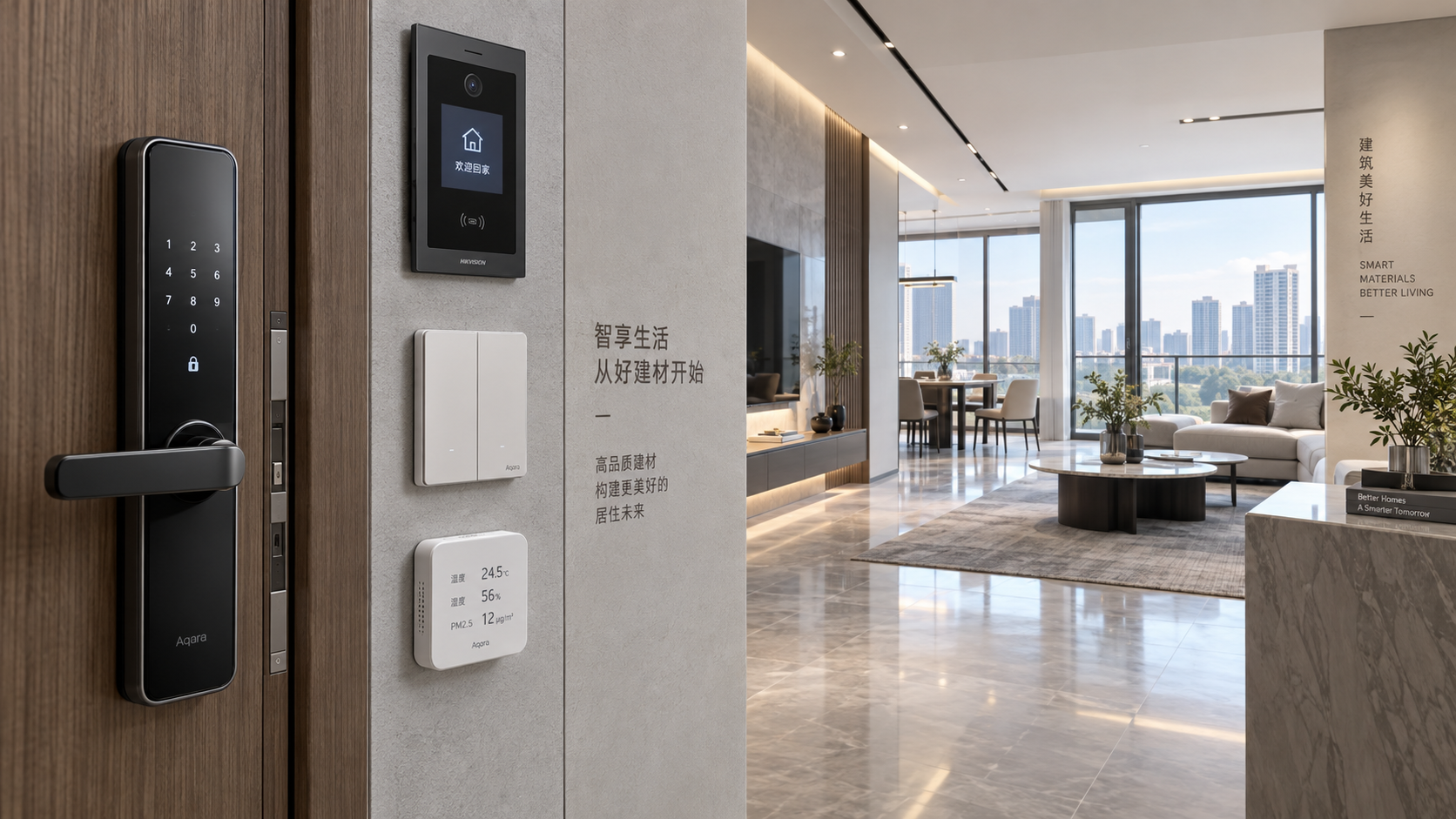
Large projects rarely fail because a smart lock, sensor, switch, or connected bathroom fitting looked inadequate in a showroom. They fail when individually acceptable products cannot be commissioned as one operating environment, when delivery changes arrive after drawings are frozen, or when the manufacturer disappears from the project once the goods leave the factory.
A smart home building materials manufacturer should therefore be evaluated as a project partner with product responsibility, interface responsibility, and service responsibility—not simply as a supplier of connected devices. The central question is whether the manufacturer can deliver a defined, compliant, maintainable package through the project’s full sequence: design coordination, sample approval, factory production, logistics, installation support, commissioning, handover, and defect liability.
This distinction matters most in multi-unit residential developments, hotels, mixed-use schemes, senior-living projects, and commercial spaces where smart locks, access panels, lighting controls, motorized shading, environmental sensors, connected sanitary products, smart mirrors, kitchen systems, and building materials may all interact with the same electrical, network, and interior-finishing constraints.
Start with the project boundary, not the catalog
The term smart home building materials manufacturer can cover very different businesses. One supplier may manufacture wireless switches and gateways; another may make doors, hardware, glazing, cabinetry, or sanitary products with embedded electronics; a third may assemble purchased components under its own brand. These models carry different technical and commercial risks.
Before comparing suppliers, the project package needs a clear boundary. Identify which products are expected to be supplied, who owns the control logic, who provides the network infrastructure, and who is accountable when a device does not operate after installation. A “smart bathroom” package, for example, may involve power supplies, waterproofing interfaces, wall backing, concealed plumbing, ventilation, controls, sensors, and a mobile application. Treating this as a single product purchase can leave critical installation scopes unassigned.
A practical scope definition should establish:
- the products included in the manufacturer’s supply;
- the approved control protocol or required integration method;
- electrical, low-voltage, plumbing, structural, and finishing interfaces;
- the party responsible for gateways, cloud services, local controllers, and network configuration;
- installation prerequisites and tolerances;
- the acceptance criteria for operation, appearance, safety, and documentation;
- the support period after handover and the escalation route for faults.
If a manufacturer cannot define these boundaries in writing, the proposal may be commercially attractive but remains difficult to administer on site. Ambiguous interfaces are especially dangerous where the building contractor, electrical contractor, low-voltage integrator, interior fit-out contractor, and device supplier work under separate contracts.
Test system compatibility at drawing stage
Technical compatibility is more than confirming that a device can connect to Wi-Fi or that an application is available in an app store. The relevant question is whether the proposed system can operate reliably within the project’s actual architecture.
For connected products, request a complete topology showing devices, gateways, controllers, routers, cloud platforms, and user interfaces. It should identify the protocol used by each layer—such as wired bus systems, Ethernet, Wi-Fi, Bluetooth, Zigbee, Z-Wave, Thread, Matter, or proprietary radio—and explain how the system behaves if internet access is interrupted. A project should not assume that “smart” means interoperable. Products carrying a common connectivity label may still require a vendor-specific gateway, account structure, commissioning tool, or firmware ecosystem.
Local operation deserves particular attention. Door access, essential lighting, bathroom safety alerts, and basic environmental controls may need to function when cloud connectivity is unavailable. A manufacturer should be able to distinguish between functions that operate locally and those dependent on remote servers. It should also explain what happens after a router replacement, tenant turnover, password reset, power outage, or firmware update.
Physical interfaces are equally important. Smart devices often create requirements that standard finishes do not reveal until installation: deeper back boxes, neutral conductors at switch locations, service access above ceilings, waterproof junction boxes, dedicated circuits, transformer locations, cabinet ventilation, backing plates, or precise door and frame preparation. For smart glazing, shading, mirrors, sanitary systems, or kitchen appliances, the electrical and mechanical coordination can affect fabrication drawings long before a device is delivered.
Manufacturers should provide coordinated drawings, installation details, connection diagrams, load requirements, mounting tolerances, and maintenance-clearance requirements early enough to be incorporated into construction documents. A generic brochure is not a substitute for approved-for-construction information.
Examine whether the manufacturer owns the technology it is selling
The degree of technical control held by a manufacturer affects both continuity and troubleshooting. A business that designs its own electronics, firmware, and software may control updates and fault analysis more directly. A business that integrates third-party modules may be entirely capable, but the dependency chain must be visible.
The important issue is not whether every component is made in one factory. Modern smart-building products often rely on specialized chipsets, wireless modules, power supplies, and cloud infrastructure. The issue is whether the supplier can identify those dependencies, manage substitutions, and remain accountable if an upstream component changes.
Useful technical due-diligence questions include:
- Which components are proprietary, and which are sourced from external vendors?
- Can a wireless module, controller, battery, actuator, or display be changed without affecting certifications, dimensions, or system behavior?
- Who maintains the firmware and mobile software?
- How are software releases tested before deployment to occupied units?
- Can the system be commissioned and serviced without permanent reliance on a single installer or cloud account?
- What is the expected availability period for replacement parts and compatible controllers?
A manufacturer that responds only with broad claims of “full compatibility” or “easy integration” has not yet provided enough information for a project decision. Compatibility should be demonstrated against the specified system, not inferred from marketing language.
Separate certificates from project compliance
Certificates are necessary evidence, but they do not automatically prove that a product is lawful or suitable for a particular project. Compliance depends on the destination market, product category, installation context, and applicable building, electrical, fire, water, accessibility, and data-protection requirements.
For electrical and connected products, project teams should verify the relevant product safety and electromagnetic compatibility evidence for the market of installation. Radio-enabled equipment also requires appropriate radio compliance. In the European Economic Area, depending on the product and applicable legislation, this may involve obligations associated with CE marking, including electrical safety, electromagnetic compatibility, and radio equipment requirements. In the United States and Canada, the applicable listing or certification route depends on the equipment and local code requirements; a mark accepted in one jurisdiction should not be assumed sufficient in another.
Building-material claims require the same discipline. Fire performance, slip resistance, water resistance, corrosion resistance, load capacity, thermal performance, indoor-air-emissions declarations, and antimicrobial claims must correspond to a recognized test method and the exact product construction proposed. A test report for a decorative surface does not necessarily validate the complete installed assembly. Nor does a certificate for one voltage, finish, factory, or model automatically cover a revised version.
Ask for a controlled compliance register rather than a folder of certificates. The register should link each proposed model, component revision, manufacturing site, and intended market to its supporting evidence. It should identify expiration dates where applicable and clarify whether reports are issued to the manufacturer, an affiliate, or an unrelated component supplier.
For projects with sustainability requirements, environmental documentation should also be assessed for relevance rather than simply counted. Environmental Product Declarations, material-health documentation, recycled-content claims, forestry certifications for wood-based products, and declarations concerning restricted substances can support assessment, but only when they relate to the exact product and recognized program requirements. A sustainability statement without product-level traceability is weak evidence for a controlled project submittal.
Assess production control through the change-management process
Large projects are exposed not only to defective products, but also to undocumented changes. A manufacturer may substitute an internal module because of component availability, change a finish batch, revise a power supply, move production, or update firmware. Some changes are harmless; others alter fit, compliance, wireless performance, serviceability, or appearance.
The manufacturer should have a documented process for engineering changes and material substitutions. The process should state which changes trigger notification, what supporting documentation is required, who approves the deviation, and how revised products are identified in packing, serial records, and as-built documentation.
Factory capability should be evaluated against the package being purchased, not through a general statement of annual capacity. Review whether the supplier can produce the specified finish, configuration, voltage, language version, access credential format, and regional certification variant at the required sequence. A supplier capable of producing a high volume of standard devices may still struggle with phased, unit-specific, or hospitality-grade orders that require room labeling, keying schedules, pre-programming, and sequenced delivery.
Quality assurance should extend beyond final visual inspection. Depending on the product, relevant controls may include incoming component verification, functional testing, electrical safety tests, water-tightness or pressure tests, finish inspection under agreed conditions, firmware version control, and traceability by batch or serial number. For smart locks and access products, a record linking the device identifier, firmware version, and installed location can materially reduce later fault-finding time.
Delivery reliability is a coordination issue, not merely a shipping issue
Lead time should be evaluated as a chain of commitments: design release, sample approval, procurement of critical components, production, inspection, export packing, transport, customs clearance, site receipt, and release to installers. A quoted factory lead time often excludes several of these events.
For imported smart building materials, packaging and documentation matter as much as manufacturing readiness. Connected products may include batteries, electronic modules, delicate finishes, glass, ceramic components, or pre-programmed equipment. Packaging must protect the goods while allowing site teams to identify the correct building, floor, room, and installation phase without opening every carton.
A robust delivery plan should specify:
- the approved production release date and any long-lead components;
- inspection hold points before shipment;
- shipping terms and responsibility for insurance, customs documents, and local clearance;
- delivery sequencing by zone, unit type, or installation trade;
- rules for partial shipment, overage, spare parts, and damaged-goods replacement;
- procedures for protecting software configuration and credentials during transport and site storage.
Price comparisons become misleading when one quotation includes only ex-factory goods while another includes programming, labeling, site support, spares, and delivered-duty arrangements. The project comparison should normalize commercial scope before judging the unit price.
Require samples that prove installation, not only appearance
A finish sample can establish color, texture, and visual quality. It cannot establish whether the smart product works in the intended wall build-up, door construction, cabinet layout, wet-area condition, or network environment. Complex packages need a representative mock-up or pilot installation that includes the relevant trades and interfaces.
The mock-up should test the conditions most likely to create rework: mounting alignment, cable routing, device pairing, gateway coverage, response after power restoration, operation without internet access where required, interaction with fire or access-control systems, cleaning exposure, and maintenance access. The goal is not to prove every possible failure scenario; it is to turn unresolved interfaces into decisions before repetition across hundreds of units.
Acceptance criteria should be defined before the mock-up is reviewed. “Working correctly” is too vague for a contractual milestone. A meaningful acceptance record identifies the functions tested, the software and firmware versions used, the approved finishes, visible tolerances, required documents, open defects, and the conditions under which final production can proceed.
Service capability determines the real lifecycle cost
Smart materials introduce a longer obligation than conventional finishes because functionality can depend on software, credentials, batteries, controllers, sensors, and communication paths. Warranty wording should distinguish material defects, manufacturing defects, installation-related defects, software defects, connectivity failures, and failures caused by third-party networks or platforms. Without this distinction, fault responsibility can pass between multiple parties while the asset remains unusable.
Evaluate whether the manufacturer has a defined support model in the project location or can provide one through an accountable service partner. Response times, languages, remote-diagnostic capability, spare-parts holdings, training, and escalation procedures should be contractually visible where the package is critical to occupancy or operations.
Cybersecurity and data ownership should be reviewed proportionately. Products that collect occupancy patterns, access logs, video, voice data, or health-related information create different governance concerns from a locally controlled smart dimmer. The manufacturer should identify what data is collected, where it is stored, who can access it, how accounts are transferred at handover, how credentials are revoked, and how security updates are issued. A building owner should not discover after completion that routine operation requires an installer’s personal account or an untransferable cloud subscription.
Make the final decision on controlled evidence
The strongest manufacturer is not necessarily the one with the largest product range or the lowest initial quotation. It is the one that can demonstrate control over the project’s specific risks: integration, compliance, production consistency, delivery sequencing, commissioning, and post-handover support.
A disciplined evaluation should place greater weight on evidence that can be checked: coordinated technical submittals, valid certificates linked to exact models, documented interface matrices, prototype results, change-control procedures, production traceability, delivery plans, warranty boundaries, and service commitments. Catalog breadth and polished demonstrations can support the decision, but they cannot replace these controls.
For large developments, selecting a smart home building materials manufacturer is ultimately an exercise in reducing uncertainty before it becomes site rework, delayed handover, or an unsupported installed system. The manufacturer that makes its dependencies, limits, responsibilities, and operating requirements visible is often the safer choice than one that promises simplicity without showing how it will be delivered.
Industry Briefing
Get the top 5 industry headlines delivered to your inbox every morning.