
Modular Building Systems vs Traditional Construction: Which Fits Faster Delivery and Site Constraints?
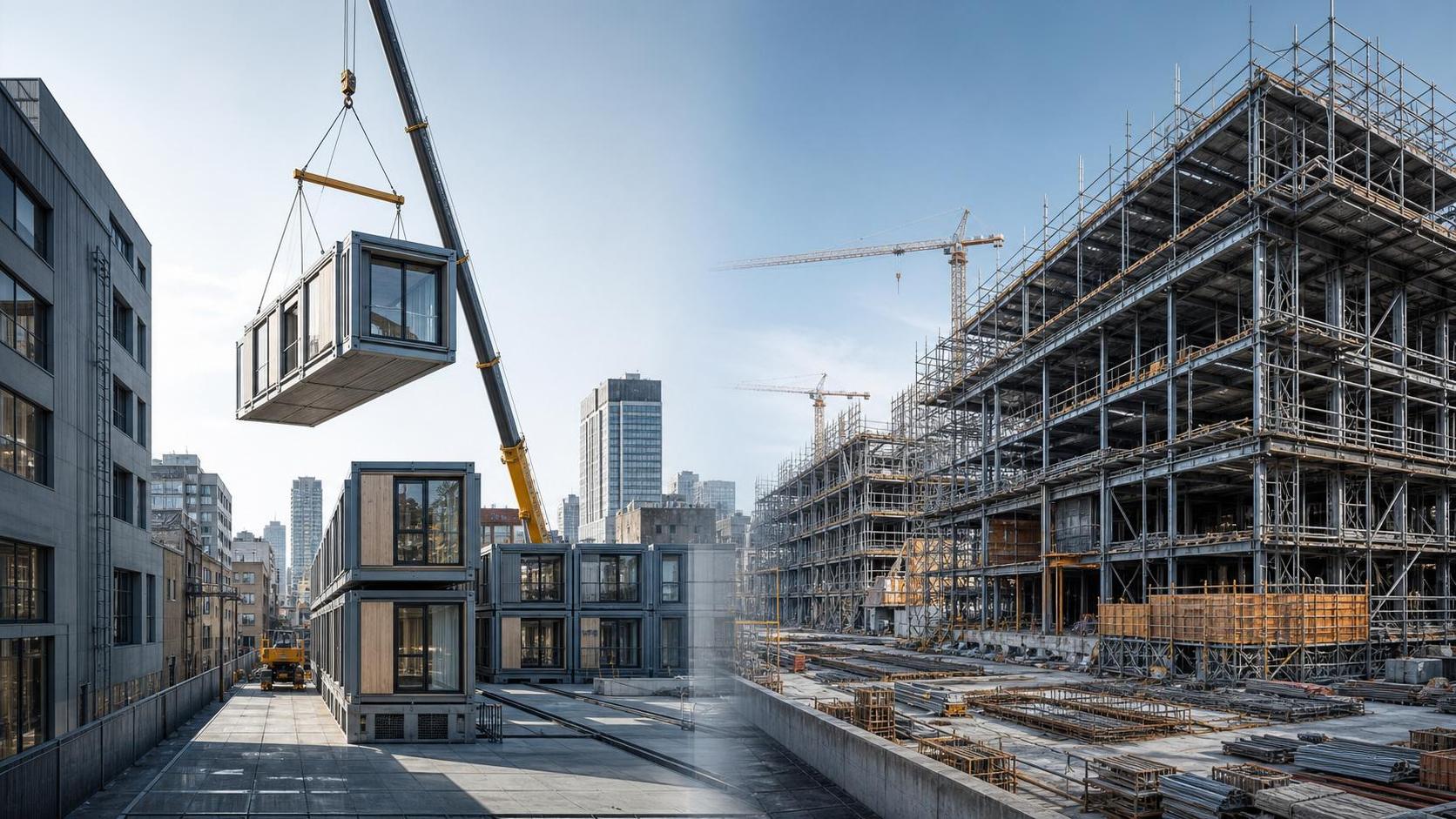
Modular Building Systems vs Traditional Construction: Which Fits Faster Delivery and Site Constraints?
When schedules tighten, the construction method becomes a delivery decision, not just a design choice.
That is why modular building systems now sit in more early-stage planning meetings.
They promise shorter timelines, less site disruption, and better control in constrained conditions.
Traditional construction still remains the default for many complex projects.
It offers flexibility during execution and fits teams used to conventional sequencing.
The better choice depends on delivery pressure, logistics, design stability, and how much uncertainty the site can absorb.
Why the comparison matters more now
Recent market changes have made construction planning less forgiving.
Labor shortages, urban access limits, noise controls, and financing pressure all raise the cost of delay.
In that context, modular building systems are not only about prefabrication speed.
They are also about reducing on-site variables that often damage schedule certainty.
Traditional construction, however, can still outperform when scope keeps moving or transport conditions are difficult.
What modular building systems actually change
Modular building systems shift more work into controlled factory settings.
Structure, MEP coordination, interior fit-out, and quality checks can happen before modules arrive on site.
That compresses the field schedule because foundation work and off-site production can overlap.
Traditional construction follows a more sequential pattern.
Trades wait on access, weather, inspections, and one another.
This does not always mean slower overall delivery, but it usually means more site-driven risk.
Where time savings usually come from
- Parallel workflows between site preparation and module fabrication
- Fewer weather-related stoppages during enclosure and interior work
- Less trade congestion in tight urban or occupied locations
- Shorter punch-list periods from standardized assembly and testing
For projects with a fixed opening date, these gains can be commercially significant.
Speed is important, but site constraints decide the real fit
Fast delivery matters, yet site conditions often decide whether modular building systems are practical.
A constrained site can favor modular construction, but only if access planning is strong.
Large modules need transport clearances, crane windows, storage sequencing, and tight installation control.
If those conditions are achievable, modular building systems can sharply reduce site footprint and labor density.
If not, traditional construction may create fewer logistical bottlenecks.
Site conditions that often favor modular building systems
- Dense urban plots with limited laydown space
- Operational campuses where disruption must stay low
- Remote sites with unstable local labor availability
- Hospitality, housing, healthcare, or student living with repeated unit types
Site conditions that may favor traditional construction
- Irregular structures with low repetition
- Sites with difficult transport routes or crane restrictions
- Projects with frequent client-driven design changes
- Phased builds where scope is still being defined
Cost comparison needs a wider lens
Many teams compare modular building systems and traditional construction through direct capital cost only.
That is usually too narrow.
Modular building systems may carry higher early engineering and manufacturing commitments.
Yet they can reduce preliminaries, rework, site supervision pressure, and financing exposure from late delivery.
Traditional construction may look cheaper at tender stage.
But variable field productivity can push final cost higher than expected.
Evaluate total cost, not only unit price
Quality, coordination, and risk control
Quality discussions around modular building systems are more mature than they were a few years ago.
Factory conditions support repeatable tolerances, documented inspections, and better material protection.
That can improve bathroom pods, utility racks, façade assemblies, and repeated room layouts.
Still, modular building systems do not remove coordination risk.
They move it earlier, where decisions about interfaces become critical.
Traditional construction allows more adjustment in the field, but often at the cost of consistency.
Common risk points to test before choosing
- Design freeze timing and approval discipline
- Transport route surveys and permit lead times
- Tolerance management between modules and base structure
- Supplier capacity, quality records, and contingency options
- Fire, acoustic, waterproofing, and service integration compliance
When modular building systems are the stronger decision
The strongest case appears when time certainty matters more than late-stage flexibility.
Modular building systems often perform well in repeatable, service-heavy environments.
Hotels, student housing, clinics, worker accommodation, and multifamily projects are common examples.
They also fit projects where local site labor is scarce or difficult to stabilize.
In these cases, modular building systems can reduce uncertainty across schedule, quality, and installation sequencing.
When traditional construction still makes better sense
Traditional construction remains the better route for some projects.
Highly customized buildings often benefit from field-led coordination and more adaptive sequencing.
This is especially true when architecture changes are still likely.
The same applies when transport dimensions, access roads, or lifting plans weaken the modular business case.
If repeatability is low, the benefits of modular building systems may not outweigh setup complexity.
A practical decision framework
A good selection process should test method fit early, before design and procurement go too far.
In practice, five questions usually clarify the direction.
- Is the completion date fixed, revenue-linked, or politically sensitive?
- How repetitive are rooms, service zones, or structural bays?
- Can the team freeze interfaces early enough for modular building systems?
- Do access, crane, and transport studies support off-site delivery?
- What costs emerge if site disruption, delay, or labor instability increases?
If most answers point toward certainty, repetition, and limited site tolerance, modular building systems deserve serious priority.
If the answers point toward changeability and irregular execution, traditional construction may stay ahead.
Final takeaway
There is no universal winner between modular building systems and traditional construction.
The better method is the one that matches site reality, schedule risk, and design maturity.
For projects facing compressed delivery and constrained working conditions, modular building systems often create a stronger control model.
For projects that need ongoing flexibility, traditional construction can still be the more resilient path.
The key is to evaluate both methods through execution risk, not habit.
That approach leads to better delivery decisions, clearer procurement strategy, and fewer surprises once work begins.
Industry Briefing
Get the top 5 industry headlines delivered to your inbox every morning.