
Smart Building Solutions for Multi-Site Properties: Integration Priorities and Common Pitfalls
Smart Building Solutions for Multi-Site Properties: Integration Priorities and Common Pitfalls
For enterprises managing multiple locations, smart building solutions are no longer optional. They now shape operating cost, service quality, security posture, and long-term property value.
That shift is especially clear across offices, retail chains, healthcare campuses, hospitality groups, and mixed-use portfolios. Leaders want connected buildings, but they also want control, speed, and measurable returns.
The problem is not access to technology. The real challenge is deciding what to integrate first, what to standardize, and where common mistakes quietly erode value.
In practice, smart building solutions work best when they connect business priorities with building infrastructure. That means fewer silos, cleaner data, stronger governance, and a rollout model that scales from one site to many.
Why Multi-Site Portfolios Need a Different Integration Strategy
A single building can tolerate some inconsistency. A portfolio cannot. Once systems vary too much across sites, operating complexity rises fast.
Different vendors, aging controllers, fragmented access platforms, and uneven maintenance practices create blind spots. Those blind spots make energy management, security response, and capital planning far harder than they should be.
This is why smart building solutions for multi-site properties must start with interoperability. If systems cannot share usable data, dashboards become cosmetic rather than operational.
From a business perspective, the goal is simple. Build one operating logic across many properties, while keeping enough flexibility for local needs, regulations, and asset conditions.
The Integration Priorities That Deliver the Fastest Value
Not every connected system deserves equal urgency. The smartest path is to prioritize functions that improve visibility, reduce waste, and strengthen resilience across every site.
1. Build a Unified Data Layer First
Before adding more devices, create a shared data foundation. This is the backbone of effective smart building solutions.
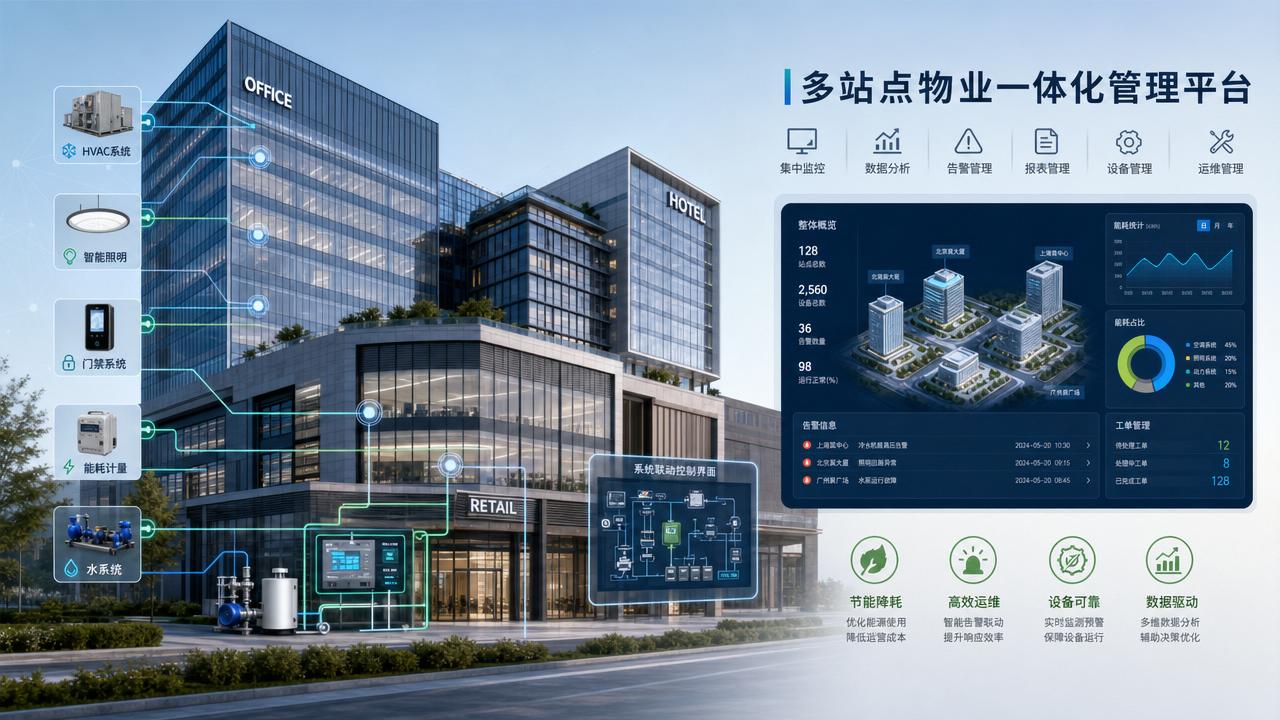
A unified data layer connects HVAC, lighting, occupancy sensors, access control, water systems, and metering into one operational view. It also reduces duplicate reporting and manual reconciliation.
Without this step, every later upgrade becomes more expensive. Teams spend time translating data instead of acting on it.
2. Standardize Energy and Environmental Monitoring
Energy is usually the quickest path to visible ROI. That is why many smart building solutions begin with utility intelligence and environmental controls.
Standardized monitoring helps compare buildings fairly. It shows which properties waste energy, which equipment underperforms, and where schedules no longer match occupancy patterns.
It also supports carbon reporting and compliance planning. For organizations under pressure to cut emissions, that matters as much as cost reduction.
3. Connect Security With Facility Operations
Security can no longer operate in isolation. Access control, visitor flow, surveillance alerts, and emergency workflows should connect with broader building operations.
When smart building solutions link security and facilities, incident response becomes faster. Occupancy anomalies can trigger ventilation changes, lockdown procedures, or after-hours checks automatically.
This kind of integration also improves audit readiness. Decision-makers gain a clearer view of policy enforcement across locations.
4. Prioritize Remote Management and Predictive Maintenance
Multi-site properties rarely have equal onsite expertise. Remote visibility helps central teams support local operations without increasing headcount at every building.
Predictive maintenance adds another layer of value. Instead of waiting for failure, smart building solutions can flag performance drift, abnormal runtime, or water loss before disruption spreads.
That reduces emergency repair costs and helps extend equipment life. Over a large portfolio, those savings compound quickly.
A Practical Rollout Model for Smart Building Solutions
A workable rollout plan is usually more valuable than an ambitious technology list. In real projects, pacing and governance determine whether integration succeeds.
- Audit every site’s current systems, protocols, asset age, and network readiness.
- Define a portfolio-wide architecture with open standards and clear data ownership.
- Select one or two pilot sites that represent typical operational conditions.
- Measure outcomes using energy, response time, downtime, and labor indicators.
- Refine templates, then scale in waves rather than upgrading all sites at once.
This phased model keeps risk manageable. It also prevents costly surprises around legacy equipment, integration gaps, or unrealistic internal timelines.
The strongest smart building solutions programs treat pilots as learning engines, not marketing showcases. What matters is repeatability across the whole estate.
Common Pitfalls That Undermine Multi-Site Integration
Most failures do not come from a lack of technology. They come from unclear priorities, weak coordination, and a mismatch between vendor promises and operational reality.
Treating Every Building the Same
Portfolio standards are necessary, but identical deployment plans are not. Buildings differ in age, occupancy profile, mechanical condition, and digital maturity.
Effective smart building solutions balance standardization with site-specific adaptation. Otherwise, some sites become over-engineered while others remain underconnected.
Focusing on Hardware Before Outcomes
Buying more sensors does not guarantee better performance. If outcome metrics are vague, integrations often drift into feature accumulation.
Start with operational questions. Which sites have the highest energy variance? Where are response times too slow? Which assets fail repeatedly? Smart building solutions should answer those problems directly.
Ignoring Cybersecurity and Access Governance
Connected buildings expand the attack surface. Every gateway, controller, remote login, and third-party connection needs governance.
This is where many smart building solutions projects fall short. Security reviews happen late, access rights stay broad, and vendor dependencies remain poorly documented.
A better approach includes network segmentation, role-based permissions, lifecycle patching, and documented escalation paths from day one.
Underestimating Change Management
Even the best platform fails if teams do not trust it or use it consistently. Local facility teams often need new workflows, not just new dashboards.
Smart building solutions should come with training, reporting routines, and clear accountability. Adoption is an operational design issue, not a side task.
How to Evaluate Vendors and Platforms More Effectively
Vendor evaluation should go beyond product demos. In multi-site environments, integration quality matters more than interface polish.
- Ask which protocols and legacy systems the platform already supports.
- Check whether portfolio reporting works across different building types.
- Confirm how alarms, permissions, and device updates are governed centrally.
- Review cybersecurity practices, service coverage, and long-term support capacity.
- Request proof of measurable outcomes from comparable multi-site deployments.
This is also where intelligence platforms like GIAM add value. Better market visibility helps teams compare technical pathways, regulatory trends, and category innovation with less guesswork.
For organizations tracking green materials, water-saving systems, smart locks, and connected sanitary or kitchen environments, that broader context supports better investment timing.
What Stronger Integration Looks Like in Practice
The best smart building solutions do not simply connect devices. They create a stable operating model across the property lifecycle.
That means capital planning uses live asset insights. Energy teams use real occupancy patterns. Security teams coordinate with facilities. Local managers act faster because information arrives in context.
More importantly, leadership gains a portfolio view that supports strategic decisions. Which sites deserve retrofit funding? Which technologies scale well? Where are the hidden operational risks?
When those questions can be answered clearly, smart building solutions stop being isolated projects. They become a durable framework for efficiency, resilience, and brand value.
Final Takeaway
For multi-site properties, the path forward is not to digitize everything at once. It is to connect the right systems in the right order.
Start with data architecture, energy visibility, security integration, and remote maintenance. Then scale with governance, measurable outcomes, and realistic rollout waves.
Enterprises that take this approach are more likely to avoid silos, control costs, and unlock lasting value from smart building solutions.
The next practical step is simple: map your current systems, rank the highest-friction sites, and build an integration roadmap that reflects both operational reality and long-term portfolio goals.
Industry Briefing
Get the top 5 industry headlines delivered to your inbox every morning.