
What Are Industrial Foundations and Which Types Fit Heavy Equipment Projects?
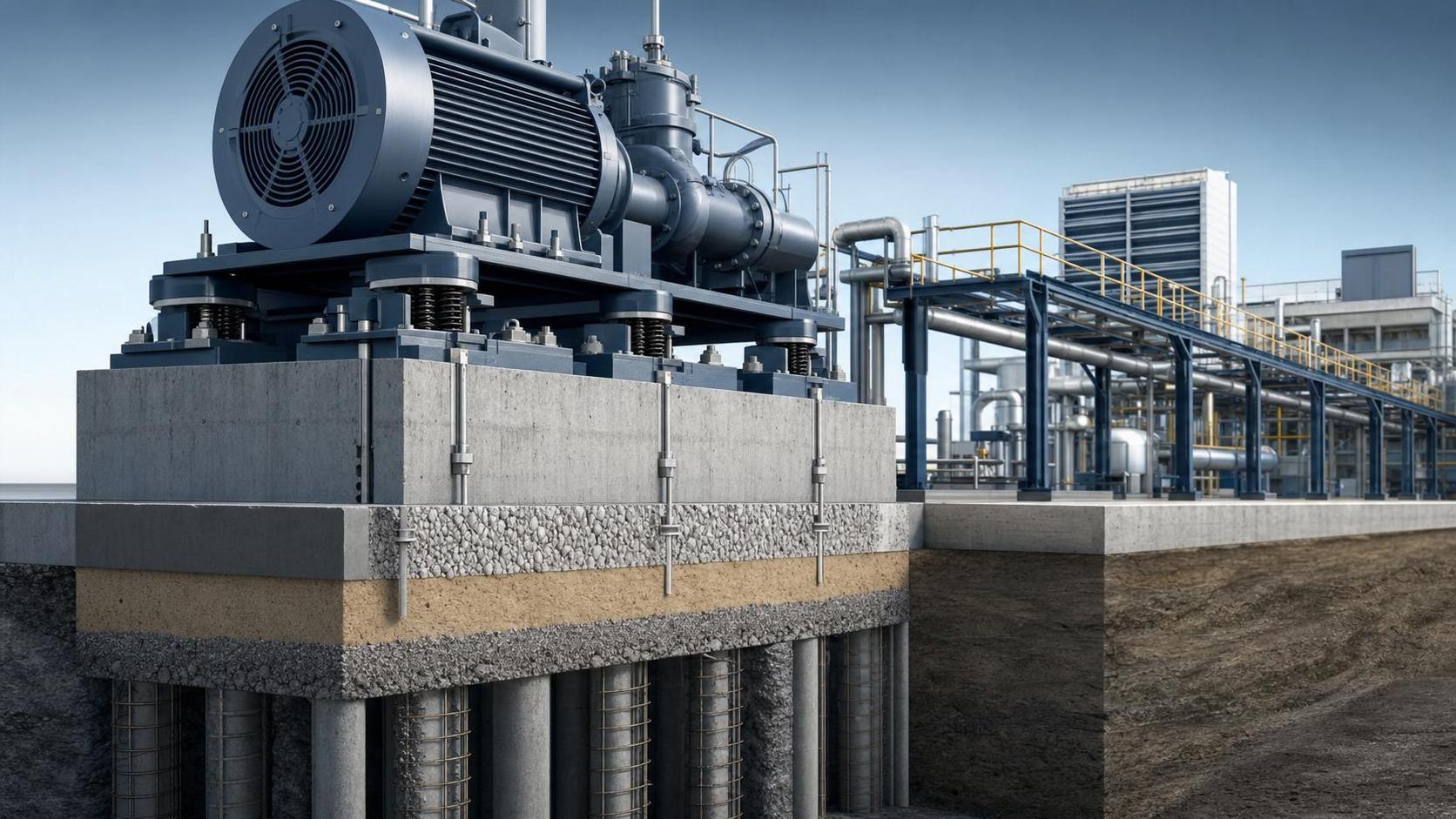
Why do industrial foundations matter so much in heavy equipment projects?
Industrial foundations rarely get attention after commissioning, yet they decide whether equipment runs smoothly or becomes a long-term liability.
In simple terms, industrial foundations transfer machine loads into the ground while controlling settlement, vibration, alignment, and durability.
That sounds basic, but heavy equipment changes the equation. Static weight is only one part of the design problem.
Rotating machinery, impact loads, thermal movement, and maintenance access all influence which industrial foundations make sense.
A foundation that works under a storage tank may fail under a compressor skid, even when total weight looks similar on paper.
This is why early foundation choices affect safety, uptime, repair cost, and schedule certainty across the whole project lifecycle.
GIAM often frames construction decisions through a wider systems view. That perspective is useful here.
Industrial foundations support not only equipment, but also the performance standards expected in modern, efficient, and lower-risk industrial spaces.
What exactly counts as an industrial foundation?
The term covers engineered substructures built to carry industrial loads safely into soil or rock.
Unlike ordinary building footings, industrial foundations usually respond to machine behavior, anchor bolt precision, grout performance, and service conditions.
They may support presses, turbines, generators, crushers, boilers, tanks, process skids, pipe racks, or material handling systems.
In practice, the most common categories include:
- Shallow foundations such as spread footings, mats, and slabs-on-grade.
- Deep foundations such as driven piles, drilled shafts, and micropiles.
- Special machine foundations designed for vibration control and strict alignment.
- Hybrid systems combining soil improvement with reinforced concrete support blocks.
The right choice depends less on labels and more on how load, motion, soil, and construction constraints interact.
Which types of industrial foundations fit different heavy equipment conditions?
A useful way to compare industrial foundations is by asking what problem each type solves best.
Spread footings remain common where soil bearing capacity is reliable and machinery loads are predictable.
Mat foundations become attractive when equipment lines are dense or when differential settlement is the bigger concern.
For turbines, presses, and rotating units, machine block industrial foundations are usually preferred because vibration response matters as much as strength.
Where soft soils dominate, pile-supported industrial foundations often protect the project from future settlement claims and alignment failures.
How do site conditions change the foundation decision?
This is often where early assumptions break down. The same equipment may need very different industrial foundations on different sites.
Soil profile is the first filter. Loose fill, expansive clay, compressible silt, and shallow rock create very different design paths.
Groundwater also matters more than many teams expect. It affects excavation stability, concrete quality, dewatering cost, and long-term durability.
In coastal or chemically aggressive environments, reinforcement protection and concrete mix design become central to foundation life.
Space constraints can also reshape the answer. Tight brownfield sites may rule out large excavations or noisy pile driving.
That is why industrial foundations should be reviewed alongside logistics, permitting, adjacent structures, and utility conflicts.
GIAM's broader intelligence approach is relevant here because material selection, hydraulic conditions, and local standards rarely act in isolation.
When comparing options, what should be checked beyond load capacity?
Load capacity is essential, but it is not enough to choose industrial foundations for heavy equipment projects.
More common decision criteria include:
- Settlement tolerance of the equipment and connected piping.
- Vibration limits during operation and startup.
- Anchor bolt layout, embedment, and installation tolerance.
- Construction sequence and cure time before commissioning.
- Access for maintenance, replacement, or future capacity upgrades.
- Exposure to chemicals, moisture, freeze-thaw cycles, or heat.
In many projects, the preferred option is the one that reduces operational uncertainty, not the one with the lowest initial concrete volume.
This is especially true when equipment downtime costs more than the civil package itself.
A practical screening method is to compare industrial foundations across four questions: can it carry the load, stay aligned, resist the environment, and fit the schedule?
What mistakes create the most trouble during construction and operation?
Most failures do not come from one dramatic error. They grow from small mismatches between assumptions and field reality.
A frequent mistake is treating industrial foundations like generic structural concrete without checking machine-specific tolerances.
Another is underestimating dynamic loading. Equipment that starts, stops, oscillates, or impacts can overstress a seemingly adequate base.
Poor geotechnical scope is another recurring issue. Limited borings may miss soft pockets, buried obstructions, or seasonal groundwater variation.
Grout and anchor systems are also common weak points. Even well-designed industrial foundations can underperform if installation control is loose.
The checklist below helps catch problems before they become expensive:
- Confirm operating loads, upset loads, and maintenance loads separately.
- Review allowable settlement against vendor alignment limits.
- Match concrete and reinforcement detailing to exposure conditions.
- Verify curing, leveling, grouting, and bolt placement procedures early.
- Coordinate civil, mechanical, and process layouts before rebar detailing begins.
How should cost, schedule, and long-term value be balanced?
The cheapest industrial foundations on bid day may not be the lowest-cost choice over ten or twenty years.
Shallow systems can reduce upfront expense, but only when soil quality, equipment sensitivity, and drainage control are favorable.
Deep foundations often add time and specialist cost, yet they can stabilize schedule risk on difficult ground.
Where production continuity matters, lifecycle thinking usually leads to more robust industrial foundations and tighter quality control.
That does not mean overdesigning every base. It means pricing the real consequences of rework, misalignment, vibration complaints, and shutdowns.
GIAM's sector intelligence often highlights the same pattern across building materials and engineered systems: smarter decisions come from connecting material behavior, operating context, and market constraints.
Industrial foundations benefit from that same discipline, especially when tariffs, standards, and sustainability targets affect material availability and design choices.
What is the best next step before locking in a foundation type?
Start with a short decision matrix instead of jumping straight to a named foundation type.
List the equipment loads, vibration profile, settlement limits, soil conditions, environmental exposure, and commissioning date.
Then compare at least two realistic industrial foundations against those criteria using both capital cost and lifecycle risk.
The strongest choices usually emerge when geotechnical findings, equipment vendor data, and construction sequencing are reviewed together.
Industrial foundations are not just concrete under machinery. They are a control point for safety, reliability, and long-term asset performance.
A grounded next move is to formalize selection criteria, test site assumptions early, and challenge any option that looks cheap only because risk is hidden.
Industry Briefing
Get the top 5 industry headlines delivered to your inbox every morning.