What to Ask a Smart Kitchen Appliances Manufacturer Before OEM or Bulk Purchase
Why does choosing the right smart kitchen appliances manufacturer matter so much?
A bulk order is never only about unit price.
The right smart kitchen appliances manufacturer affects reliability, warranty costs, delivery confidence, and how well a product fits changing market demand.
In practical terms, one weak factory decision can damage margins for months.
A delayed shipment, unstable Wi-Fi module, or missing certification creates downstream problems that are expensive to fix later.
That is why early questions should go beyond appearance, packaging, and quoted cost.
A dependable smart kitchen appliances manufacturer should be able to explain product architecture, testing logic, compliance scope, and long-term support with clarity.
This is also where GIAM’s market perspective becomes useful.
Across residential upgrades and commercial space projects, demand is moving toward connected, hygienic, energy-aware kitchen systems that align with broader building intelligence trends.
So the better question is not simply, “Who can make it?”
It is, “Who can make it consistently, legally, and competitively for the market I want to serve?”
What should you ask first before discussing OEM terms or bulk pricing?
Start with capability, not discount.
A serious smart kitchen appliances manufacturer should answer a few basic but revealing questions without hesitation.
- Which product categories are produced in-house, and which parts are outsourced?
- What certifications already exist for the target market?
- How mature is the smart control system, app integration, or firmware platform?
- What is the minimum order quantity for OEM changes?
- How are component risks managed during supply fluctuations?
These questions quickly separate trading-style offers from true manufacturing strength.
For example, some suppliers assemble finished units but do not control software updates or sensor sourcing.
That may look acceptable at sample stage, yet it becomes risky when a chipset changes or a connectivity issue appears after launch.
Another useful early question is whether the factory has experience with projects tied to modern interiors, built-in installations, or coordinated kitchen systems.
This matters because smart appliances increasingly sit inside larger design and building-material ecosystems, not as isolated products.
How do you judge product quality without relying on sales claims?
The safest approach is to ask for proof tied to process.
Any smart kitchen appliances manufacturer can promise quality.
A stronger one can show how quality is built, measured, and corrected.
Look at incoming inspection standards, burn-in testing, function testing, leak testing where relevant, and final inspection records.
For connected appliances, software stability deserves equal attention.
Ask how firmware versions are controlled, how bugs are logged, and whether updates can be managed safely across batches.
A polished sample does not prove production consistency.
More useful indicators include defect rate by batch, return analysis, and traceability of key components such as heating elements, control boards, and touch modules.
The table below helps structure a practical review.
If the answers stay vague, the risk is usually real.
Are certifications and compliance really that important for a smart kitchen appliances manufacturer?
Yes, and not only for customs clearance.
Compliance affects project eligibility, insurance exposure, online platform acceptance, and long-term brand credibility.
That is especially true when smart kitchen systems are sold into regulated housing, hospitality, or mixed-use developments.
A capable smart kitchen appliances manufacturer should clarify which standards already apply to each model.
Depending on market, that may include CE, CB, ETL, UL, RoHS, REACH, EMC, food-contact requirements, or energy-efficiency rules.
For connected products, data security and wireless communication compliance should also be reviewed early.
A common mistake is assuming one certificate covers every version.
In reality, a housing change, new PCB, or voltage adjustment can require fresh validation.
GIAM’s industry tracking often shows how evolving efficiency rules, tariff changes, and green-building expectations reshape sourcing decisions.
So when reviewing a smart kitchen appliances manufacturer, ask not only what certificates exist today, but also how quickly new compliance work can be completed if standards shift.
How much customization is realistic in OEM projects?
OEM flexibility is often overstated.
Some changes are simple, such as logo placement, packaging language, or interface color.
Others affect tooling, certification, software logic, and delivery time.
That is why the next discussion with a smart kitchen appliances manufacturer should focus on the boundary between cosmetic customization and engineering customization.
Useful questions include the following.
- Which parts can be changed without new tooling?
- Will software or app changes require new testing cycles?
- What is the sample lead time after design confirmation?
- What happens if one custom component is delayed?
The more connected the appliance is, the more critical system compatibility becomes.
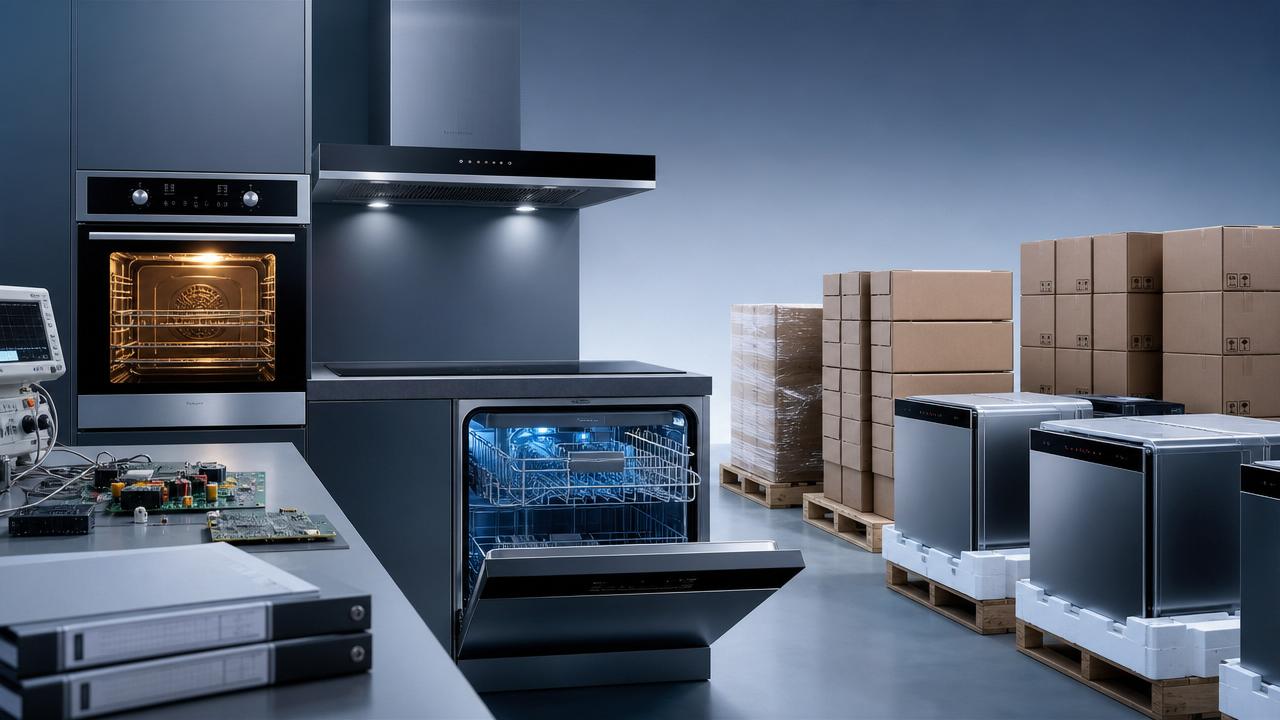
A smart oven, hood, or dishwasher may need to align with app ecosystems, voltage preferences, and installation conventions across different regions.
In actual projects, the most successful OEM programs usually begin with a stable base model and only selective adjustments.
That approach reduces cost surprises and speeds market entry.
What delivery, warranty, and after-sales questions reveal hidden risk?
This is where many bulk purchases become vulnerable.
A smart kitchen appliances manufacturer may perform well on samples but struggle with stable lead times, spare parts, or technical follow-up.
Ask about average production capacity by month, peak-season planning, and backup suppliers for critical electronics.
Then move to service conditions.
How are warranty claims handled?
Are spare boards, sensors, glass panels, or filters available for future batches?
Can technical files, wiring diagrams, and troubleshooting guides be provided in time?
It also helps to ask how the factory handles end-of-life transitions.
Smart appliances evolve fast, and discontinuing a module too early can disrupt repairs and repeat orders.
A more reliable smart kitchen appliances manufacturer plans service life, replacement parts, and communication procedures before problems appear.
That discipline matters even more as kitchens become part of wider intelligent living environments shaped by energy awareness, hygiene performance, and connected space management.
What is the smartest next step before making a final decision?
Bring the evaluation back to evidence.
A shortlist should compare more than price sheets.
Review compliance coverage, engineering depth, software stability, packaging readiness, lead-time resilience, and after-sales structure side by side.
If possible, request a sample review tied to a checklist rather than general impressions.
That checklist should cover appearance, function, connectivity, noise, installation details, documentation, and carton protection.
The best smart kitchen appliances manufacturer is not always the cheapest or the largest.
Usually, it is the one that answers hard questions directly and proves consistency across product, compliance, and service.
GIAM’s broader view of building materials, sanitary systems, and intelligent living trends points to the same conclusion.
Kitchen products now sit inside a bigger value chain shaped by safety, sustainability, and smarter spatial design.
So before placing the order, define your technical requirements, confirm your market standards, and compare each smart kitchen appliances manufacturer against the same decision framework.
That extra discipline usually protects both profit and reputation long after the first shipment arrives.
Industry Briefing
Get the top 5 industry headlines delivered to your inbox every morning.