
Architectural Design Trends in Materials: What Specifiers Are Prioritizing in Commercial Projects
Commercial Material Decisions Are Being Rewritten
In commercial construction, material selection has moved beyond finish boards and visual preference.
The strongest architectural design trends materials now reflect pressure from regulation, operating cost, wellness standards, and asset resilience.
That shift is visible across offices, hospitality, healthcare, education, mixed-use projects, and high-traffic retail environments.
What matters today is how a material behaves over time, how it supports compliance, and how it performs under changing occupancy patterns.
This is why architectural design trends materials are increasingly evaluated as part of a broader building intelligence strategy.
GIAM has tracked this change through its Strategic Intelligence Center, where material science, sanitary systems, and commercial market signals are read together.
From that wider lens, one conclusion stands out.
Specifiers are no longer choosing materials to complete a design narrative alone.
They are choosing them to reduce exposure, extend lifecycle value, and future-proof space performance.
The Change Became Visible When Performance Started Leading Aesthetics
A noticeable signal in recent commercial projects is that visual appeal still matters, but it is no longer the first filter.
Architectural design trends materials are being screened earlier for embodied carbon, VOC impact, fire behavior, moisture resistance, cleanability, and maintenance burden.
That changes the discussion at specification stage.
Materials that once won on texture or brand familiarity now face closer scrutiny around certifications, traceability, and performance data.
More importantly, the shift is not limited to envelope or structure.
Interior surfaces, sanitary spaces, kitchen systems, hardware, and smart access components are being reviewed through the same lifecycle lens.
This broader evaluation explains why architectural design trends materials are now closely tied to operational strategy, not just design intent.
What is pushing the shift
Several forces are reinforcing each other rather than acting separately.
Seen together, these factors explain why architectural design trends materials are no longer assessed in isolation.
Demand Is Moving Toward Materials That Do More Than One Job
One of the clearest market signals is the rise of multifunctional material expectations.
In practice, a single material layer is now expected to contribute to durability, indoor air quality, sustainability, and cleaning efficiency at once.
This is especially clear in sanitary areas, commercial kitchens, shared amenity spaces, and high-contact circulation zones.
GIAM’s coverage of sanitary spaces and smart kitchen and bath systems reflects the same pattern.
The market is rewarding materials and integrated systems that solve adjacent problems together.
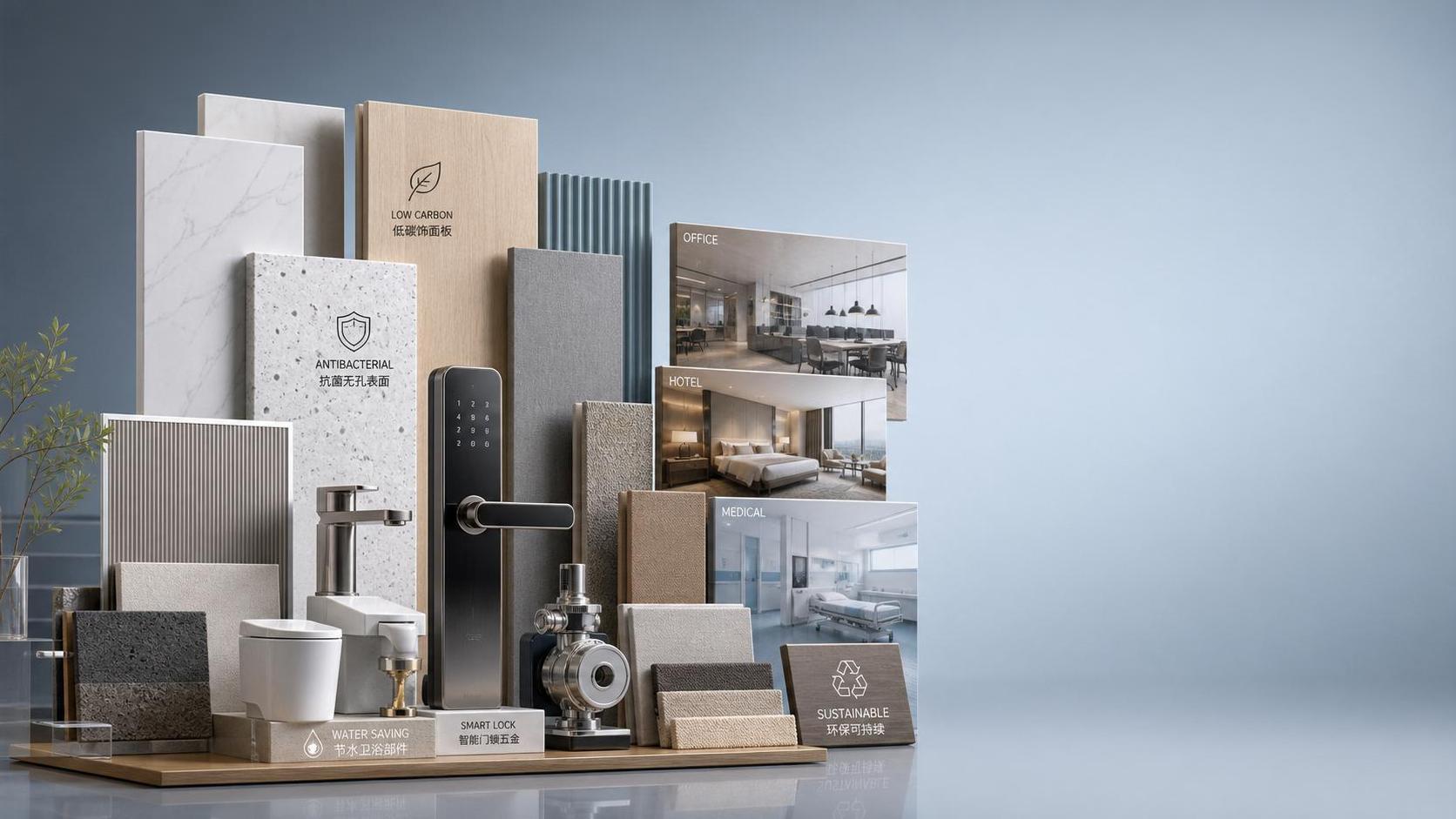
- Low-carbon surfaces that also offer abrasion resistance and stable color retention.
- Anti-bacterial finishes that reduce cleaning intensity without compromising design quality.
- Water-saving fixtures paired with durable substrates and moisture-managed detailing.
- Smart access and control components that fit architectural hardware requirements and security protocols.
This has an important consequence for architectural design trends materials.
Selection criteria become less about standalone specification sheets and more about system compatibility over the building lifecycle.
The Impact Is Spreading Across More Than One Project Stage
These shifts are not confined to early concept design.
They affect budgeting, detailing, tender alignment, installation sequencing, and long-term facility management.
That is why architectural design trends materials increasingly influence project risk long before the building is occupied.
Where the effects are most visible
The implications differ by application, but the direction is consistent.
- In office retrofits, low-disruption materials are favored because downtime now carries a measurable cost.
- In hospitality, stain resistance, water efficiency, and repairability matter as much as premium finish language.
- In healthcare and education, hygienic performance and surface resilience are central, not secondary.
- In mixed-use schemes, material continuity must balance aesthetics with varied code and maintenance demands.
A further shift is happening in documentation quality.
Teams now need better evidence around test standards, maintenance assumptions, tariff sensitivity, and supply continuity.
Without that, even strong material concepts can stall during value engineering.
Why Global Market Signals Matter More Than Before
Architectural design trends materials are increasingly shaped by cross-border forces.
Energy codes tighten in one region, tariff structures shift in another, and specification logic changes across several markets at once.
This is where GIAM’s intelligence model becomes relevant.
By linking building materials, sanitary technologies, and commercial demand signals, it frames material choice as a moving international benchmark.
That matters because local decisions increasingly depend on global inputs.
A surface material may be visually appropriate and technically acceptable, yet still become less viable if embodied carbon disclosure rules expand or logistics become unstable.
More spec decisions are therefore being made with a wider field of vision.
Architectural design trends materials now sit at the intersection of design quality, trade conditions, environmental reporting, and digital operation.
The Strongest Near-Term Signals Are Practical, Not Theoretical
Some material conversations still sound aspirational, but current project behavior is more grounded.
The near-term winners are usually the solutions that prove measurable value without creating specification complexity.
From recent demand patterns, several priorities are becoming harder to ignore.
What deserves closer attention now
- Verified carbon and emissions data, especially for materials used at scale across interior packages.
- Moisture and hygiene performance in washrooms, food-related zones, and dense circulation spaces.
- Material compatibility with smart controls, access hardware, and water-saving systems.
- Maintenance assumptions that match real operating conditions rather than ideal test environments.
- Availability resilience, including lead times, tariff exposure, and substitution risk.
These are not abstract concerns.
They increasingly determine whether architectural design trends materials hold value through design development and post-occupancy review.
A Smarter Response Starts With Better Material Judgement
The next step is not to chase every new finish or emerging claim.
It is to build a clearer framework for comparing architectural design trends materials under real project pressures.
That framework should connect performance data, compliance exposure, maintenance reality, and fit with spatial intelligence goals.
A practical review can start with four questions.
- Does the material solve more than one requirement without creating installation or service complications?
- Can its environmental and technical claims be verified through current standards and credible documentation?
- Will the material still perform under the cleaning, wear, moisture, and usage patterns of the actual space?
- Is the supply path stable enough to protect schedule and lifecycle value?
Commercial projects are entering a period where material decisions carry more strategic weight than before.
The most useful response is to track market signals continuously, compare technical evidence carefully, and reassess whether existing specifications still match current building demands.
That is where better insight becomes practical advantage.
Industry Briefing
Get the top 5 industry headlines delivered to your inbox every morning.