
Composite Materials Trends: Are Recyclable Resins Ready for Structural Use?
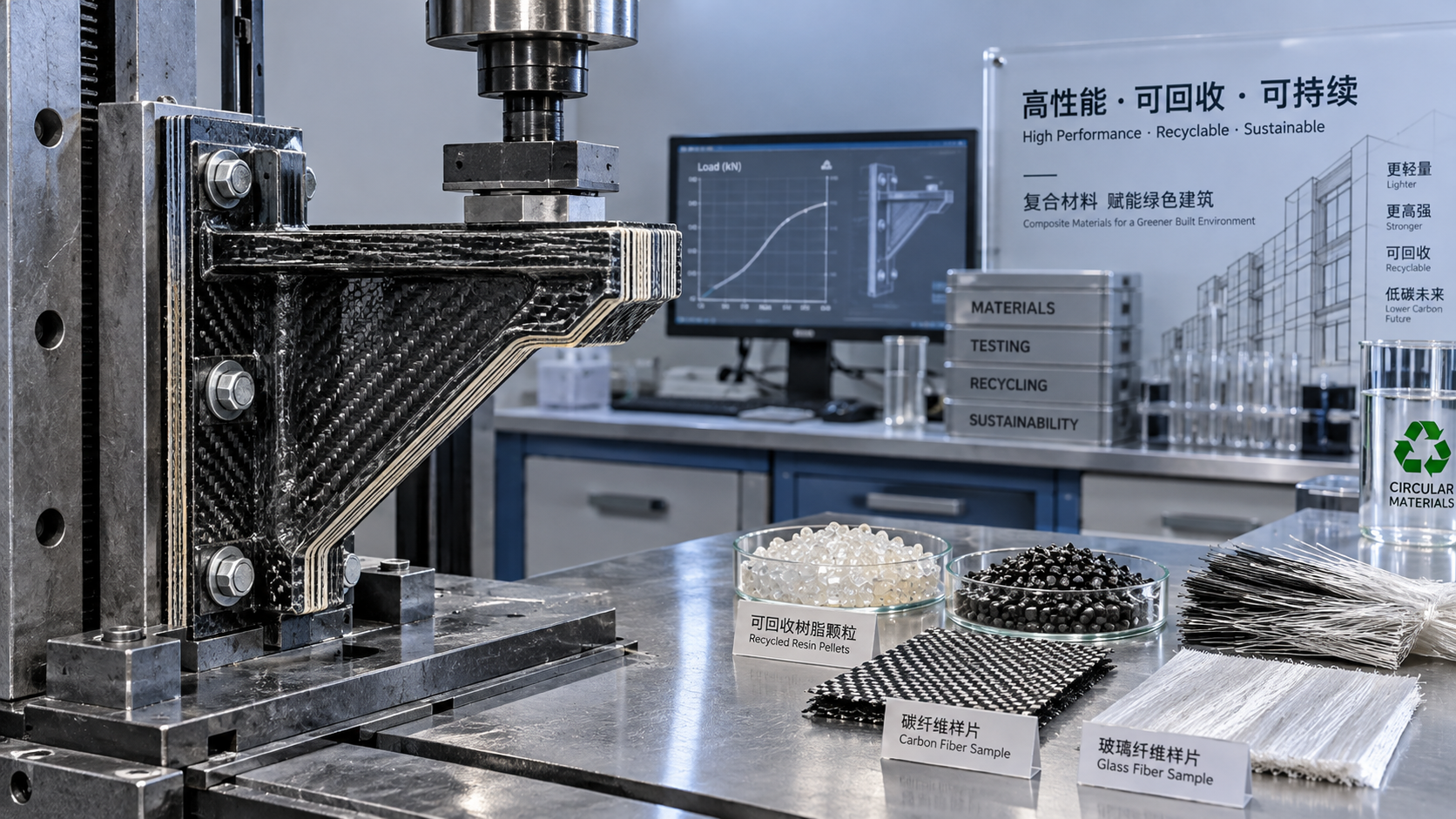
A composite façade bracket can look convincing on a test bench. The harder question is what happens after years of sustained loading, summer heat, winter moisture, and movement at its connections. Add a promise that the resin can be recycled, and technical evaluators face two separate decisions: whether the component is safe to specify, and whether its claimed circularity will survive contact with real construction practice.
For teams tracking material science trends for composite materials, recyclable resins deserve attention—but not a blanket endorsement. Some thermoplastic composites already serve demanding structural applications. Emerging reprocessable thermosets offer other routes to material recovery, yet their readiness varies substantially by chemistry, manufacturing process, and intended exposure.
The practical answer is conditional: recyclable resins can support structural use where the complete composite system has appropriate design allowables, durability evidence, manufacturing controls, and regulatory acceptance. Recyclability alone establishes none of those things.
The market is moving from “can it be recycled?” to “what comes back?”
Conventional thermoset composites owe much of their usefulness to permanent crosslinked networks. Those networks provide dimensional stability and resist flow, but they also make end-of-life separation difficult. Mechanical grinding, thermal treatment, and chemical recovery offer possible routes, although each produces different outputs and carries different energy, quality, and commercial implications.
Recyclable resin development changes that equation in several ways. Thermoplastics can be softened and reshaped under suitable conditions. Certain thermoset chemistries allow network rearrangement or controlled cleavage. Other systems prioritize recovering reinforcement rather than retaining the original matrix.
This distinction matters commercially. A process that recovers carbon fiber for a shorter-fiber molding compound is not equivalent to one that produces reusable resin feedstock or preserves continuous reinforcement. Both may have value, but they support different supply chains and different environmental claims.
For building-material buyers, the important trend is therefore a shift toward defined recovery outcomes. Evaluators should ask what material emerges, which properties remain, who can purchase it, and whether collection and processing are realistically available. A recycling demonstration proves technical possibility; it does not establish a functioning market.
Three resin routes, three different readiness questions
Thermoplastics: established capability, application-specific limits
Thermoplastic composites are not a single maturity category. Glass-fiber-reinforced polypropylene, polyamides, and higher-temperature polymers occupy very different positions in performance, processing cost, and environmental resistance. Some continuous-fiber thermoplastic systems have established structural uses outside buildings, but qualification in one industry does not automatically transfer to construction.
Their attractions include potential welding, reshaping, and reuse of manufacturing scrap. Depending on the system, fast processing can also be commercially useful. The counterweight is manufacturing complexity: melt viscosity can make fiber impregnation difficult, while cooling history, crystallinity, and residual stresses may influence final performance.
Repeated processing can degrade polymer chains or shorten reinforcement. Moisture sensitivity also differs sharply between polymer families. Consequently, “thermoplastic” should never be treated as a shortcut for either structural suitability or easy recycling.
Reprocessable thermosets: promising chemistry, demanding validation
Dynamic covalent networks, including some vitrimer systems, can rearrange bonds under specific conditions while retaining a crosslinked structure. They offer possibilities for repair, reshaping, joining, or reprocessing that conventional thermosets generally lack.
The structural question is whether those mechanisms remain sufficiently inactive throughout the service envelope. Bond-exchange behavior depends on chemistry, temperature, time, and sometimes catalysts. A material that reshapes successfully in a controlled hot press still needs evidence that sustained load and elevated service temperatures will not produce unacceptable deformation.
Reprocessability should therefore be evaluated alongside stress relaxation and creep—not as an independent sustainability feature. Room-temperature strength alone is inadequate evidence of structural readiness.
Chemically recoverable thermosets: recovery without necessarily remolding
Some resin networks are designed to break down under selected chemical conditions, enabling recovery of fibers or other constituents. This may preserve useful thermoset processing characteristics while creating an end-of-life pathway.
However, recovered fibers may have altered surfaces, residual contamination, or changed compatibility with a new matrix. Solvent management, chemical consumption, purification, and recovery yield also affect feasibility. Evaluators need to distinguish a resin designed for chemical recovery from a composite proven to deliver reusable structural-grade outputs at meaningful scale.
Where material science trends for composite materials meet structural reality
A resin datasheet is a starting point, not a design basis. Structural behavior emerges from the resin, reinforcement, fiber orientation, interface, void content, component geometry, and connections. Any change in resin chemistry or recycled content can alter that balance.
The most useful comparison is against the actual component specification, not against an idealized conventional material.
Creep is often the decisive filter. A beam, panel, or bracket may remain below its short-term failure load yet gradually exceed allowable deflection. Connections can also redistribute stress as the matrix relaxes. Design assessments should consider combined exposure: moisture and heat together may reveal limitations that separate tests miss.
Fire introduces another distinction. Reaction to fire addresses behavior such as ignition, flame spread, and smoke production. Fire resistance concerns an assembly’s ability to maintain required functions during fire exposure. Neither can be inferred simply from the other. Flame-retardant additives may also affect processing, toughness, moisture response, and recovery compatibility, so their consequences belong in the same qualification program.
Buildings make circularity harder—and more valuable
Construction presents a difficult recycling environment. Components may remain installed for decades, pass through multiple owners, and accumulate coatings, adhesives, fasteners, or contamination. By the time a composite becomes available for recovery, its producer may no longer offer that formulation.
This is why design for disassembly matters as much as resin selection. Accessible mechanical connections, identifiable material grades, and separation from incompatible layers can improve recovery prospects. Adhesive bonding may remain necessary for performance, but its end-of-life consequences should be acknowledged rather than hidden behind a recyclable-resin label.
For architectural and interior systems, service conditions also vary within the same building. A sheltered frame, an exterior façade support, and a reinforcement element near a humid sanitary space face different risks. Kitchen and bath environments can add cleaning chemicals, warm water, and repeated humidity cycles. These exposures require material-specific assessment, particularly when interfaces or coatings control durability.
At GIAM, linking material science with building-system intelligence means examining this complete context: structural demand, installation practice, indoor safety, maintenance, and eventual recovery. A lower-carbon material choice loses its advantage if premature replacement becomes necessary.
The most credible entry points are bounded applications
Adoption is easier where exposure conditions are understood, inspection is possible, and failure consequences are manageable. This does not mean that all small components are low risk. A compact façade connector can be safety-critical, while a large interior panel may carry no structural load.
Useful early opportunities may include controlled factory-made components, replaceable modules, or systems with accessible connections and well-defined loads. Manufacturing scrap is another important starting point: clean, segregated production waste is generally easier to characterize and recover than mixed demolition material.
For primary load-bearing systems, expectations should be higher. Evaluators need credible long-term design values, connection testing, environmental reduction factors, and an applicable approval pathway. Where prescriptive provisions do not cover a material, project-specific engineering and alternative approval procedures may be necessary, depending on jurisdiction.
The central commercial tension is straightforward. Suppliers want adoption to generate manufacturing experience; specifiers want manufacturing experience before adoption. Well-bounded pilot applications can help bridge that gap, provided monitoring and acceptance criteria are established before installation—not improvised afterward.
A qualification sequence that avoids expensive late surprises
Technical teams can save time by testing the supplier’s claim in the right order. Begin with the intended application and work backward to the evidence required.
- Define the service envelope. Document loads, temperatures, moisture, chemical exposure, design life, fire requirements, and acceptable deformation. Include connections and installation tolerances.
- Identify the material precisely. Record resin chemistry, reinforcement architecture, additives, recycled-content source, and manufacturing route. Agree which changes require requalification.
- Review the weakest evidence first. If creep, fire, or moisture durability is likely to control acceptance, investigate it before commissioning a broad strength-testing program.
- Move from coupons to representative components. Check holes, joints, edges, inserts, welds, and other stress concentrations. Include realistic fabrication defects and production variability.
- Verify the recovery proposition separately. Establish collection assumptions, processing conditions, output quality, and viable destinations. Do not confuse recycled content with end-of-life recyclability.
- Set procurement safeguards. Require traceability, change notification, inspection criteria, and clear responsibility for nonconforming batches.
Testing can draw on relevant ASTM, ISO, or local methods, but standards must match the material and intended use. A familiar method does not automatically establish code compliance, and accelerated testing needs defensible interpretation before it supports a multi-decade service-life claim.
The market signal to watch is qualification, not announcements
For technical evaluators, the strongest indicators of progress are less dramatic than a new resin launch: published application-specific data, consistent production batches, repeatable joining methods, independent testing, and practical recovery arrangements.
Cost comparisons should also extend beyond resin price. Tooling, consolidation energy, cycle time, inspection, joining, protective treatments, and approval work can reshape the business case. Environmental comparisons need similarly consistent boundaries, including realistic service life, processing energy, replacement frequency, and end-of-life assumptions. Recycling benefits should not be credited as though collection were guaranteed.
Recyclable resins are ready for some structural applications, but there is no category-wide clearance. Established thermoplastic systems and newer recoverable networks must each earn their place through evidence relevant to the component being specified.
The best decision is not “recyclable versus conventional.” It is whether a particular material system can deliver required performance reliably, with a credible recovery route and a defensible environmental benefit. That is where composite-material innovation becomes useful building intelligence—and where circularity can strengthen, rather than distract from, structural responsibility.
Industry Briefing
Get the top 5 industry headlines delivered to your inbox every morning.