
What Are Smart Spaces and How Do They Improve Building Efficiency and User Experience?
Smart spaces are not just connected buildings
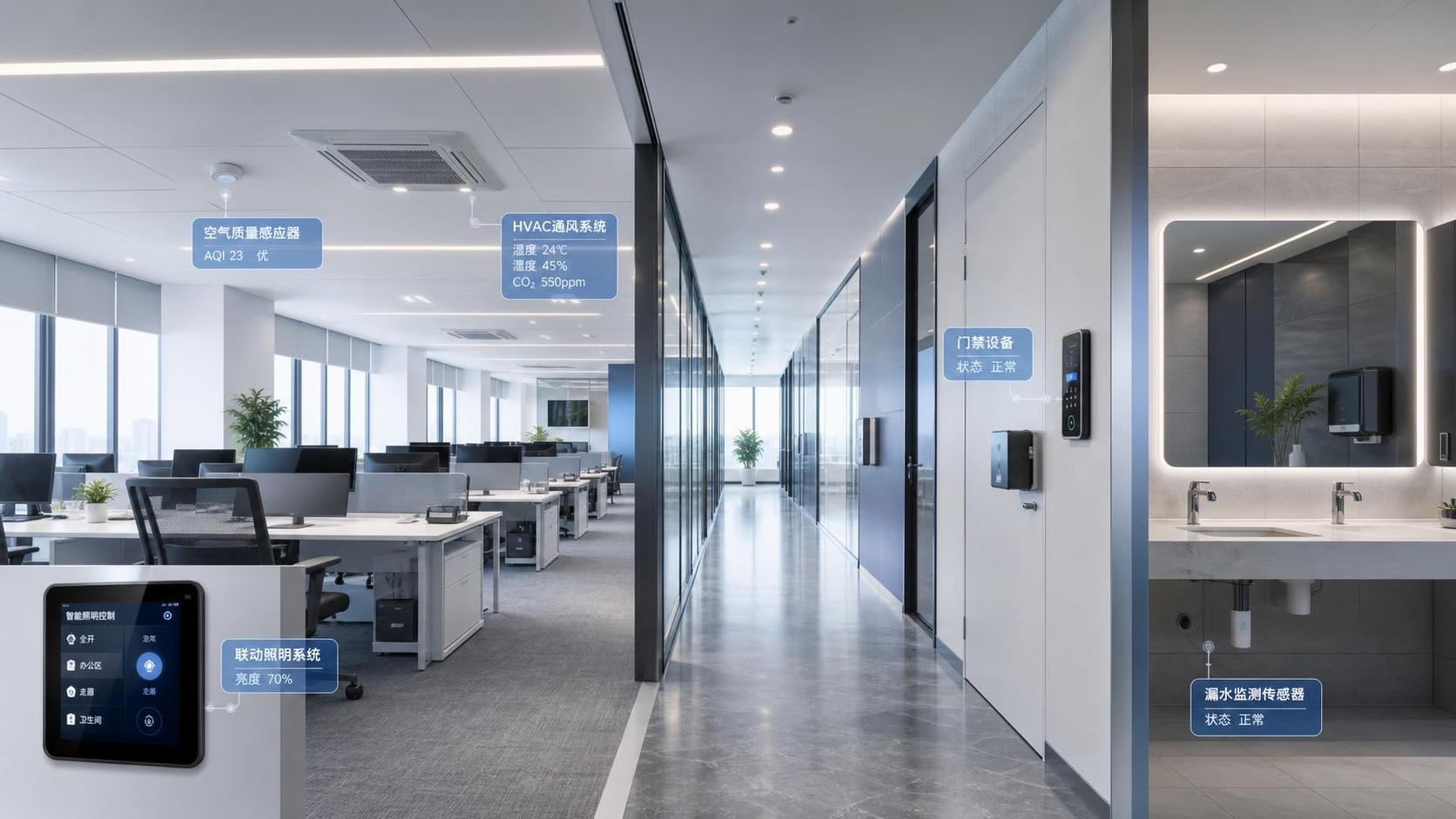
The easiest mistake is to treat smart spaces as a synonym for buildings full of sensors, apps, and automation panels. In practice, that is too narrow. A smart space is a built environment where digital systems, physical infrastructure, and user behavior are coordinated well enough that the space can respond intelligently to real conditions. The value is not in the devices themselves. It is in the way lighting, HVAC, access control, occupancy data, water systems, acoustics, indoor air quality monitoring, and sometimes even materials selection are made to work together.
That distinction matters because many projects are marketed as “smart” when they are only digitized. A building with standalone smart locks, app-controlled lighting, and a dashboard for energy consumption may still operate like a collection of isolated products. A true smart space behaves more like a coordinated system. It can reduce unnecessary energy use when occupancy drops, adjust ventilation based on measured conditions, support maintenance teams with usable operating data, and make the space feel easier to navigate and safer to use. In other words, intelligence is not added through gadgets alone; it comes from integration, logic, and operational relevance.
Why the concept matters now
The rise of smart spaces is tied to several pressures that now shape both residential and commercial construction. Energy costs are volatile. Building regulations in many markets are moving toward tighter performance expectations. Owners want better control over lifecycle costs, not just construction cost. Occupants expect more comfort and convenience, but they are less tolerant of buildings that are difficult to use, poorly ventilated, or visibly wasteful. For developers, facility operators, architects, and product manufacturers, this changes the definition of building quality.
That is why the conversation increasingly extends beyond a building management system in the traditional sense. Smart spaces now sit at the intersection of energy management, user experience, cybersecurity, water efficiency, access technology, and material performance. In residential projects, this may show up through connected kitchen and bath systems, leak detection, occupancy-aware lighting, or smart ventilation. In commercial space, it often involves HVAC optimization, space utilization analysis, predictive maintenance, visitor access, and environmental controls tied to actual demand.
Efficiency improves when the building can sense, decide, and act
Building efficiency is often described too vaguely. In a smart space, efficiency usually improves through three practical mechanisms.
The first is visibility. Many buildings waste energy and water simply because operators cannot see where losses occur in time to intervene. Submetering, occupancy sensing, equipment monitoring, and alarm logic make inefficiencies legible. If a hot water system is running outside expected load patterns, or a meeting zone is being overcooled while unoccupied, that becomes detectable instead of hidden inside a monthly utility bill.
The second is automation based on real conditions. Timers and static schedules have limits. Smart spaces can use occupancy, daylight levels, temperature drift, CO2 concentration, humidity, or equipment status to control systems more precisely. Lighting can dim when daylight is sufficient. Ventilation can respond to actual room use rather than assumed maximum occupancy. Pumps and fans can run according to demand instead of continuously at fixed levels. None of this is conceptually new, but integration makes it more reliable and scalable.
The third is operational learning. A smart space should not only react; it should help teams understand patterns over time. When building operators can compare setpoints, fault history, occupancy trends, and service records, they can tune systems rather than constantly chasing complaints. This is where digital intelligence starts to affect lifecycle performance, which is often more consequential than any single equipment upgrade.
User experience is more than convenience
People often reduce user experience in smart spaces to app-based control or touchless access. Those can help, but they are only part of the picture. The better test is whether the space reduces friction for the people who use it every day. Does the office feel consistently comfortable without manual complaints? Can a resident manage lighting, water heating, or entry without wrestling with multiple incompatible interfaces? Can visitors move through a building without confusion or security bottlenecks? Does a hotel bathroom maintain comfort and hygiene standards while also conserving water?
In well-designed smart spaces, comfort becomes more stable because systems are responsive. Safety improves because access events, leak alerts, smoke integration, or emergency overrides are part of a coherent operating framework. Convenience improves when controls are intuitive and do not demand technical knowledge from users. The most successful smart environments often feel uneventful. The systems are doing useful work in the background, and the occupant notices the result rather than the machinery.
This is particularly relevant in sanitary spaces, kitchens, and bathrooms, where user experience is shaped by small operational details: water temperature stability, touchless fixtures, air extraction, anti-bacterial surfaces, leak prevention, and reliable device response. These spaces sit at the meeting point of hygiene, comfort, resource efficiency, and hardware durability, so the smart layer has to support all four. A beautiful interface means little if valves fail, sensors drift, or maintenance becomes unnecessarily complex.
What technologies actually make a space smart
There is no single technology stack that defines smart spaces, but several layers appear repeatedly in serious projects.
At the field level, there are sensors, meters, actuators, controls, and connected devices: thermostats, valves, lighting controllers, water leak sensors, air quality monitors, smart locks, motorized shading, and occupancy detection. Above that sits the communications layer, where interoperability becomes critical. If systems cannot exchange data cleanly, the building may look connected on paper but remain fragmented in operation.
Then comes software: dashboards, analytics platforms, building management interfaces, mobile apps, and sometimes cloud-based optimization tools. This is where raw data either becomes operational insight or turns into noise. Good software helps users make decisions, exposes faults clearly, and respects the fact that facility teams do not have infinite time to interpret data streams.
Finally, the physical layer still matters. Material choices, insulation quality, plumbing layout, fixture efficiency, equipment specification, and commissioning discipline all affect whether the digital controls can deliver meaningful results. A badly designed envelope or poorly balanced water system cannot be “fixed” by software alone. Smart spaces are strongest when digital control is paired with solid building fundamentals.
Common misunderstandings that lead to weak projects
One common misunderstanding is that more devices automatically mean more intelligence. In reality, excessive complexity can create maintenance burden, user confusion, and cybersecurity exposure. A leaner system with clear control logic is often more useful than an over-equipped building where no one trusts the automation.
Another is the idea that smart spaces are mainly about premium commercial towers or luxury homes. The concept is broader. Schools, healthcare facilities, apartment buildings, hotels, and mixed-use developments can all benefit from better environmental control, water management, and operational visibility. The scale and sophistication vary, but the underlying logic remains the same: connect what matters, measure what matters, and make the building easier to run.
A third misunderstanding is to treat occupant data as a free resource. Smart spaces depend on data, but the acceptable boundary differs by jurisdiction, building type, and use case. Occupancy analytics, access logs, and behavioral patterns raise privacy and governance questions. If data handling is unclear, the system may create legal or reputational problems even if its technical design is sound.
How to judge whether a smart space strategy is credible
When evaluating a smart building concept, a useful question is not “How advanced is the technology?” but “What operational problem is being solved, and how will success be verified?” A credible strategy usually has a few recognizable traits.
- Clear links between building systems and measurable outcomes such as energy use, water loss reduction, response time, thermal comfort, or maintenance efficiency.
- Interoperability planning early in design, rather than after separate vendors have already locked systems into silos.
- Commissioning and post-occupancy tuning, because even good systems underperform when they are not calibrated to actual use.
- User interface discipline, so residents, staff, and operators are not forced to navigate unnecessary complexity.
- Attention to resilience and security, especially where access control, cloud connectivity, and remote management are involved.
It is also worth checking whether the project team understands the boundary between design ambition and operational capacity. A building owner may approve sophisticated control sequences, but if the facility team cannot maintain them, performance often degrades quickly. Smart spaces work best when the intelligence level matches the realities of management, service support, and component replacement over time.
The practical direction of the market
The market is moving toward smarter spaces not because the term is fashionable, but because buildings are under pressure to do more with less waste. In many projects, the most meaningful advances are not flashy. They involve better coordination between building materials, water-saving technologies, connected fixtures, indoor environmental controls, and data systems that help operators act earlier and more accurately. That is especially relevant in sectors where hygiene, water use, comfort, and energy performance intersect, including kitchens, baths, hospitality, residential towers, and healthcare-adjacent spaces.
For anyone researching the subject, the useful habit is to look past the label. Ask what is integrated, what is measurable, what depends on user behavior, and what can actually be maintained. Smart spaces are best understood as an operating model for buildings, not a decorative layer of technology. When that model is coherent, building efficiency improves in ways owners can track, and user experience improves in ways occupants can feel even if they never see the system behind it.
Industry Briefing
Get the top 5 industry headlines delivered to your inbox every morning.