
How trade tariffs impact on construction costs and lead times
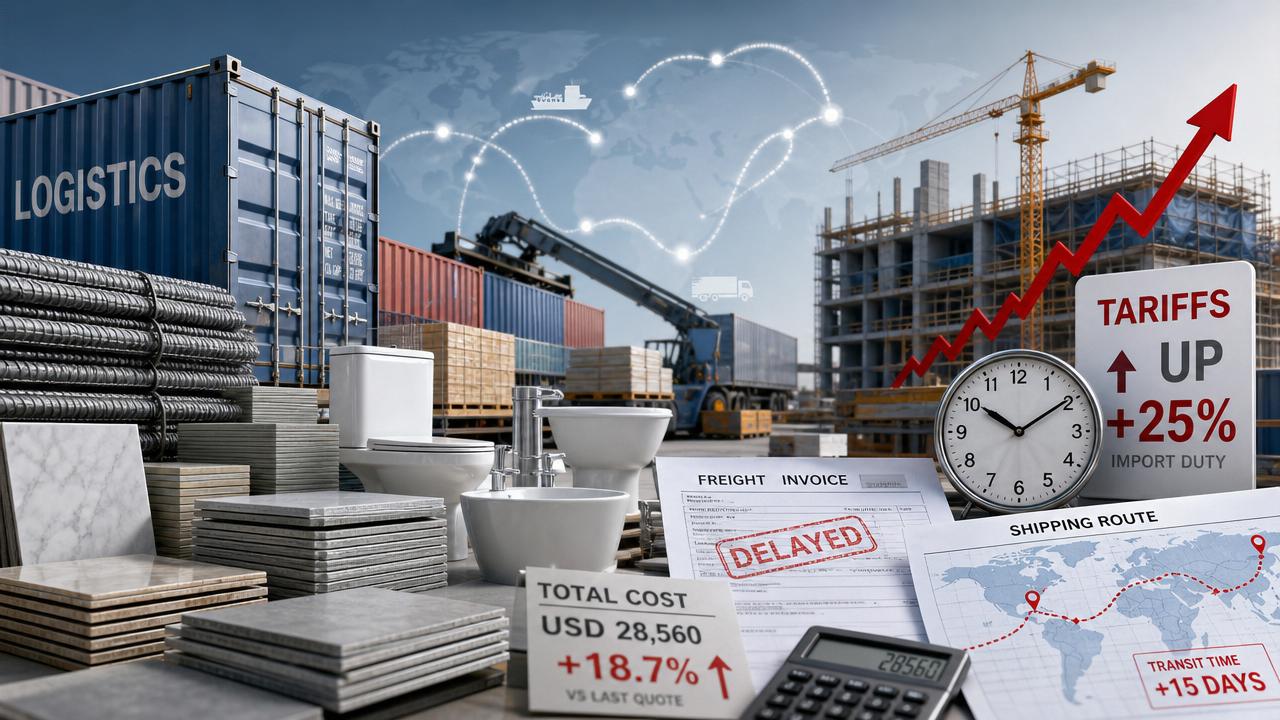
Understanding the trade tariffs impact on construction is now essential for projects facing unstable pricing, sourcing risk, and timing pressure.
From steel frames to ceramic tiles, tariff shifts can raise landed costs and slow approvals, shipping, and final installation.
The trade tariffs impact on construction is no longer limited to customs paperwork.
It now shapes budgeting discipline, supplier strategy, specification choices, and delivery certainty across residential and commercial building programs.
For GIAM, this topic matters because material intelligence increasingly connects construction economics with interior performance, sanitary systems, and smart living standards.
Why the trade tariffs impact on construction varies by project scenario
Not every project absorbs tariff exposure in the same way.
A high-rise tower using imported façades faces different risks than a regional housing project sourcing standard finishes from nearby markets.
The trade tariffs impact on construction depends on material origin, specification rigidity, inventory cycles, and contract timing.
Projects with long procurement chains often feel tariff changes earlier, especially when goods require testing, certification, or factory scheduling.
Tariffs also interact with freight rates, currency moves, and compliance updates.
That combination can turn a manageable surcharge into a broader lead-time problem.
Scenario one: Residential developments using imported finish materials
Residential projects often rely on visible finish materials where design consistency matters.
Imported tiles, sanitaryware, faucets, engineered wood, and smart kitchen fittings are common exposure points.
Here, the trade tariffs impact on construction appears first in unit cost escalation.
Even modest tariff increases can affect model-unit quality, upgrade packages, and final margin assumptions.
Lead times can also expand when developers switch sources after budget reviews.
Alternative factories may need sample approval, technical comparison, and finish matching before release.
Core judgment points in this scenario
- Whether the imported material is a design-defining item
- Whether local substitutes meet visual and performance standards
- Whether approvals can be accelerated without rework
- Whether package pricing has tariff adjustment clauses
Scenario two: Commercial spaces with strict opening deadlines
Hotels, retail centers, offices, and mixed-use assets usually operate under fixed launch dates.
In these cases, the trade tariffs impact on construction is often more severe on lead times than on direct price.
A delayed partition system, access control device, or sanitary package can postpone commissioning and revenue activation.
Commercial interiors also use more integrated systems.
If tariffs push buyers toward new suppliers, compatibility checks may slow electrical, plumbing, and digital integration.
This is especially true for smart locks, sensor faucets, and kitchen equipment requiring software or certification alignment.
Core judgment points in this scenario
- Whether opening date penalties exceed tariff-driven savings
- Whether substitute systems require redesign or retraining
- Whether customs clearance affects installation sequencing
- Whether service parts are sourced from the same tariff zone
Scenario three: Infrastructure and shell projects exposed to bulk materials
Large civil and structural programs face tariff risk through steel, aluminum products, mechanical components, and industrial fixtures.
The trade tariffs impact on construction here is highly visible because quantities are large and procurement values are concentrated.
A tariff on structural steel can move total project cost significantly.
At the same time, bulk material orders often depend on rolling production slots and shipment windows.
If buyers pause decisions while reviewing new duties, mills may reassign capacity.
That delay then extends fabrication and site delivery, not just material pricing.
Core judgment points in this scenario
- Whether tariffed materials are budget-critical or schedule-critical
- Whether stockholding is possible before duty changes
- Whether domestic mills can match capacity and standards
- Whether contract pricing is fixed, indexed, or provisional
How different scenarios change the trade tariffs impact on construction
Practical ways to reduce the trade tariffs impact on construction
Effective mitigation starts before procurement begins.
When teams map tariff exposure by material family, they can separate critical items from replaceable ones.
- Create a tariff exposure register for steel, tile, sanitaryware, hardware, and smart systems
- Track country of origin, duty category, and alternate supply regions
- Compare tariff cost against redesign cost and delay cost
- Reserve contingency for both landed cost and logistics extension
- Use dual-source specifications where performance allows
For fit-out and interior-heavy projects, design flexibility can be a major protection.
Allowing equivalent finishes or hardware ranges can keep quality stable while reducing tariff dependency.
For structural and industrial packages, indexed clauses may work better than hard fixed pricing during unstable trade periods.
Common mistakes when reading the trade tariffs impact on construction
One common mistake is treating tariffs as a simple percentage add-on.
In reality, the trade tariffs impact on construction often multiplies through storage, financing, compliance, and resequencing costs.
Another mistake is switching suppliers too late.
Late substitution usually creates approval bottlenecks and hidden installation conflicts.
A third mistake is focusing only on first cost.
Projects that save on tariffs but lose weeks on opening or handover may end up with worse financial outcomes.
It is also risky to ignore after-sales support.
Replacement parts, warranty service, and software updates can all be affected by future tariff actions.
A smarter next step for planning cost and lead-time resilience
The trade tariffs impact on construction should be reviewed as a live planning variable, not a one-time estimate assumption.
Projects perform better when material intelligence, contract structure, and specification flexibility are aligned early.
A practical next step is to audit tariff exposure across core materials, sanitary spaces, and smart kitchen and bath systems.
Then rank each item by cost sensitivity, substitution difficulty, and schedule criticality.
This approach supports clearer sourcing choices and more realistic budgets.
GIAM’s intelligence perspective helps connect those decisions with broader market signals, evolving standards, and supply-chain shifts.
In a market shaped by policy changes and global competition, better tariff awareness means stronger cost control, steadier delivery, and smarter construction outcomes.
Industry Briefing
Get the top 5 industry headlines delivered to your inbox every morning.