
MosBuild 2026 Signals a New Compliance Threshold
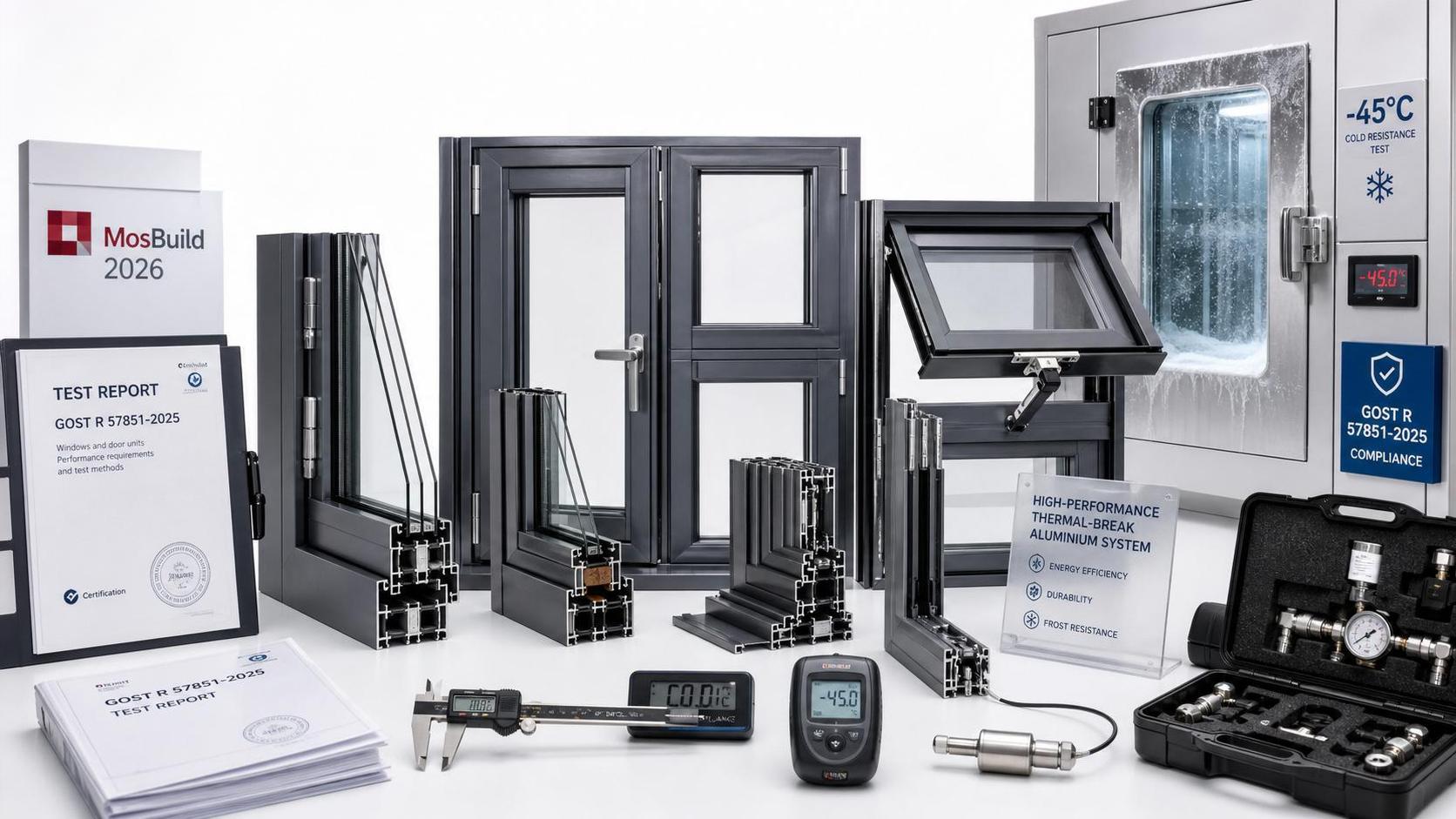
As MosBuild 2026 closed on April 3, the headline for the door and window sector was not only the reported US$120 million in intended orders secured by Chinese exhibitors, but also the compliance signal embedded in those negotiations: 73% of the intended orders required alignment with the new GOST R 57851-2025 standard, including a -45°C low-temperature opening and closing test. For manufacturers, exporters, buyers, testing-related service providers, and delivery teams, this matters because the commercial opportunity is already being linked to a more explicit technical threshold rather than treated as a secondary procurement detail.
What the exhibition outcome confirms
The 31st Moscow International Building and Interiors Trade Show, MosBuild 2026, closed on April 3, 2026. Chinese Door Systems and Window Fittings companies jointly exhibited passive-house-grade thermal break aluminum systems and cold-resistant smart electric windows. The display attracted targeted procurement discussions with a purchasing delegation from the Russian federal construction authority. During the exhibition, intended orders totaling US$120 million were reached. Of those intended orders, 73% required compliance with the new GOST R 57851-2025 standard, which includes a -45°C low-temperature opening and closing test.
Why the standard reference matters across the transaction chain
For exporters, technical access conditions are moving closer to the front of the deal
Analysis shows that the most immediate impact falls on export-oriented door and window system suppliers. When a large share of intended orders is tied to a named standard requirement, technical compliance is no longer just a post-award documentation task; it becomes part of early customer qualification, specification matching, and offer preparation. What deserves closer attention is whether product claims, test materials, and bid language can clearly correspond to GOST R 57851-2025 requirements.
For manufacturers, product configuration and validation may affect deliverability
From an industry perspective, manufacturers of thermal break aluminum systems and smart electric windows may feel the impact in design confirmation, component selection, and factory release procedures. The specific reference to a -45°C operating test suggests that low-temperature performance could become a practical checkpoint in procurement review. In business terms, this may influence how factories prepare technical files, internal validation records, and product configuration consistency before shipment commitments are made.
For buyers and procurement teams, specification alignment becomes a purchasing filter
Observably, procurement-side attention is shifting toward whether suppliers can satisfy a stated standard condition rather than only offer price or general product positioning. Buyers involved in public or project-linked sourcing may therefore pay closer attention to technical submissions, supporting test evidence, and wording consistency in tender or purchasing documents. The key issue is not only product availability, but whether the supplied system can be documented against the required standard threshold.
For testing, certification, and delivery support functions, documentation risk may rise
Testing-related service providers, certification support teams, logistics coordinators, and after-sales functions may also be affected. Analysis shows that once compliance becomes part of order expectation, supporting documentation, traceability, and handover materials gain more weight in the delivery chain. Even where execution details are not yet provided in the event summary, companies should note the possibility that incomplete technical records or inconsistent product descriptions could complicate later acceptance, shipment planning, or service follow-up.
Practical issues companies should watch next
Check whether existing files match the stated standard requirement
Companies involved in the relevant product categories should review whether current technical dossiers, product literature, and compliance statements can be directly mapped to GOST R 57851-2025. Where the order expectation explicitly mentions a low-temperature opening and closing test, the consistency between product claims and supporting materials deserves immediate review.
Prepare for closer scrutiny of test reports and technical wording
What deserves closer attention is the quality of test-related documentation and specification language used in quotations, procurement responses, and technical exchanges. If future tender or order documents repeat the same standard reference, unclear wording or incomplete supporting files could become a practical barrier during commercial negotiation or pre-delivery review.
Watch for changes in procurement language and supplier qualification requests
Observably, the exhibition result suggests that procurement-side requirements may increasingly cite concrete standard conditions. Companies should therefore monitor whether future inquiries, technical bid requests, or supplier qualification documents place greater emphasis on named standards, low-temperature performance claims, or related supporting evidence. This is a monitoring point rather than a confirmed execution outcome.
Assess delivery and service readiness alongside compliance readiness
Analysis shows that compliance preparation should not be separated from delivery planning. If intended orders progress into executed business, suppliers may need to coordinate technical documentation, product traceability, spare parts planning, and after-sales response in a more structured way. The current information does not confirm how these requirements will be enforced in practice, but it does indicate where operational pressure may emerge.
How this signal should be read at this stage
From an industry perspective, this development is more appropriately understood as an execution signal from the market rather than as a complete picture of rule implementation. The important point is that a substantial share of intended business at a major trade exhibition was already linked to GOST R 57851-2025 compliance, including a defined low-temperature test condition. At the same time, observably, the available information does not yet establish how broadly this requirement will be applied across projects, how strictly documentation will be reviewed, or how procurement language will evolve after the exhibition. That is why continued attention to standard interpretation, purchasing practice, and follow-up market feedback remains necessary.
What this means for the near-term market reading
The event does not merely indicate commercial interest in Chinese door and window systems; it also highlights that technical compliance conditions are becoming more visible in transaction discussions. Analysis shows that the most reasonable interpretation at present is that the market is sending a clearer compliance signal, especially for products positioned for cold-resistant performance and system-level specification matching. It is not yet a basis for broad conclusions about all future orders, but it is a concrete reminder that standard-linked procurement expectations may affect export preparation, technical communication, and delivery organization sooner rather than later.
Basis of this article and points requiring further verification
This article is generated from the user-provided news title, event date, and event summary. The confirmed factual basis is limited to the reported MosBuild 2026 closing date, the joint exhibition by Chinese Door Systems and Window Fittings companies, the targeted procurement discussions, the reported US$120 million in intended orders, and the statement that 73% of those intended orders required compliance with GOST R 57851-2025, including a -45°C low-temperature opening and closing test. Specific official source links were not provided in the input and therefore remain to be independently verified. For this type of event, relevant source categories typically include official announcements, regulatory releases, trade or customs authority information, industry association updates, standard organization documents, tender materials, and reporting by established industry media. Further observation is still needed on standard interpretation, certification practice, procurement wording, tender document changes, market feedback, and actual enterprise implementation.
Industry Briefing
Get the top 5 industry headlines delivered to your inbox every morning.