Building material innovations changing facade performance
Building material innovations are no longer just a design talking point. For technical evaluators, they directly affect whether a facade can meet thermal targets, resist moisture and pollution, stay compliant under tighter regulations, and deliver acceptable lifecycle cost. The practical question is not simply which new material looks promising, but which innovations measurably improve facade performance without introducing hidden risk in installation, maintenance, fire behavior, or long-term durability.
The core search intent behind building material innovations in this context is evaluative and decision-oriented. Readers want to understand which emerging facade materials and systems are worth specifying, what performance gains they deliver, and how to compare them against conventional solutions. They are less interested in trend lists and more interested in suitability, test evidence, standards alignment, and whole-life value.
For technical assessment teams, the most useful approach is to review innovations through a performance lens: thermal efficiency, structural reliability, hygrothermal control, fire safety, contamination resistance, embodied carbon, installation complexity, and maintenance burden. When judged this way, some innovations clearly stand out. Advanced insulation systems, ventilated rainscreen assemblies, low-carbon cladding, self-cleaning and antimicrobial surfaces, and digitally monitored facade components are already changing how high-performance envelopes are evaluated.
What technical evaluators actually need from facade material innovation
Before comparing products, it helps to define what “better facade performance” means in technical terms. In most projects, performance is multi-variable. A facade must limit heat gain and heat loss, manage water penetration, reduce thermal bridging, resist wind loads, remain stable under UV exposure, and comply with fire and environmental regulations. In many urban settings, acoustic control and resistance to airborne pollutants also matter.
This is why innovation alone is not enough. A new material only has value if it improves decision confidence. Technical evaluators usually need five things: verified data, compatibility with adjacent systems, compliance evidence, realistic installation requirements, and a lifecycle profile that supports the business case. Materials that score well on paper but create uncertainty in detailing or maintenance can undermine overall project performance.
From an SEO and market perspective, the strongest building material innovations are those that support both operational efficiency and procurement resilience. In other words, the best options do not merely reduce U-values. They also help projects meet carbon goals, shorten installation time, reduce callbacks, and preserve aesthetic quality over time.
Advanced insulation materials are raising the facade performance baseline
Among all building material innovations, advanced insulation has arguably had the most immediate impact on facade performance. Traditional mineral wool, EPS, and rigid foam systems still dominate many projects, but they are increasingly being challenged by materials that deliver more thermal resistance in thinner profiles or offer better fire, moisture, or sustainability characteristics.
Vacuum insulated panels, or VIPs, are one of the best-known examples. Their high thermal performance allows designers to achieve demanding envelope targets where space is constrained. This makes them especially relevant in retrofit facades, high-density urban buildings, or projects trying to maximize internal floor area. For evaluators, however, VIPs require careful review of edge vulnerability, puncture risk, and long-term performance retention. Their specification value depends heavily on detailing discipline.
Aerogel-based insulation blankets and boards are another significant development. They offer low thermal conductivity while remaining relatively thin and adaptable. Their usefulness is often strongest in areas where thermal bridges are difficult to eliminate using conventional materials, such as around brackets, slab edges, or complex junctions. Technical teams should still evaluate compressive behavior, weather exposure limitations, and cost-effectiveness against expected thermal gains.
Wood fiber insulation and other bio-based thermal materials are also gaining attention because they contribute to lower embodied carbon while offering useful thermal and moisture-buffering properties. In facade assemblies, these products can support more balanced hygrothermal behavior, especially in breathable wall systems. The trade-off is that performance assessment must be more rigorous in relation to water exposure, biological durability, and local code acceptance.
The main takeaway is that insulation innovation should not be judged by lambda value alone. Thermal performance, fire classification, moisture tolerance, thickness constraints, and installation quality all determine whether the material truly improves facade outcomes.
Ventilated rainscreen systems are improving moisture control and durability
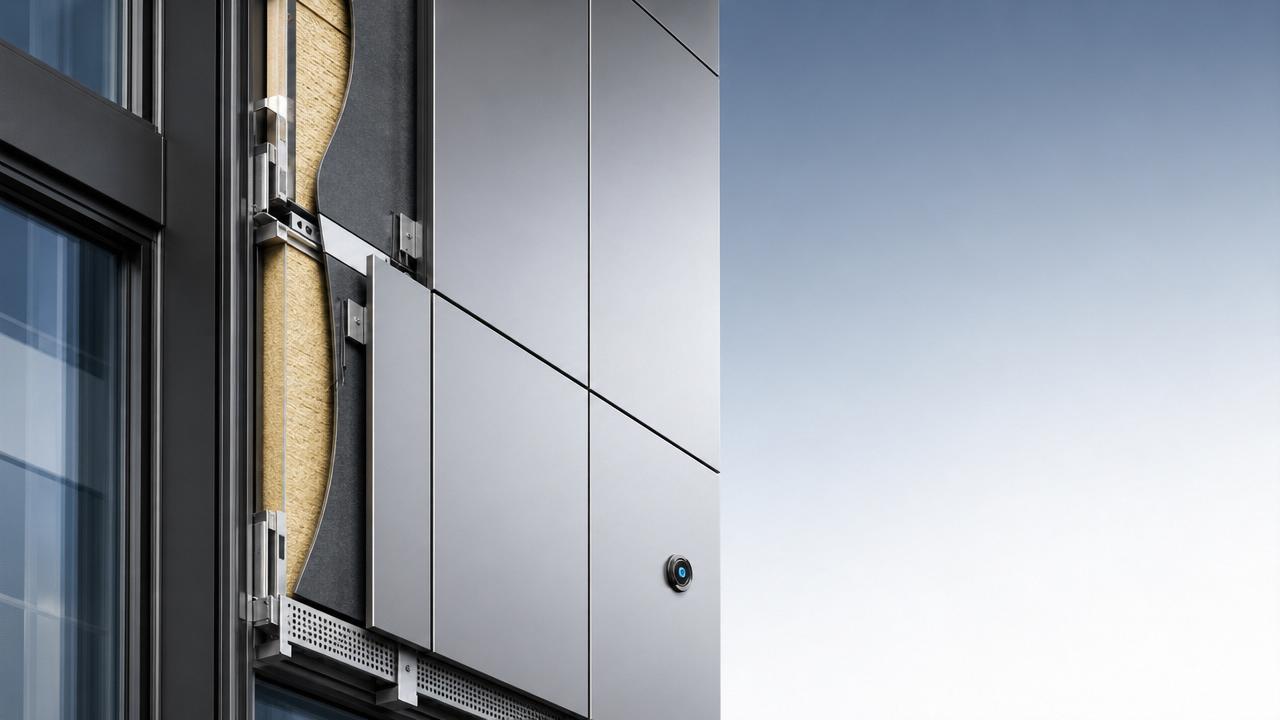
One of the most important shifts in facade design is the wider use of ventilated and pressure-moderated rainscreen systems. While not entirely new, these assemblies have evolved through better cavity design, improved support systems, more durable membranes, and a broader mix of cladding materials. Their relevance lies in how they separate weather protection from thermal and structural layers.
For technical evaluators, the key performance advantage is moisture management. Facades often fail not because of poor nominal material strength, but because trapped moisture degrades insulation, corrodes anchors, damages substrates, or causes mold and staining. Ventilated systems reduce that risk by allowing drainage and air circulation behind the visible cladding layer.
Material innovation within this category includes lightweight porcelain panels, fiber cement boards with enhanced coatings, engineered terracotta, compact laminates, recycled aluminum panels, and composite support brackets with reduced thermal bridging. Evaluators should pay particular attention to bracket conductivity, cavity continuity, fire barriers, panel fixing tolerances, and differential movement between materials.
Where rainscreen systems truly change facade performance is in lifecycle stability. They often simplify replacement of damaged outer panels without disturbing the full wall build-up. They can also maintain aesthetic quality better in pollution-heavy environments when combined with high-performance surface treatments. This makes them highly attractive in commercial and institutional projects where long-term maintenance planning matters.
Low-carbon cladding materials are moving from sustainability option to specification priority
Technical teams are increasingly expected to assess both operational and embodied performance. As a result, low-carbon cladding is no longer a niche interest. It is becoming part of mainstream facade evaluation, especially on projects with ESG, green building certification, or public procurement requirements.
Several building material innovations are shaping this shift. Recycled aluminum with lower embodied energy, low-carbon concrete panels using supplementary cementitious materials, bio-based facade boards, and responsibly sourced timber systems are all expanding the range of viable facade options. Some manufacturers are also improving transparency through environmental product declarations, which helps evaluators compare materials beyond marketing claims.
However, low-carbon does not automatically mean high-performance. A technical evaluator still needs to check weathering behavior, UV stability, fastening compatibility, dimensional movement, impact resistance, and fire performance. For example, timber-based facade systems may offer strong carbon credentials and visual warmth, but they also demand robust detailing for moisture protection, cavity ventilation, and code-compliant fire design.
The strongest specification decisions happen when low embodied carbon aligns with reduced lifecycle intervention. A facade material that has slightly higher initial emissions but lasts significantly longer with less maintenance may outperform an apparently greener alternative over the building’s service life. This is why embodied carbon data should be reviewed together with durability and replacement cycles, not in isolation.
Surface technologies are extending facade cleanliness, hygiene, and service life
Surface innovation is an area where material science is quietly changing facade performance. Coatings and treatments are no longer just decorative finishes. They are increasingly engineered to reduce dirt adhesion, resist microbial growth, limit corrosion, reflect solar radiation, or improve resistance to chemical exposure in polluted urban environments.
Self-cleaning coatings, often based on photocatalytic or hydrophilic technologies, are particularly relevant for facades exposed to dust, traffic emissions, or staining rain patterns. These systems can reduce visible soiling and lower cleaning frequency, which supports both aesthetic continuity and maintenance cost control. For technical evaluators, the important questions are not only initial performance, but retention under UV exposure, abrasion, and local climate conditions.
Antimicrobial surfaces have become more common in sectors where hygiene perception matters, such as healthcare, hospitality, and mixed-use developments with high-touch facade interfaces or sheltered exterior elements. While the facade-wide impact may be more limited than in interior applications, these innovations can still support project differentiation and better environmental health outcomes in selected zones.
Cool roof and solar-reflective facade coatings are also relevant, especially in hot climates or urban heat island conditions. By reducing solar absorption, they can help control surface temperature and lower cooling demand. Their real value depends on orientation, local irradiance, aging behavior, and integration with glazing and insulation strategy. This is a good example of why facade performance must be judged as a system rather than through isolated material claims.
Fire safety and regulation are now central to evaluating facade innovation
Any discussion of facade materials today must address fire performance. Regulatory scrutiny has increased sharply in many regions, and technical evaluators are under pressure to confirm not just product-level classification but system-level behavior. This is especially important when reviewing composites, insulation products, air barriers, cavity barriers, and external cladding assemblies.
Many innovative materials offer excellent thermal or environmental benefits, but they may complicate compliance if their combustibility, smoke generation, or installation sensitivity is not fully understood. Product certificates are useful, but they are not enough on their own. Evaluators should verify how a material performs within the exact facade build-up being proposed, including support rails, cavity depth, joints, membranes, and fire stopping details.
This is one area where technically conservative decisions may still be justified. A material can be innovative and commercially attractive, yet still unsuitable for certain building types, heights, occupancy risks, or insurance frameworks. High-performance facades must satisfy fire, structural, and moisture criteria together. No single gain in thermal or sustainability performance should override those fundamentals.
As innovation expands, a disciplined compliance review process becomes more valuable. That means checking local code requirements, test standards, installer qualifications, third-party assessments, and substitution risks during procurement. For technical teams, the best innovations are often the ones backed by robust documentation and repeatable quality assurance in real construction conditions.
Digital integration is making facades more measurable and easier to manage
Another important shift is the integration of smart monitoring into facade systems. Sensors embedded within envelopes or attached to facade components can now track moisture, temperature, structural movement, air leakage indicators, and even maintenance conditions. While these technologies are not traditional materials in themselves, they are increasingly paired with innovative facade assemblies to improve operational performance.
For technical evaluators, this development changes how material value is judged. A facade solution that enables long-term condition monitoring may reduce uncertainty around service life, help detect hidden failures earlier, and support predictive maintenance. This is especially useful for complex commercial buildings, premium residential towers, and projects in harsh climatic zones.
Digitally enabled facades also support better post-occupancy verification. Instead of relying only on modeled performance, asset teams can compare expected and actual behavior over time. That feedback loop helps improve future specification choices and creates a more evidence-based approach to building material innovations.
The practical limitation is integration complexity. Sensors, data platforms, maintenance protocols, and ownership responsibilities all need to be defined. Technical teams should therefore evaluate digital facade features as part of the asset strategy, not as isolated add-ons.
How to assess whether an innovative facade material is truly worth specifying
Because the market is full of claims, technical evaluators need a structured method for comparing materials. A useful framework begins with performance priorities. Is the project driven mainly by thermal targets, compliance risk reduction, embodied carbon, maintenance savings, or premium aesthetics? Different priorities change which innovation is most valuable.
Next, assess evidence quality. Independent test data, environmental declarations, weathering results, and documented reference projects are more reliable than broad product narratives. If a material is new to a region, supply-chain stability and installer familiarity should be checked as carefully as technical performance.
Third, review system compatibility. Facade underperformance often comes from junctions, anchors, membranes, and workmanship, not from the main visible panel. An innovative cladding board or insulation layer may fail to deliver expected value if it creates difficult detailing or demands unrealistic installation tolerances.
Fourth, compare lifecycle cost rather than initial cost alone. Maintenance intervals, expected replacement timing, cleaning requirements, and repair access all influence true value. In many cases, a higher-cost material becomes the better option when viewed over twenty or thirty years of operation.
Finally, consider risk concentration. If a material delivers exceptional benefit in one area but introduces uncertainty in fire testing, moisture durability, or procurement continuity, its overall specification suitability may be limited. The goal is balanced facade performance, not isolated optimization.
Which innovations are likely to matter most over the next few years
Looking ahead, the most influential building material innovations for facades will likely be those that solve multiple pressures at once. Thin high-performance insulation will remain important as buildings pursue stricter energy targets without sacrificing space. Low-carbon cladding will accelerate as carbon reporting becomes more embedded in procurement. Smarter coatings will gain traction where maintenance cost and urban pollution are major concerns.
At the same time, hybrid solutions are likely to define the next stage of facade performance. Instead of one breakthrough material replacing all others, technical teams will increasingly combine advanced insulation, ventilated assemblies, low-carbon panels, and digitally monitored details into integrated envelope systems. This system-level approach reflects how real building performance works.
For GIAM’s audience, the strategic implication is clear. Competitive advantage will come not just from knowing which materials are new, but from understanding which combinations create durable, compliant, commercially viable facade solutions across different climates and project types.
Conclusion: innovation only matters when it improves verified facade outcomes
Facade performance is being reshaped by a wide range of building material innovations, from advanced insulation and ventilated cladding to low-carbon panels, surface technologies, and smart monitoring. For technical evaluators, the opportunity is significant, but so is the need for disciplined review. The best materials are not simply newer or greener. They are the ones that demonstrate measurable improvement in thermal efficiency, moisture control, durability, compliance, and lifecycle value.
When assessing facade innovation, the most reliable mindset is practical rather than promotional. Ask what problem the material solves, what evidence supports its claims, how it behaves within the full assembly, and whether it reduces long-term risk as well as short-term performance gaps. That approach leads to smarter specifications, stronger project outcomes, and more resilient building envelopes in a rapidly evolving construction market.
Industry Briefing
Get the top 5 industry headlines delivered to your inbox every morning.