
CBAM Compliance Tightens for Natural Stone Exports
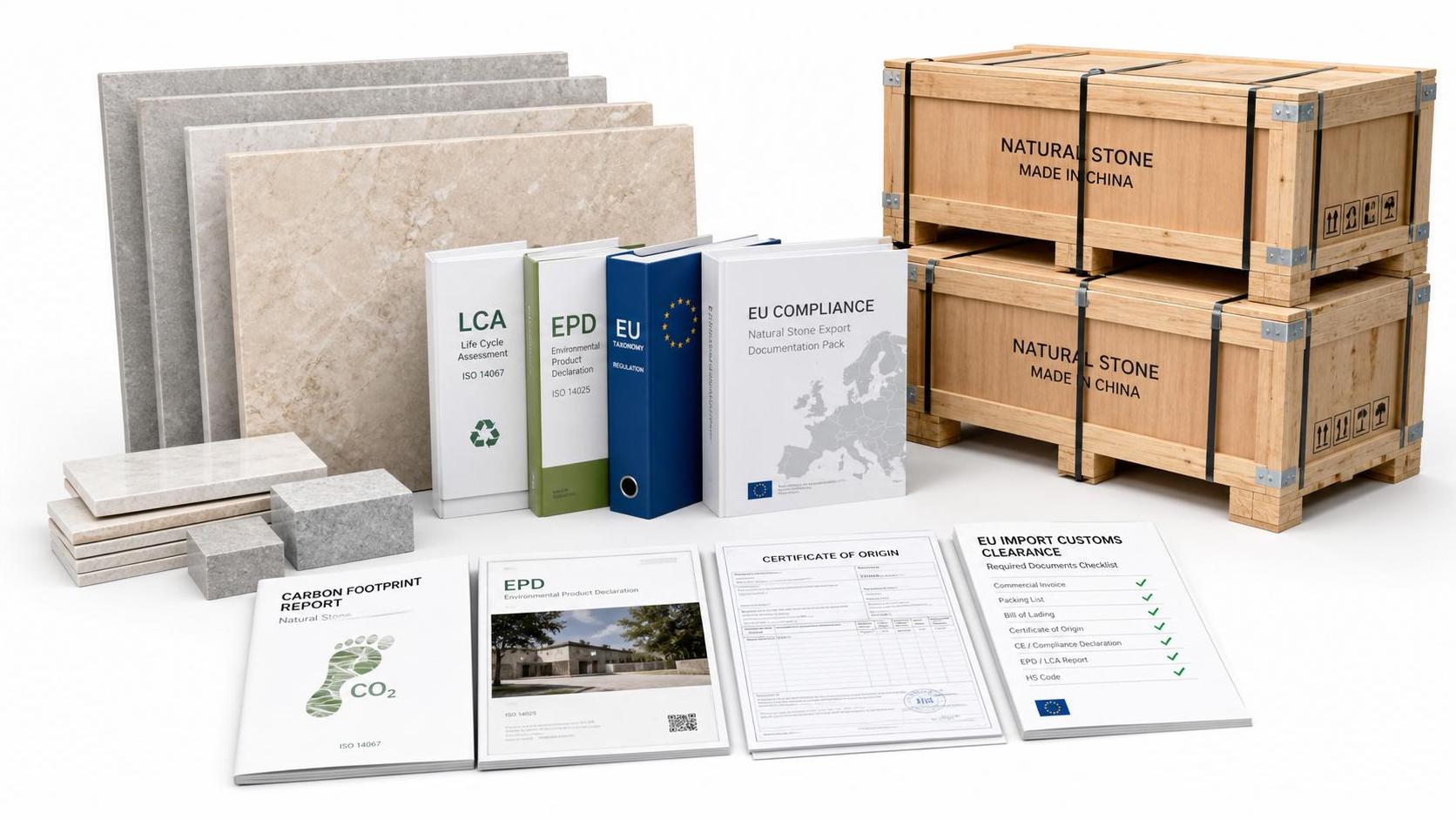
The timing of the underlying event is not specified in the provided information, but the policy signal is clear: from June 2026, the EU’s Carbon Border Adjustment Mechanism (CBAM) will move into routine mandatory enforcement, and natural stone under HS 2515/6802 is included in the second batch of expanded sectors. For exporters, processors, logistics participants, and buyers tied to EU-bound stone shipments, the issue is no longer limited to pricing or customs paperwork; it now extends to whether verified emissions documentation can cover the full chain from quarrying to transport without delaying clearance or triggering added carbon cost.
What the confirmed update says
According to the provided information, CBAM will fully enter normalized mandatory enforcement from June 2026. Natural stone classified under HS 2515/6802 has been placed in the second group of expanded industries.
Exporters will be required to submit both an Environmental Product Declaration (EPD) verified by a recognized body and a Life Cycle Assessment (LCA) carbon footprint report. The required data must cover the full process, including extraction, cutting, polishing, and transport.
If the requirements are not met, non-compliant shipments may face a carbon tax of EUR 92 per tonne of CO₂e, and customs clearance efficiency may also be affected.
Where the pressure is likely to appear first
Export-facing stone businesses move from product delivery to data delivery
From an industry perspective, direct exporters are likely to feel the most immediate pressure because the obligation is linked not only to the stone product itself but also to the supporting emissions evidence. The practical impact may show up in quotation preparation, order confirmation, document collection, and customs readiness for EU-bound business.
Processing plants may need tighter upstream-downstream coordination
Analysis shows that processors involved in cutting and polishing may be affected because these stages are explicitly part of the required reporting boundary. This means operational data from factory processes may become more important in export compliance workflows, especially when preparing records that align with both EPD and LCA requirements.
Logistics and delivery schedules may face documentation risk
Observably, supply chain service providers and shipment coordinators may also be drawn into the compliance process because transport emissions are included in the reporting scope, and customs timing is identified as a potential consequence of non-compliance. The issue is therefore not only carbon cost, but also whether documentation can be assembled in time to support delivery commitments.
EU buyers and procurement teams may raise documentation expectations
What deserves closer attention is that buyers sourcing natural stone for the EU market may increasingly focus on whether suppliers can provide verified reporting rather than only material specifications and lead times. For procurement functions, the change may affect supplier screening, document requests, and transaction confidence before shipment.
What companies should monitor now
Watch for how official wording is implemented in practice
Analysis shows that one key task is to distinguish the policy direction already stated from the detailed operational rules that may shape day-to-day compliance. Businesses should pay close attention to any further official clarification on submission format, verification expectations, and how the dual-report requirement is applied in practice.
Prioritize product lines tied to HS 2515/6802 and EU shipments
For companies with mixed markets or multiple stone categories, the immediate focus is likely to be on the product lines and customer orders that fall within HS 2515/6802 and are destined for the EU. This helps narrow where internal checking, supplier coordination, and document preparation need to begin first.
Check whether supplier records support full-process reporting
Because the required data must cover extraction, cutting, polishing, and transport, firms should examine whether upstream and processing-stage records are sufficiently complete to support verified EPD and LCA submissions. The practical concern is not abstract sustainability messaging, but whether each stage can be evidenced in a form acceptable for compliance use.
Prepare for customer and customs communication risks
Observably, companies may also need contingency planning around delivery discussions, document lead times, and the possibility of customs delays if reporting is incomplete. For sales and account teams, this makes customer communication a compliance issue as much as a commercial one.
Why this reads as more than a one-off update
Analysis shows that this development is better understood as a concrete compliance signal rather than a short-lived market headline. The requirement for both EPD and LCA, together with a defined carbon tax consequence and possible customs impact, suggests that carbon accounting is moving closer to routine trade administration for affected natural stone exports.
At the same time, it is still appropriate to separate confirmed requirements from broader assumptions. The provided information establishes the direction, scope, reporting expectation, and penalty reference, but further observation is still needed on how implementation details evolve in real transactions and document workflows.
How the sector may need to frame this development
From an industry perspective, the main significance of this update is that carbon reporting for natural stone exports to the EU should no longer be viewed as a peripheral ESG exercise. It is more appropriate to understand it as an operational trade requirement with implications for documentation quality, coordination across the production chain, and shipment execution.
A measured reading is still necessary. The confirmed information points to a clear compliance threshold from June 2026, but the business impact will depend on how well exporters and their supply-chain partners can translate reporting obligations into workable order, sourcing, and delivery processes.
About the basis of this article
This article is based on the user-provided news title, the note that the event timing was not specified, and the provided summary of the CBAM-related requirement for natural stone exports. No specific official source link was included in the input, so any later use of this information should continue to verify official notices, company disclosures, industry association updates, authoritative media reporting, and relevant standard or verification documents where available.
Areas that still merit continued monitoring include any later official clarification on enforcement practice, document verification details, and the operational treatment of EPD and LCA submissions during customs-related procedures.
Industry Briefing
Get the top 5 industry headlines delivered to your inbox every morning.