
Choosing Antibacterial Tiles for High-Traffic Public Spaces
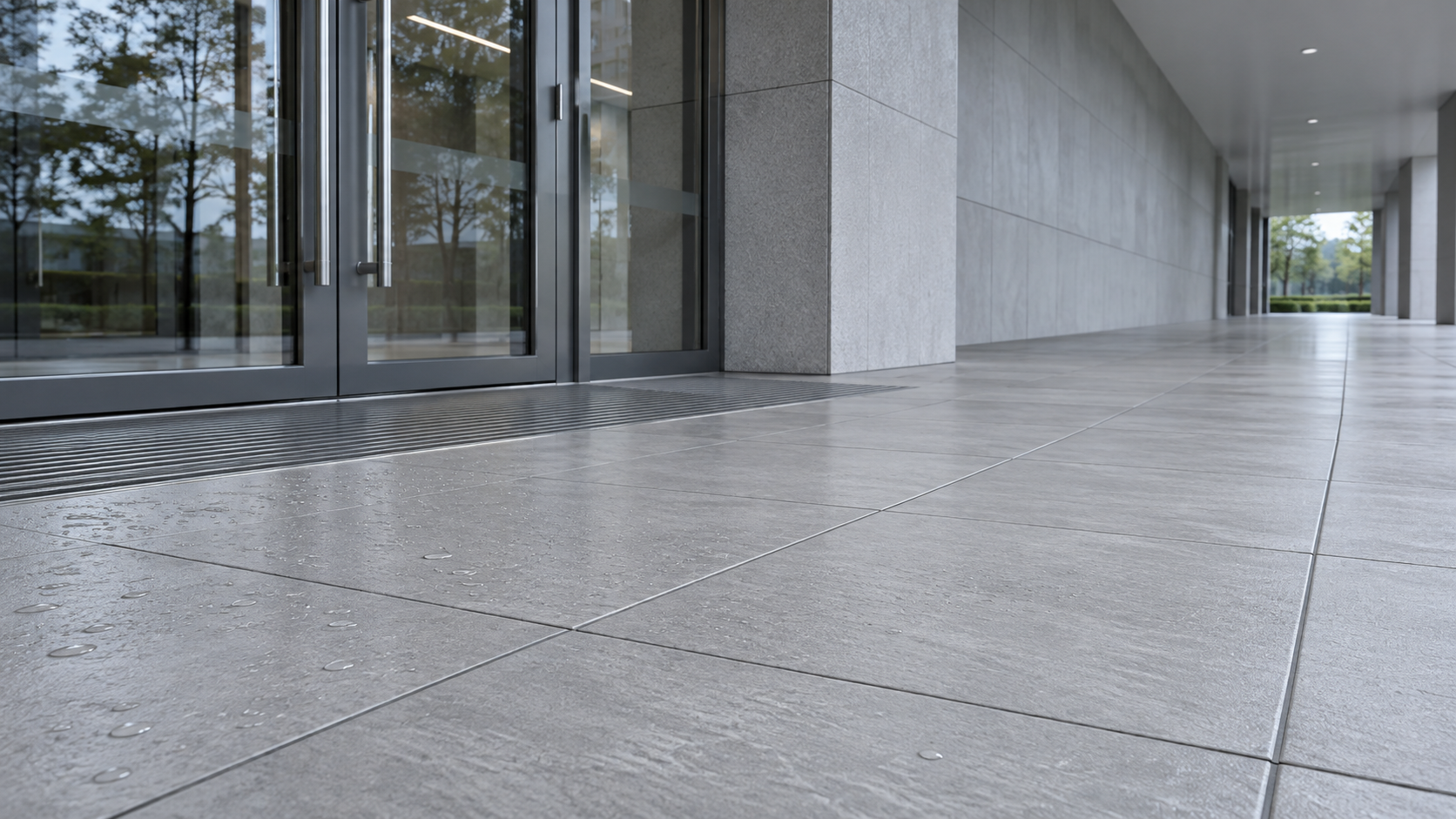
Antibacterial performance should not be the deciding factor when a tile is unsuitable for the traffic, moisture and cleaning conditions of a public space. A tile that performs well in a laboratory antibacterial test can still create an unacceptable slip risk, wear prematurely or become difficult to clean once installed.
The most defensible specification treats antibacterial activity as an additional surface property, not as a substitute for routine cleaning or infection-control measures. The choice depends on whether the claimed effect is supported by relevant evidence and whether the finished floor or wall meets the project’s requirements for safety, durability and maintenance.
Define where antibacterial performance is needed
Public spaces contain surfaces with different exposure patterns. A busy entrance floor may be subject to tracked-in grit, rainwater and heavy abrasion, while a washroom wall may face repeated splashing and chemical cleaning. A wall near a handwashing station may also be touched more frequently than a floor. These differences affect both the value of an antibacterial claim and the performance requirements that take priority.
For floors, pedestrian safety and resistance to wear generally need to be established before comparing antibacterial treatments. In a frequently wet washroom, a tile with credible antibacterial data but inadequate slip resistance is not an acceptable trade-off. In a dry circulation area, cleaning access, abrasion resistance and appearance retention may carry more weight than a highly textured finish intended for wet conditions.
It is also important to distinguish an antibacterial tile from an antibacterial building strategy. Tile covers only part of a space; door hardware, taps, counters, fixtures and other frequently touched surfaces have separate material and cleaning requirements. For an anti-bacterial building for public spaces, tile selection should fit the hygiene plan rather than be expected to deliver it alone.
Interpret antibacterial claims in context
Antibacterial tiles may use an active substance incorporated into a glaze or surface layer, or a treatment applied to the finished surface. Silver-based agents are one example, but the presence of an ingredient does not establish that the installed tile will perform as claimed. The relevant questions are where the active material is located, whether it remains accessible at the surface and what evidence supports activity after the exposure conditions expected in service.
Ask for the complete test report, not just a percentage reduction in a brochure. A useful report identifies the tested product, organisms, method, contact time, test conditions and results against an appropriate control. Confirm that the tested sample has the same glaze, finish and treatment as the tile being specified. A result obtained on a treated laboratory panel or a different finish should not automatically be transferred to the proposed product.
ISO 22196 is a laboratory method for measuring antibacterial activity on plastics and other non-porous surfaces. It can provide a basis for comparing products tested under the method, but its controlled conditions do not reproduce every public-space surface. Moisture, temperature, contact time, surface soiling and cleaning chemistry can all differ from the test environment. A reported reduction therefore does not establish the speed or extent of bacterial reduction during normal occupancy.
Check the scope of the claim carefully:
- Organisms: Activity against the bacteria named in a report does not demonstrate activity against all bacteria, fungi or viruses.
- Contact time: A result after prolonged laboratory contact should not be interpreted as an immediate effect between successive touches.
- Surface condition: Testing on a new, clean sample does not establish performance under dirt, detergent residue or wear.
- Claimed outcome: A reduction in organisms on a test surface is not evidence that the tile prevents infections or makes cleaning unnecessary.
If a project requires antibacterial performance to persist for a defined service period, seek evidence after relevant wear and cleaning exposures. Test methods and conditioning should be identified so that the result can be assessed against the intended use. Where persistence evidence is unavailable, a selection can still be made on the tile’s conventional properties, but the antibacterial benefit should not be treated as a verified long-term performance commitment.
Resolve slip resistance against the actual floor conditions
Slip resistance is a property of a particular finished surface under defined test conditions. It is not established by a tile being porcelain, unglazed or described as “non-slip.” Water, soap, tracked-in contaminants, footwear and surface wear can change the risk after installation.
Specify the assessment route required by the project jurisdiction and occupancy, then compare results obtained using the same method and conditions. ANSI A326.3 is used in North America to assess dynamic coefficient of friction for hard surface flooring, while methods in the EN 16165 framework are used for slip-resistance assessment in European practice. Results from different methods are not interchangeable simply because they all address slip resistance. The selected method and acceptance criterion should match the applicable local requirements and intended use.
Review the exact surface finish and format, especially where a product family includes polished, matt and textured versions. A supplier’s result for one finish should not be assumed to apply to another. For wet areas, obtain results relevant to the expected wet condition rather than relying only on dry-floor data.
Texture creates a genuine selection trade-off. A more pronounced profile may improve traction in a contaminated or wet setting, but its recesses can retain soil and make mechanical cleaning more demanding. A very smooth surface may be easier to wipe yet unsuitable where water or soap reaches the floor. The appropriate finish is the one that meets the required slip criterion and can be cleaned effectively with the available equipment and operating schedule.
Separate wear resistance from antibacterial durability
High traffic affects a tile in more than one way. Abrasive particles can alter its appearance and surface texture; impacts can chip edges; and repeated cleaning can expose the finish to chemicals and mechanical action. Any of these changes may influence the practical value of an antibacterial treatment located at or near the surface.
For glazed tiles, ISO 10545-7 addresses resistance to surface abrasion. Its classification can help assess suitability, but the class should be considered alongside the expected traffic, tracked-in grit and maintenance regime. A public entrance exposed to abrasive soil requires a different assessment from a protected internal corridor. For unglazed tiles, ISO 10545-6 addresses deep abrasion; it is not the same test and its result should not be compared directly with a glazed-tile abrasion class.
Water absorption is another relevant property, particularly for porcelain and other ceramic tiles. ISO 10545-3 provides a method for determining water absorption, while ISO 13006 sets out definitions and specifications for ceramic tiles. Low absorption can support selection for demanding environments, but it does not by itself establish slip resistance, antibacterial activity or suitability of the complete floor assembly.
Where resistance to cleaning chemicals matters, request evidence relevant to the intended products and concentration ranges. ISO 10545-13 covers chemical resistance of ceramic tiles, but a tile test alone does not prove that every grout, sealant or accessory in the assembly will withstand the same cleaning regime. Obtain separate compatibility information for those materials.
Thickness and breaking performance also deserve attention where the floor will carry loaded trolleys, cleaning machines or other concentrated loads. Tile strength depends on the product and the installed system, including substrate support and adhesive coverage. A strong tile installed over voids or an unsuitable substrate can still crack under service loads.
Evaluate the complete installed surface
An antibacterial claim for a tile face does not automatically apply to grout joints, movement joints or sealant. These interfaces influence cleanability and may present different chemical and wear limitations from the tile itself. A specification should identify joint materials and widths, required movement joints and the cleaning procedure for the finished assembly.
Grout selection involves practical compromises. Cementitious and resin-based grouts have different application, cleaning and chemical-resistance characteristics; neither should be selected solely because of a generic hygiene claim. Assess the actual product against the expected cleaning agents, staining exposure and installation conditions. Joint layout also affects cleaning effort: smaller-format tiles create more joints, although they may be useful where a floor must follow falls toward a drain.
In wet areas, drainage and waterproofing are separate from the tile’s antibacterial properties. Tiles and grout should not be assumed to form the waterproofing system. Falls, drains, waterproof membranes and transitions need to be designed as a coordinated assembly under the applicable project requirements.
Cleaning trials can help resolve the tension between traction and soil removal. Use representative samples with the proposed grout, cleaning chemicals and equipment. Assess whether the floor can be cleaned without leaving visible residue, damaging the finish or requiring an impractical amount of scrubbing. A trial does not replace laboratory slip testing, but it can expose maintenance problems that a product data sheet does not show.
Build a specification that can be checked
A requirement such as “antibacterial, commercial-grade tile” leaves too much open to interpretation. A stronger specification identifies the application area, exact finish, required slip-test method and acceptance criterion, ceramic tile classification, relevant abrasion or chemical-resistance requirements, and the supporting documents for antibacterial activity.
The evidence package should connect each result to the proposed product. Request the product code, surface finish, manufacturer, test laboratory, test method and report identification. Check whether the reports cover the supplied finish rather than merely a related product. Where the project depends on a particular result, retain the approved samples and documentation with the procurement records.
Claims and regulatory obligations also depend on the destination market and how the tile is marketed. Antimicrobial substances and treated-product claims can be subject to different rules across jurisdictions. A laboratory test report is not, on its own, proof that a product or claim is authorized for a particular market. Confirm the applicable requirements with the supplier and the project’s compliance advisers before accepting health-related or biocidal claims.
Finally, compare lifecycle implications rather than the tile price alone. A textured surface that meets the slip requirement but requires incompatible cleaning equipment may increase operating costs. A replacement tile that does not match the approved finish may change both appearance and performance. The preferred choice is the one whose documented properties, installation details and maintenance requirements remain aligned with the conditions of the space throughout its intended service life.
Industry Briefing
Get the top 5 industry headlines delivered to your inbox every morning.