Why Architectural Material Science Matters in Wet Areas
In wet areas, performance is not just about appearance—it is about safety, durability, and compliance. That is why architectural material science matters for quality control and safety management teams evaluating surfaces, joints, drainage zones, and moisture-prone systems. By understanding how materials respond to water, heat, bacteria, and long-term wear, professionals can reduce failure risks, improve project standards, and support healthier, more resilient building environments.
Why Wet Areas Demand More Than Good Design
When wet areas fail, the problem rarely starts with aesthetics. It usually begins with hidden moisture, weak joints, poor slip resistance, microbial growth, or incompatible materials under daily stress.
For quality control and safety management teams, this means material decisions cannot be treated as a finishing-stage choice. They directly affect risk exposure, lifecycle cost, maintenance burden, and regulatory performance.
This is where architectural material science becomes essential. It helps professionals judge how a material behaves in real wet conditions, not just how it looks in a product brochure.
Bathrooms, locker rooms, kitchens, healthcare wash spaces, and public sanitary zones all expose materials to water, detergent chemistry, thermal cycling, abrasion, and repeated cleaning pressure.
In these settings, the wrong specification can trigger early staining, cracking, delamination, swelling, corrosion, mold growth, drainage defects, or slip-related incidents that damage both users and brand reputation.
The core value of material science is practical. It gives teams a framework for evaluating porosity, surface energy, thermal stability, coefficient of friction, chemical resistance, and biological susceptibility before failure occurs.
What Quality and Safety Teams Need to Evaluate First
Most search intent behind “why architectural material science matters in wet areas” is not academic. Readers want to know how to reduce failure risk and make more defensible specification decisions.
For this audience, the first question is simple: which material properties matter most in wet environments, and how should they influence approval, inspection, and ongoing risk control?
Start with water interaction. Some materials repel water effectively, while others absorb it through pores, edges, backing layers, or poorly protected interfaces, causing dimensional instability and microbial risk.
Absorption alone is not the full issue. Moisture migration through grout lines, sealant gaps, substrate cracks, and unsealed penetrations often causes hidden damage long before visible defects appear.
Next comes slip resistance. Surface texture, contaminant conditions, cleaning residue, and wear pattern all influence whether a floor remains safe under realistic use rather than laboratory assumptions.
Then consider chemical resistance. Wet areas are cleaned aggressively, and some surfaces degrade when exposed to disinfectants, descalers, alkaline detergents, or repeated sanitizing protocols over time.
Thermal behavior also matters. Hot water, steam, underfloor heating, and alternating dry-wet cycles can expand, contract, or fatigue materials and joints, especially when adjacent systems move differently.
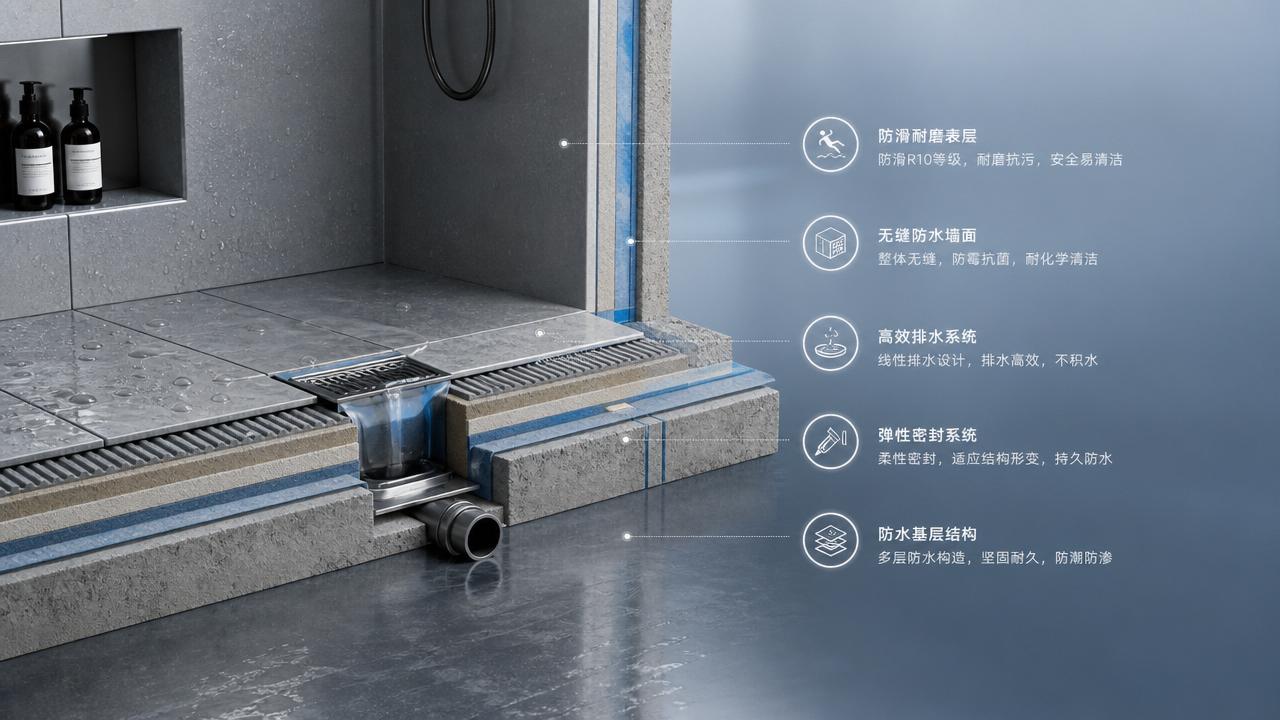
Finally, durability must be viewed as a system issue. Tile, stone, resin, membrane, adhesive, grout, sealant, drain edge, and substrate should be assessed together, not as isolated components.
How Water, Heat, and Movement Create Failure Pathways
Wet area failure is often systemic rather than accidental. Water enters through the weakest path, and that path is usually created by poor compatibility between materials with different physical behaviors.
For example, a dense surface finish may perform well, but if the adhesive retains moisture or the grout cracks under movement, the overall assembly still becomes vulnerable.
Thermal expansion mismatch is another overlooked issue. Ceramic, metal trims, polymer sealants, and cementitious layers all respond differently when exposed to repeated temperature fluctuations.
Over time, these small movements can open micro-gaps. Once water enters those spaces, the structure can experience bond loss, corrosion, efflorescence, odor, or biological contamination.
Drainage zones deserve special attention because they combine standing water, cleaning chemicals, slope transitions, mechanical wear, and frequent maintenance contact in one concentrated point of stress.
Even a premium material can fail near a drain if edge detailing, sealant performance, and local substrate reinforcement are not matched to expected wet service conditions.
Architectural material science helps teams predict these pathways. It shifts evaluation from surface appearance to performance interactions between moisture, temperature, loading, and time.
Why Surface Selection Alone Is Not Enough
Many procurement or design reviews focus heavily on visible surfaces because they are easy to compare. However, quality and safety outcomes depend just as much on the layers underneath.
A slip-resistant tile may appear compliant, yet the installation can still fail if the waterproofing membrane is punctured, the adhesive is misapplied, or the movement joints are underspecified.
Similarly, a non-porous wall panel may resist staining, but if its seams are weak or difficult to sanitize, bacterial retention can become a serious hygiene issue.
This is why experienced teams assess assemblies in terms of interface integrity. Joints, transitions, corners, penetrations, drain collars, and service openings are the true risk points.
Sealants are particularly critical in wet areas. Their elasticity, adhesion, mold resistance, and aging behavior determine whether they remain protective under vibration, cleaning, and moisture exposure.
Substrates also need scrutiny. Moisture-sensitive boards, poorly cured screeds, and uneven base layers can undermine otherwise strong finish materials and create recurring defects after handover.
From a safety management perspective, the message is clear: no finish material should be approved without reviewing the complete wet area build-up and detailing logic.
Hygiene, Mold Control, and Material Behavior
In sanitary environments, hygiene performance is as important as physical durability. Materials influence whether moisture dries quickly, whether residues accumulate, and whether microbes can colonize surfaces or gaps.
Smooth does not always mean hygienic, and textured does not always mean unsafe. The right judgment depends on cleanability, seam design, drainage, usage intensity, and maintenance capability.
Microbial growth usually thrives where moisture is trapped, organic residue remains, and cleaning access is limited. That makes corners, sealant lines, grout joints, and under-drain spaces high-priority inspection zones.
Material science supports smarter selection by comparing anti-bacterial treatments, non-absorbent surfaces, low-retention finishes, and joint systems designed to minimize contamination persistence.
However, teams should remain cautious about marketing claims. Anti-microbial labeling does not replace the need for validated cleaning performance, moisture control, and durable installation quality.
For safety and quality teams, the practical question is whether a material system supports a realistic hygiene regime without degrading, trapping contamination, or increasing labor-intensive maintenance.
In healthcare, hospitality, and high-traffic residential projects, that distinction can determine whether a wet area remains compliant and serviceable over years instead of months.
How to Judge Slip Risk More Realistically
Slip safety is one of the most visible concerns in wet zones, yet it is also one of the most misunderstood. A test value alone does not guarantee safe real-world performance.
Foot traffic type, barefoot or shod use, soap residue, grease contamination, cleaning products, and wear patterns all influence the actual friction users experience on site.
A heavily textured floor may improve traction, but it can also trap dirt and become harder to sanitize. A smoother floor may clean easily, yet become hazardous under wet contamination.
The right balance depends on end use. Public showers, hotel bathrooms, accessible washrooms, and commercial kitchens each require different performance priorities and maintenance assumptions.
Quality control teams should therefore evaluate slip performance together with cleanability, drainage slope, edge transitions, and long-term surface wear instead of approving materials in isolation.
Mock-ups, contamination-condition testing, and post-installation verification are often more valuable than relying solely on supplier literature or dry-condition sample review.
Architectural material science adds value here by framing friction as an evolving property affected by chemistry, abrasion, maintenance, and user behavior over the service life.
Compliance, Documentation, and Defensible Decision-Making
For many readers, the real concern behind this topic is accountability. If a wet area fails, quality and safety teams need evidence that material choices were reviewed systematically and responsibly.
That means documentation should go beyond product names. Teams should record performance criteria, compatibility checks, environmental exposure assumptions, installation controls, and inspection acceptance standards.
Useful records include water absorption data, slip resistance benchmarks, chemical resistance information, sealant specifications, movement joint layouts, substrate moisture limits, and cleaning protocol compatibility.
Commissioning and handover should also include verification of drainage behavior, ponding risk, surface continuity, joint finishing, and maintenance guidance aligned with the selected material system.
This approach strengthens compliance not only with internal standards but also with insurance, warranty, and facility management expectations that increasingly focus on performance traceability.
When architectural material science informs documentation, decisions become easier to defend because they are tied to measurable behavior and foreseeable service conditions rather than preference alone.
That is especially important in public-facing projects where injury claims, water damage, shutdowns, and reputational consequences can become far more expensive than material upgrades.
A Practical Evaluation Framework for Wet Area Material Approval
To make the topic actionable, quality and safety teams can use a simple review framework when evaluating materials and assemblies for wet applications.
First, define the exposure profile. Will the zone face standing water, steam, aggressive cleaning, bare feet, wheeled traffic, hard water scaling, or frequent thermal shifts?
Second, assess the visible material properties. Review porosity, surface finish, friction behavior, stain resistance, impact tolerance, and ease of cleaning under actual operating conditions.
Third, assess the hidden system layers. Verify membrane suitability, adhesive compatibility, substrate readiness, movement accommodation, sealant selection, and drain integration details.
Fourth, test maintenance realism. Ask whether the selected materials can be cleaned effectively using the facility’s actual staffing, tools, chemicals, and service intervals.
Fifth, review failure consequences. Consider what happens if cracking, leakage, or slip deterioration occurs—can the issue be isolated, repaired quickly, and detected early?
Finally, require mock-up validation or sample area review for high-risk zones. This step often reveals practical weaknesses that specifications and catalogs fail to capture.
By applying such a framework, teams move from reactive defect control to preventive risk management, which is the real operational benefit of architectural material science.
Why This Matters for Long-Term Project Value
Wet areas are small in footprint but large in risk concentration. A localized failure can disrupt operations, trigger expensive repairs, increase liability exposure, and compromise user trust.
That is why material science should not be seen as a technical luxury. It is a decision tool that protects lifecycle value across design, construction, maintenance, and compliance management.
For quality control professionals, it supports clearer acceptance criteria and fewer hidden defects. For safety managers, it strengthens prevention of slips, contamination, and moisture-related hazards.
It also improves communication between procurement, design, installation, and operations teams by giving them a common language for discussing performance rather than style alone.
In a market increasingly shaped by higher hygiene expectations, sustainability pressure, and stricter building performance demands, that clarity becomes a strategic advantage.
The best wet areas are not simply attractive on day one. They remain safe, dry, cleanable, and serviceable through years of real use because material behavior was understood from the start.
Conclusion
Architectural material science matters in wet areas because these spaces test materials under constant moisture, heat, cleaning, movement, and safety pressure. Performance must be engineered, not assumed.
For quality control and safety management teams, the key insight is that failure usually begins at interfaces, hidden layers, and real-use conditions rather than at the visible surface alone.
Better decisions come from evaluating whole assemblies, documenting performance logic, and matching materials to realistic exposure, maintenance, hygiene, and compliance requirements.
In practice, this reduces defects, strengthens defensible approvals, and creates wet environments that are safer, more durable, and easier to manage over the long term.
That is the true value of applying architectural material science in wet areas: fewer surprises, lower risk, and better building outcomes where performance matters most.
Industry Briefing
Get the top 5 industry headlines delivered to your inbox every morning.