How to compare a smart kitchen appliances manufacturer
Choosing the right smart kitchen appliances manufacturer requires more than comparing product catalogs. For business evaluators, the real difference lies in production capability, compliance, innovation, supply stability, and long-term market competitiveness. This guide outlines the key factors to assess, helping you identify manufacturers that align with project goals, brand positioning, and evolving smart living demand.
What should business evaluators compare first?
A smart kitchen appliances manufacturer sits at the intersection of hardware engineering, software integration, industrial design, and regulatory compliance. That means supplier comparison should start with business risk, not only product appearance or unit price.
In residential and commercial space projects, smart kitchen systems are increasingly connected to energy efficiency, hygiene expectations, premium user experience, and property value. Evaluators therefore need a framework that reflects both construction logic and consumer technology cycles.
GIAM’s industry perspective is useful here because smart kitchen sourcing no longer belongs to a single category. It is influenced by building material trends, sanitary space upgrades, digital living standards, tariff changes, and the rising demand for low-carbon, intelligent interiors.
- Compare manufacturing depth: Does the supplier control key production stages, or rely heavily on outsourced assembly and third-party electronics?
- Compare market fit: Can the manufacturer support premium real estate, hospitality projects, retail channels, or OEM/ODM brand development?
- Compare execution reliability: Can they maintain delivery under component shortages, standard updates, or cross-border logistics pressure?
- Compare future readiness: Do their products align with water-saving, energy-saving, anti-bacterial, and connected-home trends shaping modern interiors?
How to build a practical evaluation matrix for a smart kitchen appliances manufacturer
Business evaluators often need a scoring model that works across different projects. The table below helps compare a smart kitchen appliances manufacturer on dimensions that affect procurement risk, lifecycle cost, and strategic fit.
This matrix makes comparison more objective. It also helps procurement teams explain supplier choices internally, especially when a lower quoted price does not mean lower total commercial risk.
Why catalog comparison is not enough
Many suppliers can present similar feature lists: touch controls, app connection, sensor systems, or sleek finishes. But business value depends on repeatability, certification fit, service response, spare parts planning, and the ability to keep specifications stable across production batches.
Which manufacturing capabilities reveal a stronger supplier?
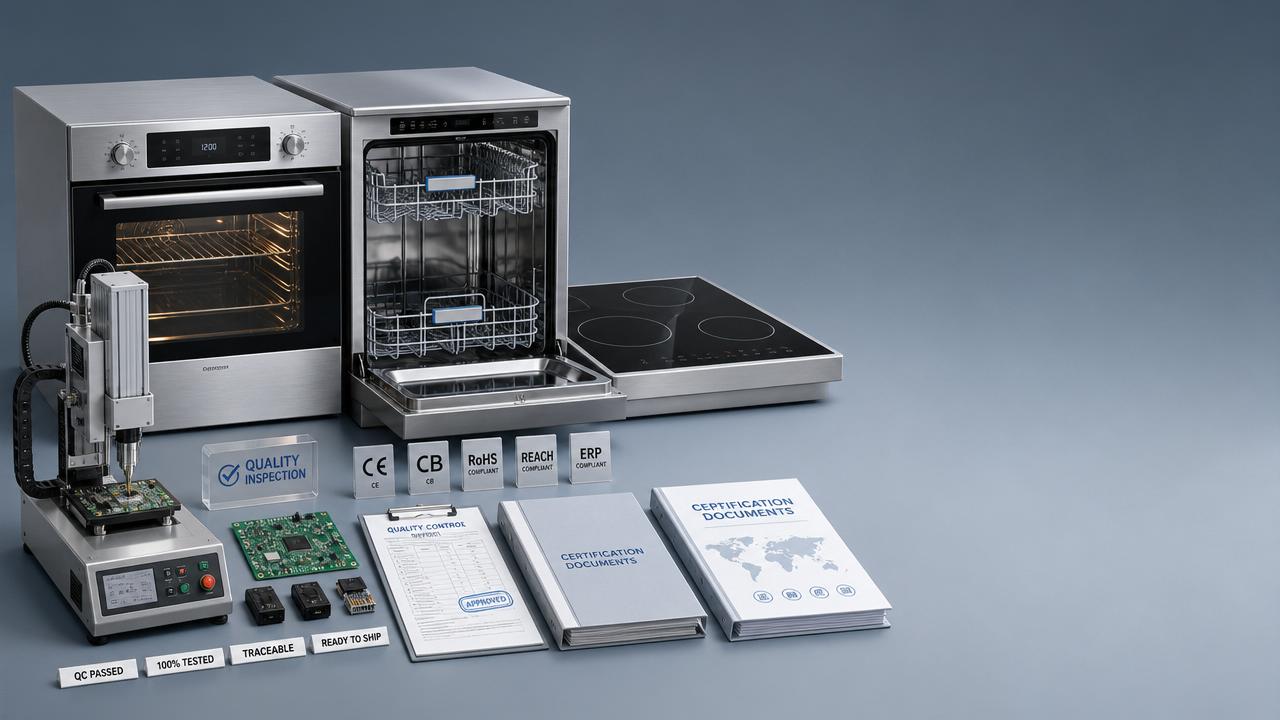
When assessing a smart kitchen appliances manufacturer, manufacturing capability should be reviewed as a systems question. The key issue is not whether the factory is large, but whether it can produce intelligent products with stable quality and traceable control.
Core areas to verify
- Incoming material inspection for electronics, heating elements, sensors, plastic parts, and surface materials used in visible kitchen environments.
- Process control for assembly, calibration, firmware loading, and electrical testing before packing.
- Traceability systems that connect batch records to component sourcing and quality incidents.
- Engineering support for design changes, localization needs, or private-label adaptation.
For kitchen appliances used in built environments, appearance alone is misleading. A product that fits luxury interior positioning but fails under temperature variation, humidity, frequent use, or voltage differences creates warranty exposure and reputation loss.
GIAM’s cross-sector intelligence is especially relevant because appliance evaluation should also consider adjacent material and space trends. Surface durability, anti-bacterial expectations, energy-saving building targets, and integrated kitchen planning increasingly influence purchase approval.
What technical and compliance points should be checked before shortlisting?
Shortlisting a smart kitchen appliances manufacturer without technical and compliance screening can delay projects later. Business evaluators should request structured evidence early, especially for export, property development, hospitality, and branded retail programs.
The table below summarizes common checkpoints for technical performance and market access review.
A technically capable supplier should answer these questions with process evidence, not vague promises. Even when final certifications differ by market, preparation quality often reveals whether the manufacturer understands global project requirements.
Compliance is also a timing issue
Evaluators should not treat certification as a final-step document task. Design choices, materials, power configuration, labeling, and packaging all affect compliance readiness. Early alignment reduces redesign cost and protects launch schedules.
How should you compare cost, lead time, and total commercial value?
A smart kitchen appliances manufacturer may offer an attractive unit price while creating hidden costs elsewhere. Business evaluators need to compare total value across purchasing, logistics, installation, service, and brand impact.
Look beyond quoted price
- Check tooling and customization costs for panel finishes, software interface changes, packaging, and multilingual documentation.
- Review lead time under peak season, not only under normal factory loading conditions.
- Estimate warranty handling cost, spare parts storage, and replacement cycle for electronic modules.
- Assess the cost of inconsistent quality, which may include installation rework, delayed property handover, and channel complaints.
This is where GIAM’s commercial insights matter. Tariff changes, regional demand patterns, urbanization-driven premiumization, and the growth of smart living expectations all affect the real competitiveness of a sourcing decision.
Which manufacturer profile fits your project scenario?
Different projects require different types of smart kitchen appliances manufacturer. Matching supplier profile to application scenario avoids common evaluation errors.
The following comparison helps teams decide whether they need a volume-driven factory, a customization-focused partner, or a compliance-oriented export supplier.
The right supplier is therefore context-specific. A factory ideal for private-label retail may not be the best choice for a hotel fit-out program requiring rapid spare-parts response and finish durability.
What mistakes do evaluators often make?
Mistake 1: Treating smart features as the main value driver
Connectivity matters, but reliability matters more. If firmware updates are unstable, app support is unclear, or local network compatibility is weak, premium features quickly become service liabilities.
Mistake 2: Ignoring the built-environment context
Smart kitchen appliances are not isolated gadgets. They belong to integrated spaces shaped by cabinetry, ventilation, power systems, sanitary expectations, and increasingly by green building standards.
Mistake 3: Evaluating samples but not production repeatability
A polished sample can hide weak mass-production control. Ask how quality is maintained across batches, suppliers, seasonal demand peaks, and customized versions.
Mistake 4: Overlooking market evolution
A smart kitchen appliances manufacturer should not only meet today’s specification. It should be capable of adapting to water-saving expectations, carbon reduction targets, hygiene upgrades, and future smart-home interoperability.
FAQ: practical questions before selecting a smart kitchen appliances manufacturer
How do I verify if a manufacturer can support customized projects?
Ask for a clear development workflow: drawing review, prototype timing, engineering change control, packaging options, user interface localization, and minimum order expectations. A capable supplier should explain which parts can be customized without creating unstable lead times or certification complications.
What is the most important document set to request early?
Start with product specifications, testing process summaries, target-market compliance documents, user manuals, packaging information, and warranty terms. These materials reveal whether the smart kitchen appliances manufacturer is commercially organized and ready for structured procurement.
How should lead time be evaluated?
Do not only ask for standard lead time. Request a breakdown for sampling, tooling if needed, first production, repeat orders, and peak-season conditions. Also ask which components carry the highest shortage risk and whether approved alternatives exist.
Are smart kitchen products suitable for premium building projects only?
No. They can serve multiple tiers, but the feature set, durability requirement, and design integration level should match project positioning. For some developments, practical energy-saving and safety functions deliver more value than advanced app-driven features.
Why market intelligence matters before final supplier selection
Supplier comparison becomes stronger when product evaluation is combined with sector intelligence. A smart kitchen appliances manufacturer may look competitive today but lose relevance if it cannot adapt to tariff shifts, regulatory tightening, or changing demand in urban residential and commercial projects.
GIAM supports this broader view through linked intelligence on building materials, sanitary spaces, and smart kitchen and bath systems. That perspective helps evaluators understand not only what a supplier can ship, but where the market is moving and which product capabilities will remain commercially valuable.
- Track evolving building and energy-saving standards that may affect kitchen appliance specification.
- Monitor demand for anti-bacterial materials, water-saving systems, and integrated smart living functions.
- Identify where premium demand is strengthening across urbanization-driven construction and interior upgrade cycles.
Why choose us for your evaluation process
GIAM helps business evaluators compare a smart kitchen appliances manufacturer through a wider decision lens. Instead of looking only at isolated product claims, we connect manufacturing assessment, compliance logic, market trends, and spatial application insight.
You can consult us for parameter confirmation, product selection strategy, supplier comparison criteria, delivery cycle assessment, customization feasibility, certification requirement review, sample evaluation direction, and quotation discussion support.
If your project involves residential development, commercial interiors, hospitality upgrades, or private-label sourcing, we can help structure the decision process around commercial risk, future demand, and smart living competitiveness. That makes your supplier shortlist clearer, your internal reporting stronger, and your procurement decisions more defensible.
Industry Briefing
Get the top 5 industry headlines delivered to your inbox every morning.