Kitchen and Bath Innovation That Solves Real Space Constraints
For project managers facing tighter footprints, stricter compliance, and rising user expectations, kitchen and bath innovation has become a practical answer to real space constraints. From compact layouts and water-saving systems to smarter material selection and integrated functionality, the right solutions can improve efficiency, usability, and project value without compromising design intent.
Why scenario differences matter before selecting any solution
In real projects, space pressure rarely looks the same from one job to another. A micro-apartment tower, a business hotel, a healthcare renovation, and a mixed-use commercial block may all require kitchen and bath innovation, but the decision logic is very different in each case. One project may prioritize fast installation and standardized maintenance, while another may need premium finishes, universal accessibility, or aggressive water-efficiency targets. For project managers and engineering leads, the key question is not whether innovation is desirable. It is whether a specific solution fits the actual operating, construction, and lifecycle conditions of the space.
That is why scenario-based evaluation matters. In a constrained footprint, every millimeter of circulation, every pipe route, every cabinet depth, and every service access panel affects cost and usability. GIAM’s intelligence perspective is especially relevant here: successful space decisions come from aligning material performance, hydraulic logic, user behavior, compliance needs, and long-term asset value. In other words, kitchen and bath innovation should be treated as a project tool, not a styling exercise.
Where kitchen and bath innovation most often appears in project delivery
Most procurement and design teams encounter kitchen and bath innovation when a project faces one or more of the following pressures: reduced floor area, higher occupancy density, renovation limits, sustainability requirements, or stronger expectations for smart functionality. These pressures appear across several recurring scenarios.
- Urban residential developments with compact unit plans
- Hotels, serviced apartments, and co-living properties
- Healthcare, senior living, and assisted-use environments
- Commercial office pantries, washrooms, and amenity zones
- Renovation projects in older buildings with fixed shafts and structural limits
- Premium mixed-use developments where aesthetics must coexist with durability and low maintenance
In each of these contexts, kitchen and bath innovation serves a different business purpose. Sometimes it unlocks more sellable area. Sometimes it reduces water and energy use. Sometimes it simplifies cleaning, lowers callbacks, or supports safer user movement. The practical benefit changes by scenario, so the evaluation criteria must change as well.
Scenario comparison: what project teams should prioritize
Before moving into product selection, it helps to compare the dominant needs in typical project settings. The table below gives project managers a quick decision framework for matching kitchen and bath innovation to actual constraints.
Scenario 1: compact residential projects need integrated functionality
In urban residential developments, kitchen and bath innovation often starts with a simple problem: how to keep a small unit marketable. Buyers and tenants increasingly expect full-function kitchens, comfortable showers, generous storage, and modern finishes even when unit sizes shrink. This creates a design tension that project teams must solve through integration, not enlargement.
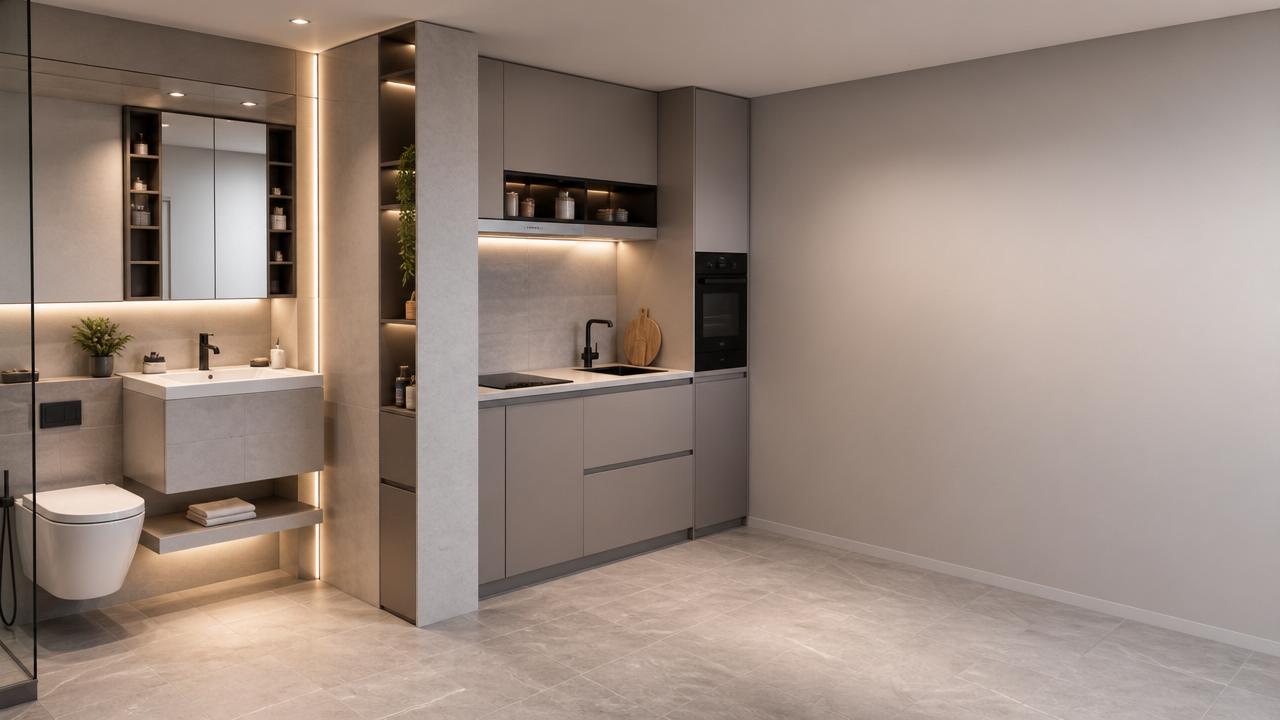
The most suitable solutions in this scenario are those that combine multiple functions in one footprint. Examples include mirrored storage cabinets, wall-hung vanities that free floor area, corner basins, pocket or sliding access solutions, shallow-depth counters, and integrated appliance modules. In the kitchen, compact work triangles and vertical storage become more important than adding more hardware. In the bathroom, door swing optimization and wet-dry separation can improve usable movement more than increasing area on paper.
For project managers, the evaluation should focus on repeatability, installation tolerance, and end-user perception. A highly innovative system may look efficient in a sample room but fail if it complicates MEP coordination or creates difficult replacement cycles after handover. Good kitchen and bath innovation in this setting should support standardization across many units while still delivering a premium feel.
Scenario 2: hospitality projects need speed, consistency, and low disruption
Hotels, serviced apartments, and co-living projects use kitchen and bath innovation in a more operational way. Here, the challenge is not just space efficiency but repeatable performance across dozens or hundreds of rooms. A compact bathroom in hospitality must be easy to clean, resistant to moisture damage, visually consistent, and serviceable with minimal room downtime. A kitchenette must provide essential utility without increasing maintenance complexity.
In this scenario, modular bathroom pods, pre-coordinated fixture packages, anti-stain surfaces, and low-flow fittings often create strong value. Sensor-based controls may also make sense in common-area washrooms, especially where hygiene and water reporting matter. Project leaders should pay close attention to maintenance access behind panels, spare-parts availability, and the labor implications of installation. A solution that saves floor area but increases shutdown time during repairs may reduce long-term operating value.
Hospitality teams should also distinguish between guest-facing innovation and back-of-house efficiency. Not every visible smart feature improves satisfaction, but silent gains such as leak detection, pressure balancing, and durable anti-bacterial finishes can reduce complaints and operating costs over time.
Scenario 3: healthcare and assisted-use spaces require safer innovation
In healthcare clinics, rehabilitation centers, senior living, and assisted-use residential spaces, kitchen and bath innovation should be assessed through safety, hygiene, and accessibility first. Space constraints still matter, but the wrong compact solution can create user risk. Narrow maneuvering zones, poor grab-point planning, reflective surfaces, or hard-to-operate controls may satisfy layout efficiency while failing actual use conditions.
Suitable innovations in this category include anti-bacterial materials, easy-clean integrated sinks, thermostatic mixing controls, touch-reduced fixtures, slip-resistant finishes, and storage planning that reduces bending or reaching. In bathrooms, wall-hung systems can support easier floor cleaning, but only if installation robustness and user support needs are fully checked. In compact kitchen areas for assisted users, reachable storage and simplified appliance interfaces matter more than visual minimalism.
For engineering and project leads, this is a scenario where compliance alignment must happen early. Spatial innovation should not be approved based only on showroom dimensions. Mock-up testing, user-path checks, and maintenance review are essential before procurement is locked.
Scenario 4: commercial amenity zones need throughput and durability
Office towers, retail complexes, education spaces, and mixed-use developments often struggle with washrooms and pantry areas that serve fluctuating user volumes. Here, kitchen and bath innovation is less about private comfort and more about throughput, resilience, and cleaning efficiency. The question becomes: how can a limited service area support many users with minimal interruption?
Project teams in this scenario should prioritize layouts that reduce bottlenecks, materials that resist staining and impact, and fixture systems that support rapid maintenance. Sensor taps, water-saving flush systems, compact handwash stations, and modular sink runs are common choices. For pantry zones, integrated waste sorting, easy-wipe counters, and compact appliance stacks can reduce clutter and keep circulation clear.
The business lens here is important. A visually attractive washroom that closes frequently for repairs is not a success. Likewise, a pantry that appears efficient but creates cleaning congestion at peak use can affect tenant satisfaction. Kitchen and bath innovation should therefore be tested against real occupancy patterns, not idealized design assumptions.
Scenario 5: renovation projects need flexible systems more than bold concepts
Renovation is where many project teams overestimate the value of trend-driven innovation and underestimate physical constraints. In older buildings, existing shafts, slab openings, pipe gradients, wall conditions, and legacy dimensions may limit what can actually be installed. In such cases, the best kitchen and bath innovation is often the solution that adapts to the building rather than forcing expensive restructuring.
Useful approaches include shallow service cavities, flexible waste routing, compact sanitaryware with proven installation tolerances, prefabricated subassemblies, and finishes that can improve perceived quality without major demolition. Smart leak monitoring can also be valuable in aging assets, especially where hidden infrastructure risk is high.
Project managers should insist on early site verification, clash review, and maintenance path mapping. If the innovation depends on ideal wall depths or exact alignment that the existing structure cannot provide, the budget risk can escalate quickly. In renovation scenarios, practicality is the highest form of innovation.
How to judge fit: a practical checklist for project managers
Across all scenarios, kitchen and bath innovation should be filtered through a consistent decision framework. This helps teams compare options without losing sight of project realities.
- Does the solution save usable space, or only reduce visual clutter?
- Can MEP systems support it without major redesign?
- Will maintenance access remain simple after installation?
- Does it improve water, energy, hygiene, or safety performance in measurable terms?
- Is the material suited to the expected cleaning regime and user load?
- Can the solution be standardized across multiple units or locations?
- Are spare parts, replacement cycles, and supplier support clear?
This is where GIAM-style market intelligence becomes useful. Decisions should combine technical suitability with trend visibility, regulatory movement, and cost competitiveness. A product that looks advanced today may lose value if it fails future water standards, hygiene expectations, or serviceability requirements.
Common misjudgments when applying kitchen and bath innovation
Several recurring mistakes appear across projects. The first is treating all small spaces as identical. A compact ensuite, an accessible bathroom, and a high-traffic office washroom may share size pressure but need completely different solutions. The second is overvaluing visual minimalism while underestimating service access and durability. Hidden systems can look elegant, but if repairs require destructive work, the operational penalty is severe.
Another common error is selecting fixtures and materials in isolation. True kitchen and bath innovation usually comes from coordinated performance: material choice, water-saving hardware, cabinet geometry, drainage planning, lighting, ventilation, and user movement all need to work together. Finally, many teams postpone user-scenario testing until late stages. By then, revisions are expensive. Early mock-ups and maintenance reviews are far more cost-effective than late corrective changes.
FAQ: scenario-based questions project teams often ask
Is kitchen and bath innovation only relevant for premium developments?
No. In many mid-market and efficiency-driven projects, kitchen and bath innovation delivers value through better layout use, reduced water consumption, easier maintenance, and faster installation rather than luxury positioning.
Which scenario benefits most from compact integrated systems?
Compact residential units, hospitality rooms, and renovation projects often benefit the most, provided that service access and code compliance are protected.
When should teams be cautious about smart features?
Be cautious when maintenance support is weak, user traffic is extremely high, or replacement parts are uncertain. Smart functionality should solve a clear operational problem, not add complexity for its own sake.
Turning space constraints into project advantage
The most effective kitchen and bath innovation does not begin with a catalog. It begins with a scenario. Project managers who define the real constraint first—space, hygiene, compliance, occupancy, renovation risk, or lifecycle cost—are far more likely to choose solutions that perform after handover. Whether the project is residential, hospitality, healthcare, commercial, or retrofit-focused, the winning approach is the same: match innovation to use conditions, verify technical fit early, and measure value across the full operating lifecycle.
If your team is comparing options for constrained kitchens, bathrooms, or sanitary spaces, start by mapping the actual scenario, user load, maintenance model, and compliance target. From there, kitchen and bath innovation becomes a disciplined project decision—one that can improve efficiency, protect budgets, and strengthen long-term asset performance.
Industry Briefing
Get the top 5 industry headlines delivered to your inbox every morning.