
UAE Tightens EER Rules for Integrated Cooling Modules
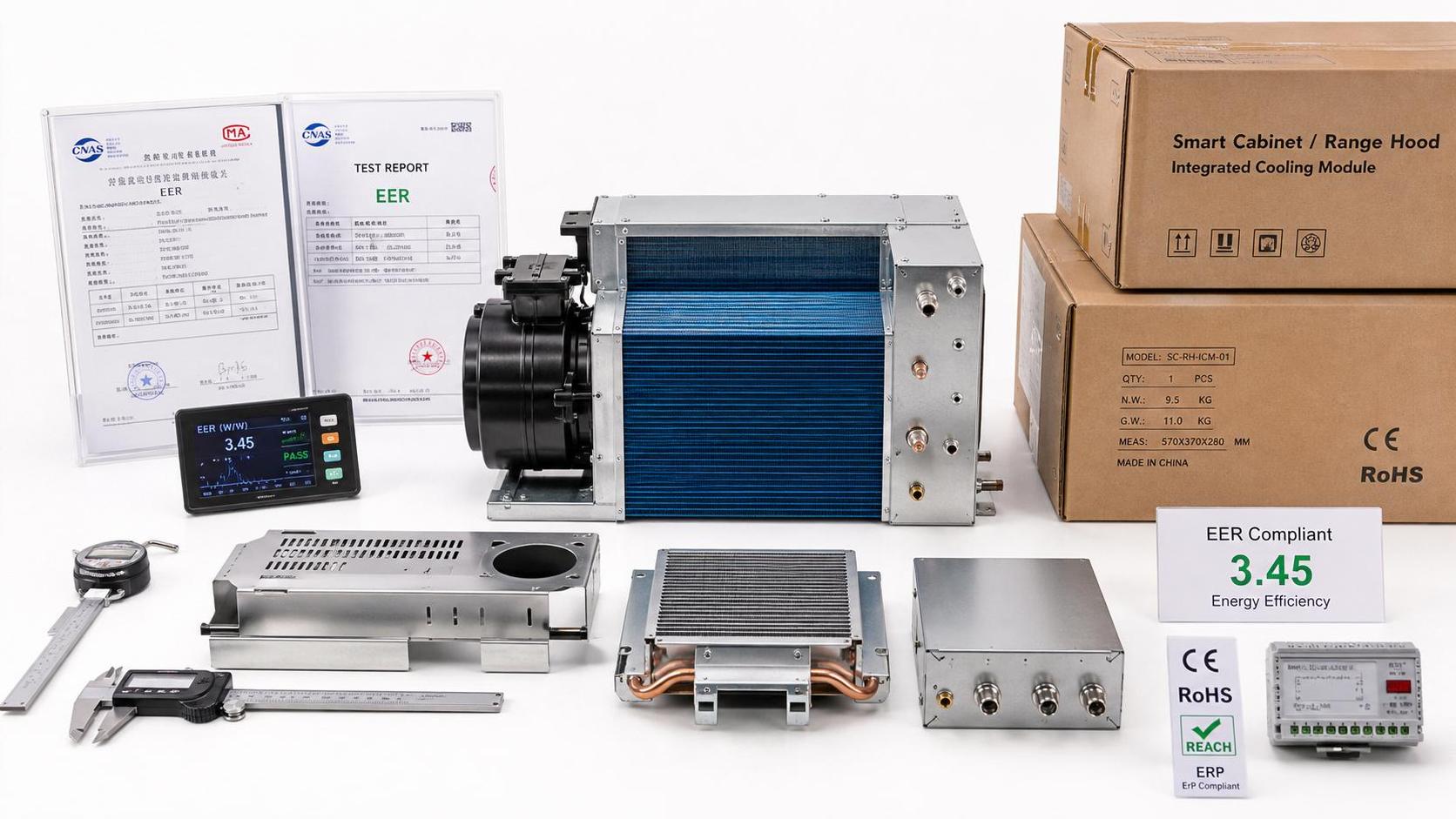
On June 23, 2026, the UAE brought a revised air-conditioner energy efficiency rule into effect under ESMA S 5050:2026, extending mandatory energy performance control to heat-exchange and cooling modules integrated into Smart Cabinets and Range Hoods. The change matters not only for product design, but also for export documentation, testing, customs clearance, and delivery planning, especially for suppliers shipping related components into Jebel Ali Free Zone.
What the rule now covers
The confirmed change is that the revised ESMA air-conditioner energy efficiency regulation, effective June 23, 2026, now brings integrated heat-exchange and cooling modules used in Smart Cabinets and Range Hoods into mandatory energy efficiency supervision.
The stated threshold is EER ≥ 4.2.
For related components exported from China, a measured test report issued by an ESMA-recognized laboratory is required. Without that report, the goods cannot complete customs clearance into Dubai's Jebel Ali Free Zone.
Where the immediate pressure points appear
Export shipments face a document-first compliance check
For exporters of related components, the rule change may affect the shipment release process more directly than marketing claims or product positioning. The practical issue is whether the shipment file includes a valid measured report from an ESMA-recognized laboratory. If that document is missing, the impact may appear at the customs clearance stage rather than later in the sales cycle.
Manufacturers need to connect design output with test evidence
For manufacturers of integrated cooling or heat-exchange modules, the new requirement may affect product specification review, sample preparation, and model-level compliance screening. From an industry perspective, what deserves closer attention is the link between actual energy performance and export eligibility, because the stated EER threshold now sits alongside a specific test-report requirement.
Buyers and procurement teams may need tighter technical alignment
For procurement teams sourcing components for Smart Cabinets or Range Hoods, the rule may affect supplier qualification, technical specification alignment, and delivery scheduling. A purchasing decision that previously focused on fit, cost, and lead time may now also need to verify whether the supplier can provide the required ESMA-recognized laboratory report before shipment.
Testing and compliance service providers may see a more operational role
For laboratories, certification support teams, and compliance service providers, the change may shift attention toward test readiness, document completeness, and timing coordination. Analysis shows that the issue is not only whether a component can meet EER ≥ 4.2, but also whether the supporting evidence is accepted in the form required for market entry and clearance.
What companies should review now
Check whether the affected product scope touches integrated modules
Companies involved with Smart Cabinets, Range Hoods, or related embedded cooling assemblies should review whether their shipped items fall within the newly regulated scope described in the update. Where product classification or scope interpretation is not fully clear from internal files, it is more appropriate to treat this as a compliance review point rather than assume exclusion.
Verify report readiness before shipment windows are fixed
Because the input states that a measured report from an ESMA-recognized laboratory is required for related Chinese exports, companies should pay close attention to whether testing documents are complete before booking delivery milestones. Observably, this is a document sequence issue as much as a technical issue, since missing paperwork can affect clearance into Jebel Ali Free Zone.
Recheck tender files, technical sheets, and supplier submissions
Where tenders, quotations, or supply agreements involve integrated cooling functions, companies may need to review whether technical files and supplier submissions reflect the new EER threshold and the required test evidence. If commercial or technical documentation still reflects an earlier understanding of product scope, the gap may surface during order execution or border clearance.
Keep watching for execution language and market practice
The provided information confirms the rule change and the report requirement, but it does not provide fuller execution details beyond that. Companies should therefore continue monitoring official wording, compliance interpretation, and transaction-level practice before treating all operational questions as settled.
Why this looks like an execution signal
Analysis shows that this development is better understood as more than a labeling update in name alone. The notable shift is that integrated cooling modules inside Smart Cabinets and Range Hoods are now explicitly tied to a mandatory energy efficiency threshold and a recognized test-report requirement for export clearance.
At the same time, it is also appropriate to view this as a rule whose market execution still deserves observation. The confirmed facts establish the threshold, the covered integrated modules, and the report requirement for Chinese exports, but industry participants still need to watch how specification language, supplier screening, and customs-facing documentation practices align in actual transactions.
How to read the latest change
From an industry perspective, the current update is most usefully read as a landed compliance change with immediate trade relevance, rather than as a distant policy signal. Its importance lies in the way technical performance, recognized testing, and customs access are now connected for certain integrated cooling components.
A cautious conclusion is that affected businesses should not overstate the broader market impact, but they also should not treat the change as a routine label adjustment. At this stage, it is more appropriate to understand it as a concrete compliance threshold that can influence sourcing, export preparation, and delivery execution.
Basis of this article
This article is generated based on the user-provided news title, event date, and event summary. The specific official source link was not provided in the input, so it still requires follow-up verification against relevant source types typically associated with such developments, including official regulatory notices, releases from the competent standards or metrology authority, customs or trade administration information, standard-setting documents, industry association materials, and reporting by authoritative trade media.
Further observation is still needed on detailed implementation language, certification and testing interpretation, tender-document updates, market feedback, and how affected companies apply the requirement in shipment and clearance practice.
Industry Briefing
Get the top 5 industry headlines delivered to your inbox every morning.