Indonesia Tightens Fire Safety for Bathroom Cabinets
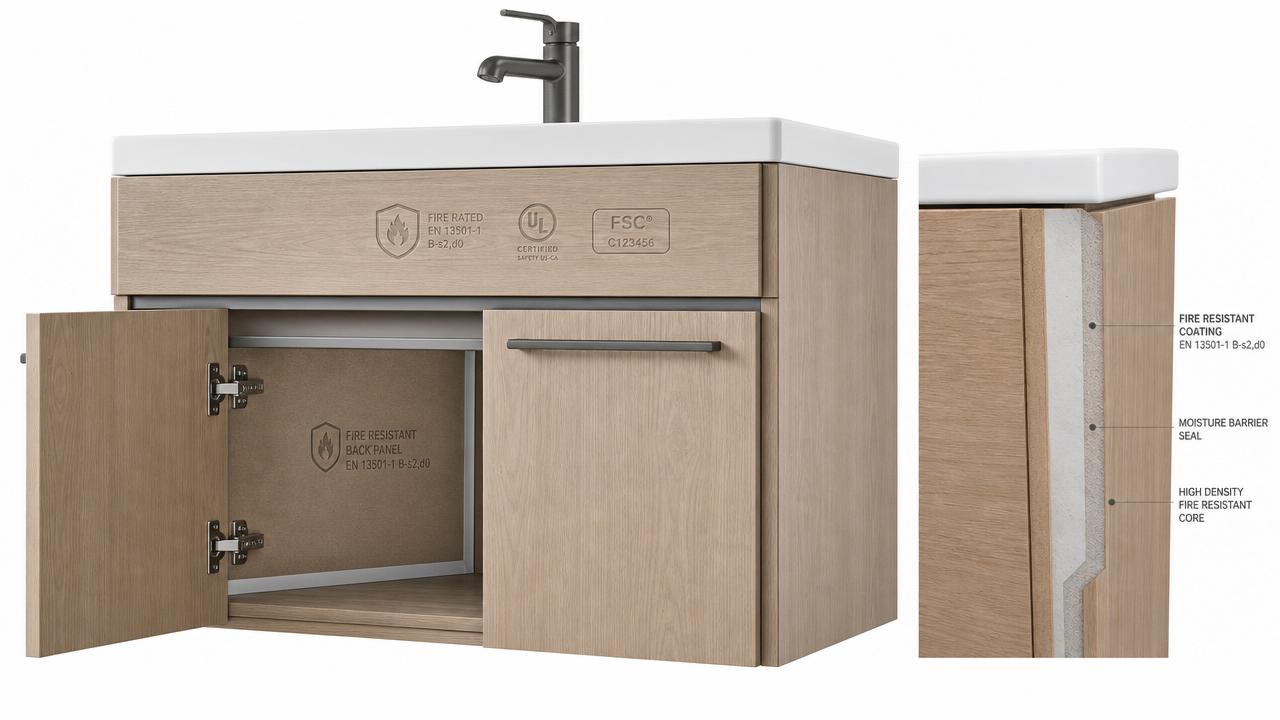
On May 10, 2026, Indonesia’s Statistics Agency (BPS) and the National Fire Directorate jointly updated technical guidelines for fire certification of bathroom cabinets — introducing a stricter thermal radiation penetration limit of ≤15 kW/m² under GB/T 27904-2023 testing. This revision directly impacts manufacturers, exporters, and distributors of bathroom cabinets targeting the Indonesian market, as compliance is now mandatory for obtaining the SNI mark and accessing formal distribution channels.
Event Overview
Indonesia’s Statistics Agency (BPS) and the National Fire Directorate issued an update on May 10, 2026, to the technical guidance for fire safety certification of bathroom cabinets. The amendment mandates that all imported bathroom cabinets — regardless of material (wood, engineered wood, stainless steel) — must achieve a thermal radiation penetration value of no more than 15 kW/m² when tested per GB/T 27904-2023. This replaces the previous limit of 25 kW/m². The requirement takes effect immediately; non-compliant products are barred from receiving the SNI mark and cannot enter Indonesia’s regulated distribution system.
Industries Affected
Direct Trading Enterprises: Exporters and importers of bathroom cabinets face immediate customs clearance and market access risks. Since SNI certification is now contingent on meeting the revised thermal radiation threshold, shipments without verified test reports may be detained or rejected at port. Certification timelines may extend due to retesting needs, affecting order fulfillment cycles and contractual penalties.
Raw Material Procurement Enterprises: Suppliers of substrate materials (e.g., MDF, particleboard, fire-retardant plywood, coated stainless steel) must now ensure their base products contribute to meeting the tighter thermal barrier performance. Previously acceptable flame-retardant additives or surface treatments may no longer suffice, prompting reassessment of supplier specifications and incoming quality protocols.
Manufacturing Enterprises: Cabinet fabricators must revise product designs and assembly methods — especially joint sealing, back panel insulation, and internal cavity management — to suppress radiant heat transfer during fire exposure. Process validation (e.g., prototype testing, batch sampling) becomes more resource-intensive, and production line adjustments may be required to accommodate new material combinations or protective layers.
Supply Chain Service Enterprises: Third-party testing labs, SNI certification consultants, and logistics providers specializing in regulatory compliance must update their service offerings. Labs need to calibrate equipment and validate test repeatability for the lower 15 kW/m² pass/fail criterion; consultants must revise client readiness checklists and pre-submission audits accordingly.
Key Focus Areas and Recommended Actions
Verify Existing Product Test Reports Against the New Threshold
Enterprises should retrieve and re-evaluate all prior GB/T 27904-2023 test reports: if results show thermal radiation penetration between 15–25 kW/m², those products require redesign or retesting. Do not assume grandfathering — the regulation applies to all new certifications and renewals effective May 10, 2026.
Engage Accredited Testing Labs Early for Revalidation
Given potential lab backlogs and the need for controlled test conditions (e.g., specimen conditioning, ignition source calibration), companies should initiate retesting at BPS-recognized laboratories well ahead of planned shipment dates. Prioritize high-volume SKUs and best-selling configurations first.
Review Material Specifications with Tier-1 Suppliers
Procurement teams must request updated technical data sheets from raw material suppliers confirming compatibility with the ≤15 kW/m² requirement — particularly for fire-retardant coatings, laminates, and core substrates. Joint verification testing may be advisable where supplier claims lack third-party corroboration.
Update Internal Compliance Documentation and Labeling
SNI application dossiers, technical files, and product labeling must explicitly reference compliance with the revised thermal radiation limit. Misstating the standard version or omitting the 15 kW/m² figure may result in certification rejection or post-market audit findings.
Editorial Perspective / Industry Observation
Observably, this tightening reflects Indonesia’s broader shift toward harmonizing domestic fire safety standards with ASEAN-wide risk mitigation frameworks — rather than merely adopting international benchmarks. Analysis shows the 40% reduction in allowable thermal radiation (from 25 to 15 kW/m²) targets real-world flashover prevention in compact, moisture-prone bathroom environments, where rapid heat buildup poses disproportionate risk to occupants. From an industry perspective, the change is less about incremental compliance and more about recalibrating thermal performance expectations across the entire cabinet value chain. Current more critical concern lies not in feasibility — many premium-tier products already meet or approach 15 kW/m² — but in consistency across mass-produced variants and cost-sensitive supply tiers.
Conclusion
This amendment underscores that fire safety regulation in emerging markets is evolving from prescriptive ‘pass/fail’ checks toward performance-based, scenario-informed thresholds. For global bathroom cabinet stakeholders, it signals a need to embed thermal engineering considerations earlier in product development — not just as a final certification hurdle. A rational interpretation is that Indonesia’s move may catalyze similar updates in neighboring jurisdictions, making proactive alignment strategically advantageous beyond immediate market access.
Source Attribution
Official notice issued by Badan Pusat Statistik (BPS) and the National Fire Directorate of Indonesia, dated May 10, 2026. Technical reference: GB/T 27904-2023 ‘Test method for fire resistance of building components — Determination of thermal radiation penetration’. Note: Implementation guidance documents, laboratory accreditation lists, and transitional arrangements remain under official publication — to be monitored closely through BPS and the Indonesian National Standardization Agency (BSN).
Industry Briefing
Get the top 5 industry headlines delivered to your inbox every morning.