
EU REACH update tightens compliance for bathroom hardware
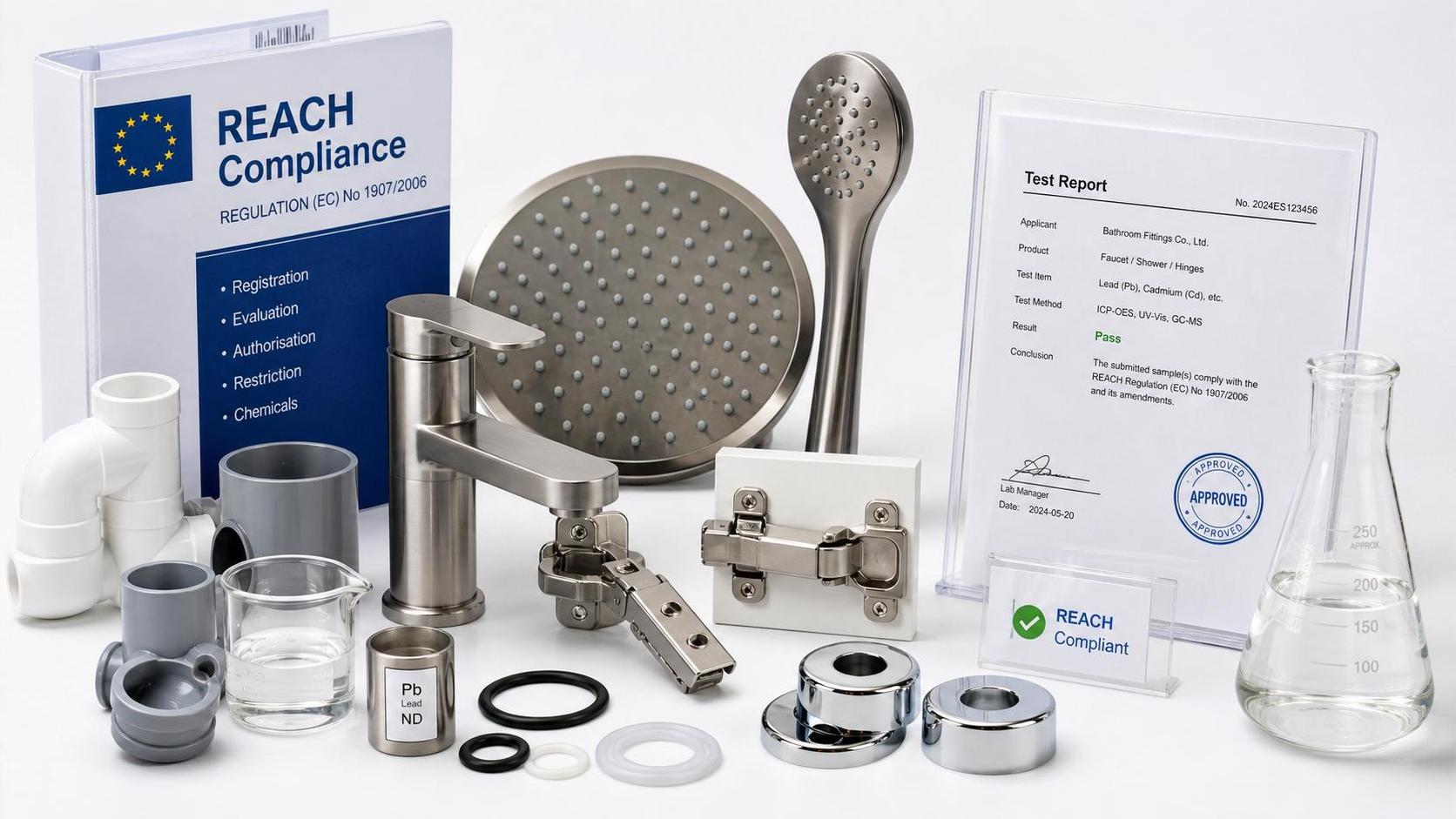
On June 22, 2026, the EU updated the REACH restriction list in a change that directly affects bathroom hardware containing PVC, silicone, or plated components. The update covers newly added restricted substances relevant to products such as faucets, showers, and bathroom cabinet hinges, and it links market access to SVHC notification and a Declaration of Conformity (DoC). For exporters, manufacturers, sourcing teams, and distribution channels, the key issue is not only the substance list itself, but the fact that products without the required compliance filing may be refused entry or removed from sale from July 22, 2026.
What the rule change confirms
The confirmed information is limited but commercially significant. The EU updated the REACH restriction list on June 22, 2026, adding three categories of phthalate derivatives and one organotin compound. The scope expressly applies to components used in faucets, showerheads, and bathroom cabinet hinges where PVC, silicone, or plating is involved.
The stated compliance consequence is also clear: from July 22, 2026, products that have not completed SVHC notification and a DoC will face refusal of entry or removal from the market. Based on the information provided, this is a live compliance condition tied to market access rather than a distant policy signal.
Where the pressure is likely to appear first
Material and component purchasing moves closer to compliance review
For procurement teams and raw material buyers, the immediate issue is whether PVC, silicone, sealing, and plated parts in current supply arrangements can still support compliant declarations. Their exposure is not limited to price or lead time; it now extends to whether upstream materials can be documented in a way that supports SVHC notification and a DoC for finished products.
Manufacturing and export functions face tighter release decisions
For processors, assemblers, and export-oriented manufacturers, the impact is likely to fall on shipment readiness, product file review, and release control. Products such as faucets, showers, and hinge assemblies may require renewed internal checks where plating, sealants, or polymer-based parts are involved. What deserves closer attention is that a missing filing does not appear to be a minor paperwork gap in this context, because the stated consequence is rejection at entry or market withdrawal.
Distributors and channel operators carry downstream exposure
For distributors, importers, and channel operators, the rule change affects listing continuity and stock risk. If a product has not completed the required notification and declaration steps by the stated date, the issue may extend beyond customs clearance to shelf availability and post-entry compliance status. This means document collection and supplier confirmation become part of routine channel risk control.
Testing and certification-related service providers may see a document-driven response cycle
For compliance service providers, laboratories, and technical documentation support teams, the likely impact is an increase in requests tied to declaration support, material verification, and product file updates. Analysis shows that the market response may center less on abstract regulatory interpretation and more on whether supporting records are complete enough for transaction, shipment, and listing decisions.
What companies should review now
Check which product structures fall within the named material scope
Companies should first screen product families that contain PVC, silicone, sealing compounds, or plated parts, especially where those structures are present in faucets, shower products, and bathroom cabinet hinges. The practical question is whether existing compliance files still match the updated restriction scope described in the event summary.
Re-examine whether notification and declaration files are complete
From an operational perspective, the priority is document completeness. Businesses should review whether SVHC notification and DoC materials for affected products are already in place, need revision, or depend on updated supplier inputs. Because the provided information does not include detailed enforcement procedures, it is more appropriate to treat this as a compliance checkpoint that requires confirmation rather than assume a uniform execution path in every transaction scenario.
Watch delivery planning and order commitments around the July 22 date
Export scheduling, customer confirmation, and release timing may require closer coordination where affected components are involved. Observably, any product moving close to the stated enforcement date may require stronger internal review of technical files and supplier documentation before shipment or listing commitments are finalized.
Keep supplier qualification and traceability under active review
Where plated layers, sealants, silicone parts, or PVC-based components are sourced externally, supplier qualification may need to be revisited through a compliance lens. This is not only a purchasing issue; it also affects traceability, after-sales response, and the ability to support product statements if a channel partner or buyer requests proof of conformity.
Why this looks more like an execution signal than a distant policy topic
From an industry perspective, this update is better understood as an execution-level compliance signal tied to actual market access conditions. The short interval between the June 22 update and the July 22 consequence date shifts attention from policy awareness to filing readiness, document availability, and shipment control.
At the same time, analysis should remain measured. The input does not provide detailed enforcement language, testing pathways, or transaction-specific handling. For that reason, the most useful reading at present is that the rule change has already crossed into practical compliance territory, while the exact market interpretation and implementation rhythm still require observation.
How the market may need to interpret this change
A rational takeaway is that the update does not simply add substances to a regulatory list; it also raises the compliance threshold for selected bathroom hardware structures that rely on PVC, silicone, sealants, or plated parts. For affected businesses, the immediate task is not broad strategic repositioning, but disciplined review of materials, declarations, supplier support, and shipment readiness.
Current conditions make it more appropriate to understand this event as a rule change with near-term commercial consequences, while still recognizing that some enforcement details and market responses may develop through subsequent implementation practice.
Basis of this article and what still needs verification
This article is generated from the user-provided news title, event date, and event summary. It does not rely on any additional unverified policy number, agency statement, company case, market data, or source link.
For events of this kind, relevant source categories typically include official regulatory notices, releases from supervisory authorities, customs or trade administration updates, industry association communications, standards-related documents, and reporting by established professional media. However, a specific official source link was not provided in the input, so the exact official publication path still requires follow-up verification.
What still needs continued observation includes any further policy detail, compliance interpretation, certification practice, tender document changes, channel requirements, industry feedback, and how affected companies implement document updates and product review in response to the July 22 threshold.
Industry Briefing
Get the top 5 industry headlines delivered to your inbox every morning.