
EN 16688:2026 Takes Effect for Smart Toilets
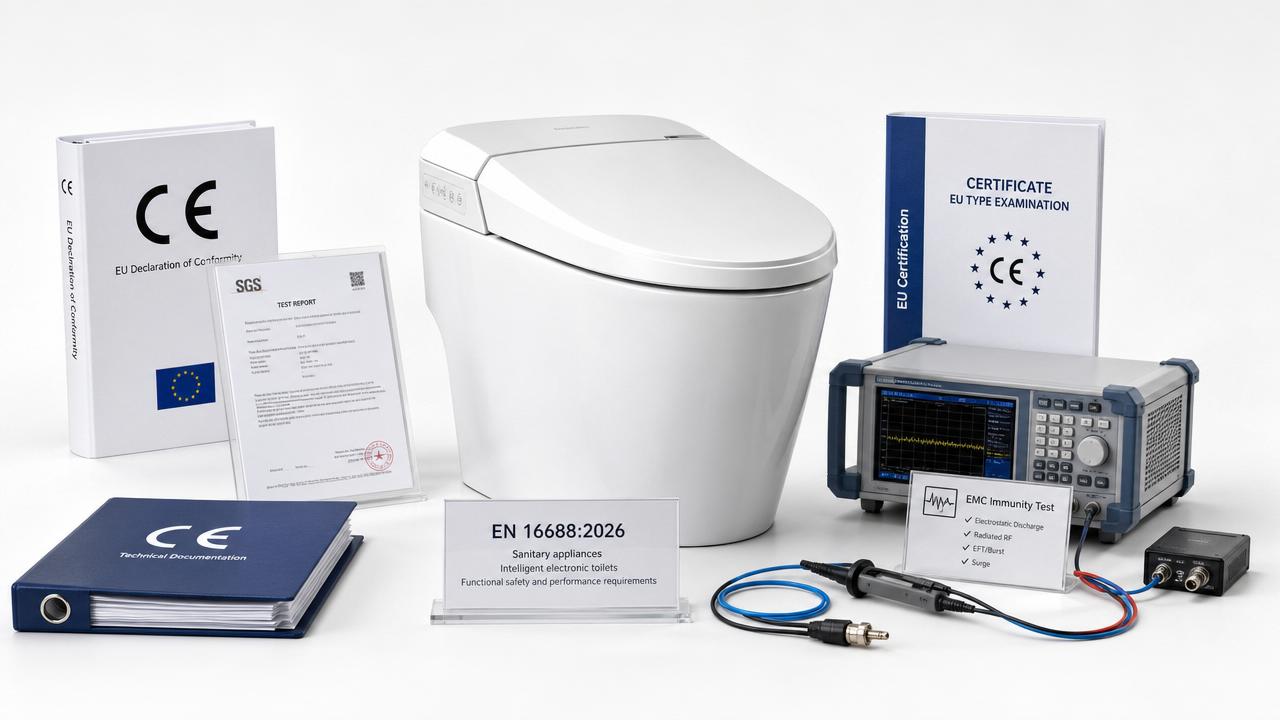
As of June 1, 2026, the EU has formally put EN 16688:2026 into force for smart toilets entering its market, making stricter EMC immunity testing a practical compliance condition rather than a technical preference. For exporters, certification teams, test service providers, import channels, and delivery planners, the issue is not only the standard update itself, but also its immediate connection to report renewal, CE documentation updates, customs compliance, and the risk of returns or market access restrictions for non-compliant products.
What the new requirement now changes
The confirmed change is that the EU is mandatorily implementing the revised standard EN 16688:2026 from June 1, 2026. Under this version, all smart toilets entering the EU market must pass stricter electromagnetic compatibility immunity tests. The testing scenarios mentioned include radio-frequency induced fields, electrostatic discharge, and electrical fast transient burst conditions. The information provided also makes clear that this change directly affects the updating of type test reports, the revision of CE certification documentation, and customs compliance for Chinese exporting companies. Products that do not meet the requirement may face return or market access prohibition.
Where the pressure is likely to appear first
Export shipments face a documentation and timing issue
From an industry perspective, exporters are likely to feel the impact first because market entry now depends on whether existing technical files and test evidence remain aligned with the new standard version. The practical pressure point is not limited to product performance; it also extends to whether shipment documents, certification status, and supporting compliance materials can match the updated requirement during customs clearance and delivery.
Manufacturers need to reassess test readiness
For manufacturers, the change matters because the new EMC immunity focus covers specific disturbance scenarios that may require renewed type testing rather than reliance on older reports. What deserves closer attention is whether products currently prepared for export can still support CE-related documentation without a report update tied to EN 16688:2026.
Certification and testing service providers may see a version-conversion workload
Certification-related companies and testing institutions are also directly affected because customers will need updated reports and certification materials reflecting the new standard. Analysis shows that the immediate business impact is likely to center on document review, version replacement, testing arrangement, and consistency between reports and CE compliance files.
Importers, distributors, and procurement teams need to verify supply continuity
For downstream buyers and circulation channels, the issue is whether supplied smart toilets can still be placed on the EU market without interruption. In practice, procurement and channel teams need to pay closer attention to the compliance status of incoming models, the validity of supporting documents, and the risk that non-compliant goods could be delayed, returned, or excluded from sale.
What companies should review now
Check whether existing reports still match the enforced standard version
Analysis shows that one immediate task is to verify whether current type test reports remain usable under the mandatory application of EN 16688:2026. If the report basis, standard version, or test scope no longer matches the enforced requirement, the compliance gap may affect both certification and shipment release.
Re-examine CE file updates as a linked process
What deserves closer attention is that report renewal and CE documentation revision should not be treated as separate steps. The event summary explicitly links the new standard to CE certification version updates, which means companies should review technical files, declarations, and related compliance records together rather than only focusing on laboratory testing.
Watch customs-facing compliance materials before delivery
Observably, the customs compliance element makes this more than a design or test issue. Exporters and supply-chain service providers should pay attention to whether shipping batches, supporting files, and product compliance statements are aligned before dispatch, because the stated risk includes returns and market access restrictions for products that fail to meet the requirement.
Monitor how market-side documents begin to reflect the new rule
Since the provided information does not include detailed enforcement language beyond the mandatory requirement, it is more appropriate to understand this as an area requiring continued attention. Companies should therefore monitor whether procurement specifications, customer document requests, and market-entry checks begin to reference EN 16688:2026 more explicitly in ongoing transactions.
Why this looks like an execution-stage signal
Observably, this development is best read as an implemented compliance change rather than an early policy discussion, because the effective date and the mandatory nature of the standard are already clear. At the same time, analysis shows that the market still needs to watch how consistently the requirement is reflected in certification handling, customs review, and buyer-side document expectations. The practical significance lies less in headline policy language and more in how quickly commercial processes begin to enforce the new version requirement.
How to read the significance of this update
From an industry perspective, the main meaning of this event is that EMC immunity performance for smart toilets has become more tightly connected to market access, certification maintenance, and export execution into the EU. It is more appropriate to understand this update as a rule already in force with direct compliance consequences, while keeping a neutral view on how individual market participants will apply it in day-to-day transactions. For companies involved in export, certification, procurement, and delivery, the near-term priority is not broad strategy language but careful alignment of reports, CE materials, and shipment compliance records.
Basis of this article and points that still require verification
This article is generated based on the user-provided news title, event date, and event summary. For developments of this kind, commonly relevant source types may include official notices, regulator publications, customs or trade authority updates, industry association information, standard organization documents, and reporting by authoritative media. No specific official source link was provided in the input, so the exact official reference path still requires follow-up verification. Continued observation is also needed on implementation details, certification handling practice, procurement document changes, market feedback, and how companies execute the updated requirement in actual export workflows.
Industry Briefing
Get the top 5 industry headlines delivered to your inbox every morning.