
EU Adds Backflow Durability Test for Smart Toilets
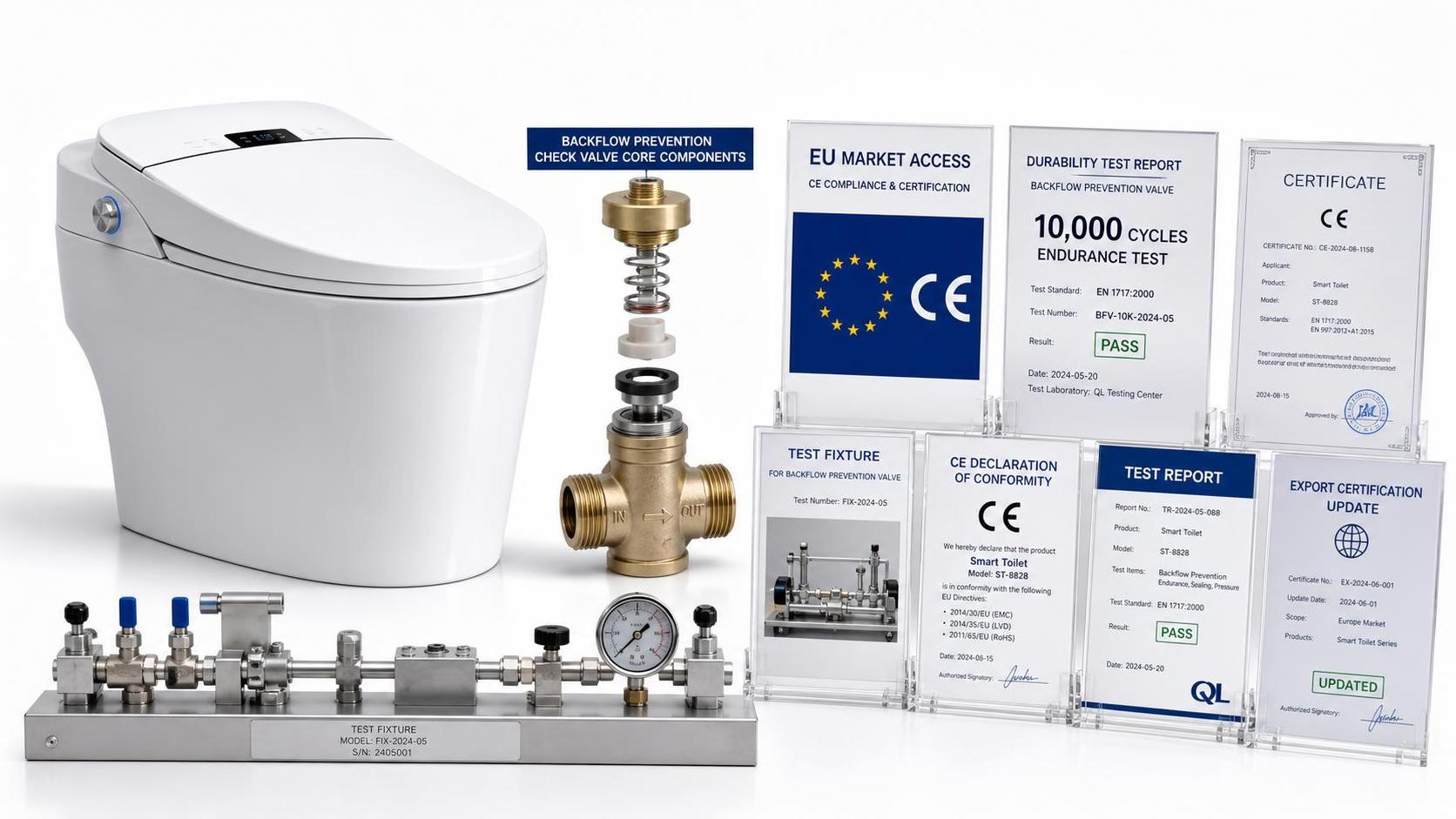
On August 7, 2026, CEN released the revised Appendix B of EN 1717:2026, adding a new compliance requirement for smart toilets entering the EU market: beyond existing dual-valve isolation certification, products must now also pass a 10,000-cycle backflow valve durability test equivalent to ISO 11253-2:2025. This matters immediately for exporters, testing and certification teams, importers, and customs-facing compliance functions, because products without updated certification documents cannot complete the CE declaration of conformity or clear customs.
What the revised appendix now requires
According to the provided information, the revised Appendix B of EN 1717:2026 was formally issued by CEN on August 7, 2026. The change applies to smart toilet products entering the EU market. From the date of release, these products must, in addition to the existing dual-valve isolation certification basis, pass a 10,000-cycle durability test for backflow valves, described as equivalent to ISO 11253-2:2025. The same information also states that this revision directly affects the validity of type test reports used by Chinese export companies. Products that have not obtained certificates under the updated requirements will be unable to complete the CE conformity declaration and customs clearance.
Where the pressure will be felt across the chain
Export shipments face an immediate document risk
From an industry perspective, direct exporters are likely to be the first group affected because the change is tied to certification validity and customs clearance. The main business impact is not only product testing itself, but whether existing report packages and certification files remain usable for ongoing EU-bound shipments. What deserves closer attention is the status of products already prepared for export under earlier test assumptions.
Manufacturing and product compliance teams need to recheck model coverage
Analysis shows that manufacturers of smart toilets may be affected at the model and documentation level. The issue is not simply whether a company has passed prior dual-valve isolation certification, but whether each relevant product now also satisfies the additional durability requirement under the revised appendix. For internal teams, the practical pressure point is the alignment between product configuration, test evidence, and certificate updates.
Importers and channel partners must review entry readiness
Observably, EU importers, distributors, and other channel-side operators may also be affected because CE documentation and customs clearance are preconditions for placing products into the market. Their exposure is concentrated in order scheduling, customs preparation, and supplier document review. What deserves closer attention is whether upstream suppliers can provide certification materials that reflect the revised standard requirement.
Testing, certification, and supply-chain service functions will see tighter timing demands
Analysis shows that service providers supporting testing, certification, documentation, and customs processes may face tighter execution windows. The new requirement creates a direct link between technical testing and shipment release. For these roles, the key concern is whether certification updates, document issuance, and shipment planning remain synchronized once the revised appendix is already in force.
What companies should focus on now
Check whether existing type test reports still support EU market access
The provided information explicitly states that the revision directly affects the validity of type test reports used by Chinese export companies. Companies with smart toilet products intended for the EU market should therefore treat report applicability as a current compliance question rather than an administrative formality.
Separate old certification status from new market-entry requirements
What deserves closer attention is the distinction between having passed the earlier dual-valve isolation certification and meeting the revised Appendix B requirement. In practice, these are no longer the same threshold for EU market access once the new durability test has become mandatory from the date of release.
Review pending orders and customs-facing documentation workflows
Analysis shows that the most immediate operational exposure may sit in products close to shipment, customs filing, or customer delivery milestones. Companies should pay attention to how certification status affects CE conformity declaration readiness, as that is directly tied to whether goods can clear customs under the information provided.
Keep watch on official wording and implementation details
Observably, the policy signal is already clear in one respect: the added test is mandatory from the date stated in the provided information. At the same time, companies should continue checking official standard wording, certification interpretations, and any related implementation guidance because business execution often depends on how technical requirements are applied in actual documentation and assessment workflows.
How this update should be understood
Analysis shows that this is better understood as an immediate compliance change with broader signaling value, rather than a distant regulatory direction. The confirmed fact is narrow but decisive: an added durability test now sits between product certification and EU customs entry for smart toilets covered by the provided information. Observably, the longer-term signal is that market-access requirements can become more stringent even when a product category already has an established certification path. That said, any wider conclusion beyond this specific revision still requires continued observation rather than certainty.
A short-term rule change with longer-term implications
At present, it is more appropriate to understand this update as an actionable market-access requirement with direct effects on testing validity, CE documentation, and shipment readiness for smart toilets entering the EU. The immediate result is already clear from the provided information, while the broader industry meaning lies in how quickly companies can align certification evidence with the revised appendix. For the sector, this is not just a technical amendment to note, but a compliance threshold that now has direct trade consequences.
Basis of this article and points for follow-up
This article is based on the user-provided news title, event date, and event summary. Information of this kind is typically associated with source categories such as official notices, standard organization documents, industry association updates, company compliance statements, and authoritative media reporting. A specific official source link was not provided in the input, so the exact document trail still requires ongoing verification. Follow-up attention should remain on official wording of the revised appendix, certification application in practice, and any subsequent clarification affecting documentation, conformity declaration, and customs clearance.
Industry Briefing
Get the top 5 industry headlines delivered to your inbox every morning.