
EU EcoDesign Rule Tightens Smart Toilet Entry
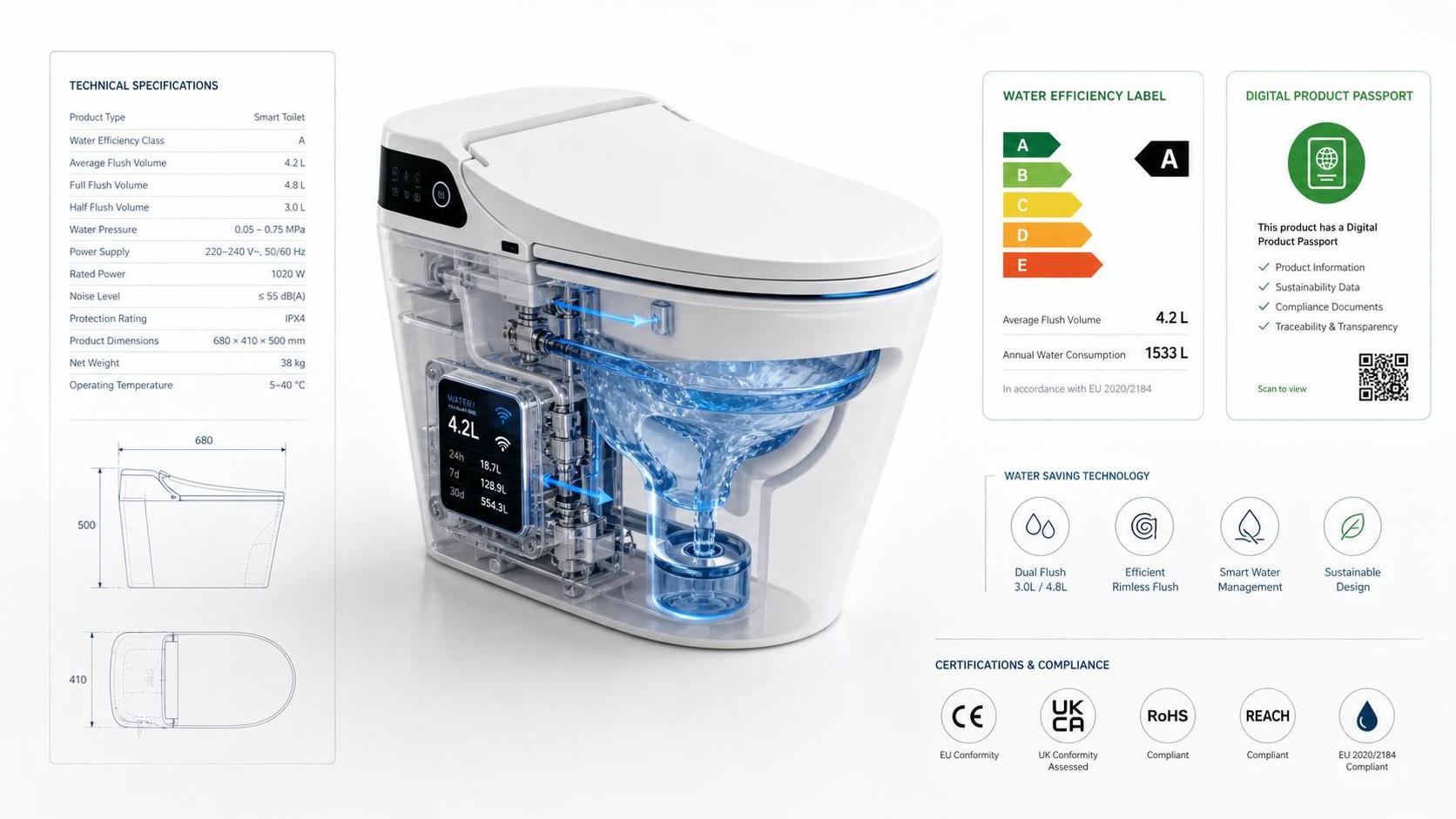
On June 27, 2026, the European Commission formally brought Regulation (EU) 2025/1893 into effect for smart toilets, introducing mandatory water-efficiency grading and linking market access to both performance and digital reporting requirements. For exporters, manufacturers, certification-related service providers, importers, and supply-chain teams serving the EU market, this matters because the change reaches beyond product labeling: it affects product design, compliance preparation, customs readiness, and delivery planning ahead of the October 1, 2026 market restriction on lower-efficiency models.
What the rule now requires
The confirmed change is that smart toilets are now subject to a mandatory water-efficiency grading system ranging from A+++ to D under Regulation (EU) 2025/1893. According to the provided event summary, products below grade B, defined as more than 4.2L per flush, will no longer be allowed to be placed on the EU market starting October 1, 2026. The rule also requires products to include an embedded remote water-use data reporting module and to align with the EU Digital Product Passport (DPP) system. The provided information further states that these requirements directly affect product design, certification pathways, and customs compliance for Chinese exporting companies.
Where the pressure will appear across the business chain
Product design moves closer to a market-access issue
For manufacturers and export-oriented producers, the immediate impact is not limited to testing outcomes. The confirmed requirements connect water-efficiency performance with an embedded reporting function, which means design teams may need to treat flushing performance and digital compliance capability as part of the same market-entry condition. From an industry perspective, the affected business stages are likely to include product specification review, model selection for the EU market, and technical documentation preparation tied to compliance submissions.
Export transactions may face stricter documentation alignment
For exporters, traders, and channel partners handling EU-bound shipments, the change is relevant because the restriction applies to products being placed on the EU market after October 1, 2026. Analysis shows that sales teams and trade operations will need to pay closer attention to whether model claims, efficiency grading, and DPP-related readiness are reflected consistently across product files, declarations, and shipment-related records. The confirmed facts do not define the full customs execution method, so this should currently be treated as a compliance preparation issue rather than a settled operational procedure.
Certification and testing workflows may become more central
For certification-related companies and testing service providers, the rule matters because it changes the compliance path, not only the product threshold. What deserves closer attention is that water-efficiency classification and compatibility with DPP-linked reporting now sit in the same regulatory development. In practical terms, businesses in this part of the chain may need to review how test results, technical files, and conformity-related materials support both performance grading and product data readiness, even though the detailed execution approach is not provided in the input.
Procurement and delivery planning may need earlier screening
For buyers, sourcing teams, and supply-chain service providers, the likely impact is on model screening and delivery scheduling. Observably, products that do not meet the B-grade threshold face a clear market-access limit from October 1, 2026, so procurement decisions tied to EU sales channels may need earlier verification of product grade and reporting-module readiness. The provided facts do not specify transition handling for all commercial scenarios, so companies should avoid assuming that existing sourcing routines will remain sufficient.
What companies should monitor now
Review whether EU-bound models still fit the new threshold
Companies serving the EU market should first identify which smart toilet models are intended for EU placement and whether their water-efficiency grade reaches at least B under the rule described in the event summary. This is a direct compliance question because the restriction date and threshold are already stated in the confirmed information.
Check how technical files handle the reporting function
The requirement for an embedded remote water-use data reporting module adds a technical compliance layer beyond flush-volume performance. Analysis shows that businesses should pay close attention to whether existing technical documents, product specifications, and compliance files are structured to demonstrate compatibility with the DPP-related requirement described in the input. Since no detailed documentation checklist is provided, this remains an area for continued verification.
Reassess certification pathways and customs-readiness documents
The event summary explicitly notes an effect on certification pathways and customs compliance. From an industry perspective, this means exporters and compliance teams should examine whether current certification planning, testing arrangements, and shipment document sets are still aligned with the new rule. It is more appropriate to understand this as a current review task, because the input does not provide a finalized enforcement template or customs filing format.
Watch for downstream changes in tender and purchasing requirements
Even where the regulation text is already in force, downstream market documents may adjust on a different timetable. Observably, companies involved in bidding, distribution, and project supply should monitor whether customer specifications, tender documents, or supplier qualification requirements begin to reference the new water-efficiency grade floor or DPP-related reporting capability. The input does not confirm such downstream revisions yet, so this is a point for monitoring rather than a confirmed market outcome.
Why this looks like an execution signal, not just a policy headline
Analysis shows that this development is better understood as a rule now entering practical execution, because it combines three elements already defined in the provided facts: a formal effective date, a clear market restriction date for lower-efficiency products, and an added digital reporting requirement tied to the EU DPP system. At the same time, it would be premature to treat all implementation details as settled. What deserves closer attention is how certification interpretation, customs handling, and customer-side specification updates are expressed in practice after the rule takes effect.
How the market should read this change
This development should be read as a concrete compliance and market-access change for smart toilets entering the EU, rather than as a general sustainability statement. The immediate significance lies in the fact that efficiency grading, product configuration, and digital traceability are now connected in one regulatory requirement. A cautious industry reading is that companies should treat the rule as active and commercially relevant now, while still reserving judgment on detailed execution points that may become clearer through subsequent regulatory guidance, certification practice, and buyer-side adoption.
Basis of this article and what still needs verification
This article is generated from the user-provided news title, event date, and event summary. For developments of this kind, commonly relevant source categories include official regulatory notices, releases from supervisory authorities, customs or trade administration information, industry association updates, standard-setting documents, and reporting from established trade media. A specific official source link was not provided in the input, so the exact source document path still requires follow-up verification. Further observation is also needed on implementation details, certification interpretation, tender-document changes, market feedback, and how companies operationalize the new requirements in export and compliance workflows.
Industry Briefing
Get the top 5 industry headlines delivered to your inbox every morning.