
EU Requires AI Water-Saving Modules in Smart Toilets
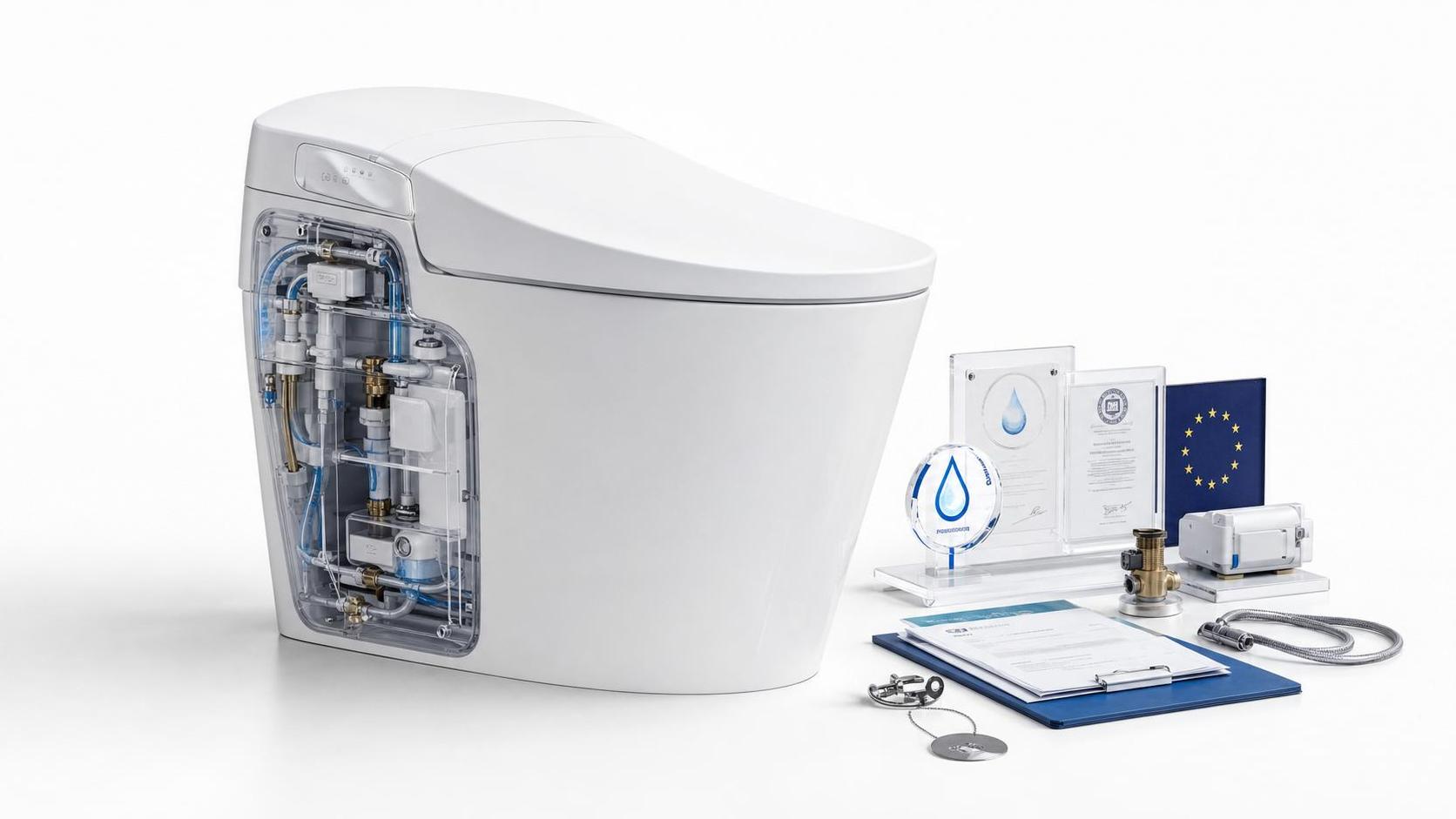
The EU’s EcoDesign compliance framework for smart toilets moved into an enforcement phase on October 1, 2026, after the European Commission formally issued Regulation (EU) 2026/1289 on July 13, 2026. The measure requires smart toilets sold in the EU market to integrate a certified AI-driven dynamic water-saving control module, making this a practical compliance issue for manufacturers, exporters, certification teams, product development functions, and cross-border supply chains that serve the European market.
What the regulation now requires
According to the information provided, Regulation (EU) 2026/1289 was formally published by the European Commission on July 13, 2026. It requires all Smart Toilets sold in the EU market, from October 1, 2026, to include a certified AI-driven dynamic water-saving control module.
The required module must monitor water use in real time and automatically optimize flushing logic. The requirement is directly linked to the revised EN 14428:2026 water-efficiency grading framework.
The same information states that products failing to meet the requirement will be denied CE marking and customs clearance. For manufacturers exporting to the EU, this creates a mandatory technical compliance upgrade window.
Where the pressure will be felt first
Export-oriented manufacturers face immediate product compliance exposure
From an industry perspective, manufacturers that place smart toilets on the EU market are the most directly affected because the rule is tied to market access. The main impact is likely to fall on product configuration, compliance documentation, certification preparation, and shipment eligibility. What deserves closer attention is whether existing product lines intended for Europe already incorporate the required certified module or will need technical revision before delivery.
Certification and regulatory teams will need to align product claims with market entry rules
Because the requirement is linked to EN 14428:2026 water-efficiency grading and to CE marking eligibility, compliance, testing, and regulatory affairs functions will likely face a more time-sensitive workload. The operational issue is not only whether a module is installed, but whether the installed solution can be presented as certified in a way that supports market access and customs procedures.
Supply chain and delivery planning may become more sensitive to component readiness
Analysis shows that the rule may also affect supply chain service providers and delivery planners supporting EU-bound shipments. If a product cannot satisfy the new technical requirement, the business impact may appear not only at the design stage but also at the shipment and customs stage. For companies serving EU customers, this increases the importance of checking technical readiness before production scheduling and export execution.
Buyers and channel partners may tighten acceptance standards
Observably, distributors, importers, procurement teams, and other downstream market participants may need to review whether the smart toilet products they source for the EU market meet the new threshold. The likely effect is a stronger focus on model-specific compliance status, supporting documents, and delivery timing for products shipped around or after the enforcement date.
What companies should review now
Separate product availability from compliant marketability
Analysis shows that one of the most important practical distinctions is between a product being technically available and being legally marketable in the EU. For EU-bound smart toilets, companies should pay close attention to whether the required AI-driven dynamic water-saving control module is both integrated and certified in line with the stated requirement.
Recheck model-by-model documentation for CE and customs readiness
What deserves closer attention is the supporting material behind each product model. Since the stated consequence of non-compliance includes denial of CE marking and customs clearance, exporters and their documentation teams should closely examine whether technical files, certification records, and product descriptions are consistent with the new rule before shipment.
Watch for the difference between the legal text and operational interpretation
From an industry perspective, companies should not assume that policy wording automatically answers every execution detail. The regulation and its link to EN 14428:2026 establish the compliance direction, but businesses still need to monitor how those requirements are reflected in product review, customer acceptance, and border-clearance practice. This is especially relevant during the transition from publication to enforcement.
Prepare customer and supplier communication around the enforcement date
Observably, October 1, 2026 is not only a regulatory date but also a contract and delivery risk point. Companies involved in EU exports should pay attention to supplier qualification, module readiness, lead times, and communications with buyers regarding which models remain eligible for shipment and market entry after the rule takes effect.
Why this looks bigger than a one-off product tweak
Analysis shows that this development is more appropriately understood as a concrete compliance shift rather than a symbolic policy signal. The rule does not describe a voluntary efficiency preference; it ties a specific technical requirement to certified functionality, water-efficiency grading, CE marking, and customs access.
At the same time, it is still more appropriate to understand the broader market effect as something that requires continued observation. The confirmed facts establish the requirement and its enforcement consequence, but the wider commercial impact across product portfolios, certification workflows, and supply relationships will depend on how quickly affected businesses adapt.
How to read the current signal
At this stage, the most balanced reading is that the EU has turned water-efficiency performance in smart toilets into a more explicit technical gate for market access. For companies selling into Europe, this is not merely a short-term procedural update. It is a near-term compliance requirement with potential longer-tail implications for product design, certification planning, and export execution.
It is also not a basis for overstating broader industry outcomes. The confirmed takeaway is narrower and more practical: businesses connected to EU-bound smart toilet sales should treat the requirement as an actionable compliance checkpoint, while continuing to monitor how implementation is interpreted in real transactions and approvals.
Basis of this article
This article is based on the user-provided news title, event date, and event summary regarding the EU EcoDesign rule for Smart Toilets, the July 13, 2026 publication of Regulation (EU) 2026/1289, and the October 1, 2026 enforcement date.
For this type of industry update, commonly relevant source categories may include official regulatory notices, company statements, industry association updates, authoritative media coverage, and standards-related documents. A specific official source link was not provided in the input, so the exact source document path still requires follow-up verification.
For continued monitoring, the most relevant areas are any further official wording, implementation guidance, certification interpretation, and market-side enforcement practices connected to Regulation (EU) 2026/1289 and EN 14428:2026.
Industry Briefing
Get the top 5 industry headlines delivered to your inbox every morning.