Smart Bath Express Launches on Ningbo–Duisburg Route
Smart Bath Express Launches on Ningbo–Duisburg Route
On May 10, 2026, China State Railway Group launched the first dedicated ‘Smart Bath Express’ train on the Ningbo–Duisburg corridor — a milestone in the evolution of rail freight for high-value, climate-sensitive home technology products. With the broader China–Europe Railway Express surpassing 130,286 cumulative departures in April 2026 (up 11.7% year-on-year), this new service signals a strategic shift toward value-added, time- and condition-sensitive logistics solutions — directly impacting manufacturers, distributors, and logistics providers across the global bathroom technology supply chain.
Event Overview
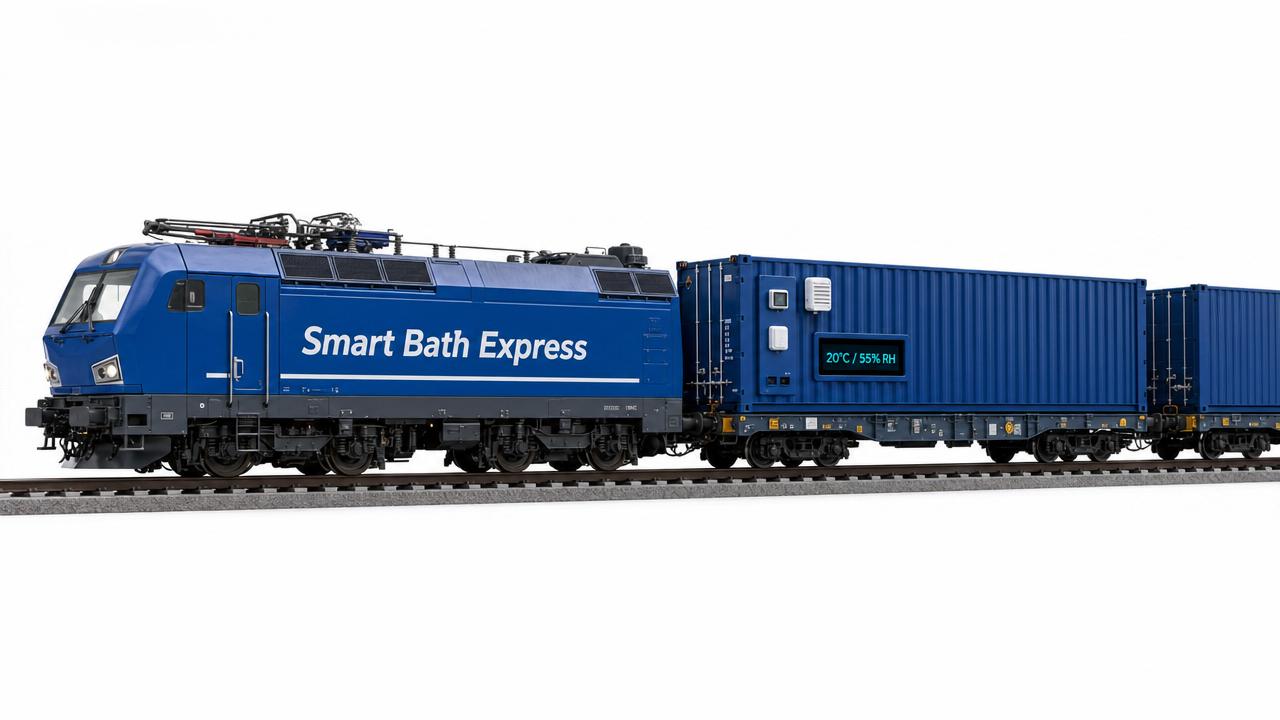
According to a May 15, 2026 bulletin from China State Railway Group, the China–Europe Railway Express recorded 130,286 total departures in April 2026, representing an 11.7% increase over April 2025. On May 10, 2026, the first ‘Smart Bath Express’ train departed from Ningbo Port bound for Duisburg, Germany. The train features end-to-end humidity monitoring and temperature-controlled cargo compartments, specifically designed for intelligent toilets, digital door locks, and integrated bathroom modules. Its scheduled transit time is 16 days — 42% faster than maritime shipping — positioning it as a cost-effective alternative to air freight for European distributors.
Industries Affected
Direct Trading Enterprises
Export-oriented bathroom technology brands and EU-based importers are directly affected due to reduced lead times and improved cargo integrity. Unlike standard containerized rail services, the Smart Bath Express guarantees stable humidity (<60% RH) and ambient temperature (15–25°C), minimizing condensation-related damage to electronic components and surface finishes. This enables tighter inventory planning and more responsive order fulfillment — especially for seasonal or promotional campaigns in European markets.
Raw Material Procurement Enterprises
Suppliers of precision sensors, waterproof PCBs, smart actuators, and antimicrobial coatings face revised demand timing and volume signals. As OEMs shift production cycles to align with the 16-day rail window (versus 28+ days by sea), procurement planning must now account for shorter upstream replenishment cycles. Observably, this increases pressure on just-in-time delivery reliability from Tier-2 and Tier-3 material vendors, particularly those without real-time logistics integration.
Manufacturing Enterprises
Domestic smart bathroom OEMs and ODMs — especially those based in Zhejiang and Jiangsu provinces — benefit from enhanced export scalability but face new operational requirements. Packaging must now comply with rail-specific moisture barrier standards; pre-shipment conditioning (e.g., desiccant loading, thermal buffering) becomes mandatory. Analysis shows that manufacturers adopting early compliance protocols gain priority slotting and lower surcharge exposure — suggesting a widening operational gap between agile and legacy producers.
Supply Chain Service Providers
Cargo consolidators, customs brokers, and last-mile integrators servicing the Ningbo–Duisburg lane must upgrade documentation workflows and cold-chain verification capabilities. The service requires certified humidity/temperature logs at origin, en route, and upon arrival — data that feeds into EU CE conformity assessments for electronic bathroom devices. Current certification frameworks (e.g., EN 60335-2-84) do not yet mandate transport-condition traceability, but regulatory alignment is accelerating. Providers lacking IoT-enabled monitoring tools risk service exclusion or liability exposure.
Key Considerations and Recommended Actions
Validate Product-Specific Environmental Thresholds
Not all smart bathroom products share identical sensitivity profiles. Manufacturers should conduct comparative testing under simulated Smart Bath Express conditions (e.g., 16-day cycling at 20°C / 55% RH) before committing to full-volume shipments — especially for battery-integrated units or OLED control panels.
Align Production Scheduling with Biweekly Rail Windows
The Ningbo–Duisburg service operates on fixed biweekly departures. Exporters should synchronize final assembly, QA, and packaging to meet cutoff windows — avoiding costly demurrage or downgrade to standard containers. Early adopters report up to 9% reduction in working capital tied up in transit inventory.
Prepare for Enhanced Documentation Requirements
EU importers must now retain certified environmental logs alongside standard commercial invoices and packing lists. These records may be requested during post-import audits by German market surveillance authorities (e.g., ZLS). Firms should assign internal ownership for log validation and archive retention (minimum 5 years).
Editorial Perspective / Industry Observation
This initiative is better understood not as a mere capacity expansion, but as infrastructure-led product standardization. By embedding environmental controls into the rail service itself, China State Railway Group effectively externalizes part of the quality assurance burden from shippers — shifting responsibility for physical integrity from packaging design to transport orchestration. From an industry perspective, this lowers the barrier to exporting high-mix, low-volume smart hardware — but raises the bar for interoperable data capture across borders. It also accelerates convergence between rail logistics and regulatory compliance ecosystems — a trend likely to influence upcoming EU Digital Product Passports (DPP) requirements.
Conclusion
The Smart Bath Express represents a calibrated response to structural friction in cross-border trade: rising air freight costs, port congestion, and tightening EU sustainability mandates. Its success will hinge less on raw speed and more on verifiable consistency — making it a litmus test for how rail can evolve beyond commodity transport into a trusted, certifiable layer of the industrial internet of things. For the smart home sector, it marks the beginning of logistics-as-a-compliance-service — not just logistics-as-a-conduit.
Source Attribution
Official data sourced from China State Railway Group’s May 15, 2026 press release (Ref: CRG-PR-20260515-08). Transit performance metrics and technical specifications confirmed via Ningbo Port Authority and Duisburg Logistics Hub operational briefings (May 2026). Regulatory implications remain subject to ongoing review by the European Commission’s Directorate-General for Health and Food Safety (SANTE) and the German Federal Institute for Materials Research and Testing (BAM). Continued monitoring is advised for updates to EN IEC 60335-2-84 Annex ZA and EU Regulation (EU) 2023/1372 on sustainable product policy.
Industry Briefing
Get the top 5 industry headlines delivered to your inbox every morning.