What defines reliable commercial building solutions today
In today’s fast-changing built environment, reliable commercial building solutions are defined by more than durability alone—they must combine compliant materials, operational efficiency, smart integration, and long-term value. For business decision-makers, understanding how these factors shape modern commercial spaces is essential to reducing risk, improving performance, and staying competitive in an increasingly data-driven construction market.
That shift is especially relevant for owners, developers, procurement leaders, and manufacturers working across office, hospitality, retail, mixed-use, healthcare, and public infrastructure projects. In these settings, a building solution is no longer judged only by its installation cost or visual finish. It is evaluated across a 10- to 25-year operating horizon, where maintenance cycles, water and energy efficiency, material compliance, safety performance, and smart system compatibility all influence total asset value.
For organizations navigating global sourcing pressure, tariff volatility, green material adoption, and changing user expectations, the question is practical: what actually makes commercial building solutions reliable today? The answer lies in the ability to align technical performance with regulatory readiness, supply-chain resilience, and space intelligence. This is where intelligence-led platforms such as GIAM help decision-makers translate market signals into sound project and purchasing choices.
The New Definition of Reliability in Commercial Space Projects
Reliable commercial building solutions used to mean robust structure, acceptable finish quality, and on-time delivery. Those factors still matter, but current project standards are broader. In most commercial developments, decision-makers now assess at least 5 dimensions at once: code compliance, lifecycle cost, installation efficiency, user safety, and digital compatibility. If one of these areas fails, the solution may become expensive even if the upfront bid looks attractive.
From product durability to system reliability
A durable tile, sanitary fixture, door system, or kitchen component is valuable, but isolated product strength is not enough. Commercial environments depend on system reliability, meaning materials, fittings, interfaces, maintenance access, and usage patterns must work together. For example, a water-saving fixture that reduces consumption by 20% to 35% can still underperform if spare parts are difficult to source or if local pressure conditions were not considered during design.
This is why procurement teams increasingly prefer solutions supported by clear technical documentation, replacement planning, and compatibility with regional standards. Reliability now means fewer installation conflicts, predictable maintenance intervals, and less unplanned downtime over 3, 5, or even 10 years.
Why compliance and adaptability matter more than ever
Commercial construction is under pressure from energy codes, water efficiency regulations, hygiene requirements, and carbon reduction targets. In many regions, project teams must account for changing standards every 12 to 24 months. A building solution that meets today’s specification but lacks flexibility for future upgrades can create hidden retrofit costs.
GIAM’s Strategic Intelligence Center reflects this reality by tracking building material shifts, tariff movements, and the adoption of anti-bacterial surfaces, water-saving systems, and smart locking technologies. For executives, that intelligence supports earlier decisions on sourcing, substitutions, and project risk control before delays spread across the construction schedule.
Core traits of a reliable solution package
- Material performance that fits actual traffic, moisture, and cleaning conditions
- Compliance readiness for current standards and likely near-term revisions
- Supply continuity with realistic lead times, often within 2 to 8 weeks depending on category
- Maintenance logic that reduces service disruption and replacement complexity
- Integration potential with smart controls, access systems, or water management platforms
The table below shows how reliability is now judged in commercial building solutions across the full project lifecycle rather than at the purchasing stage alone.
The key takeaway is clear: reliable commercial building solutions are defined by operational certainty. Decision-makers are looking for predictable performance under real conditions, not only compliance on paper or short-term savings during tender evaluation.
Key Components That Make Commercial Building Solutions Dependable
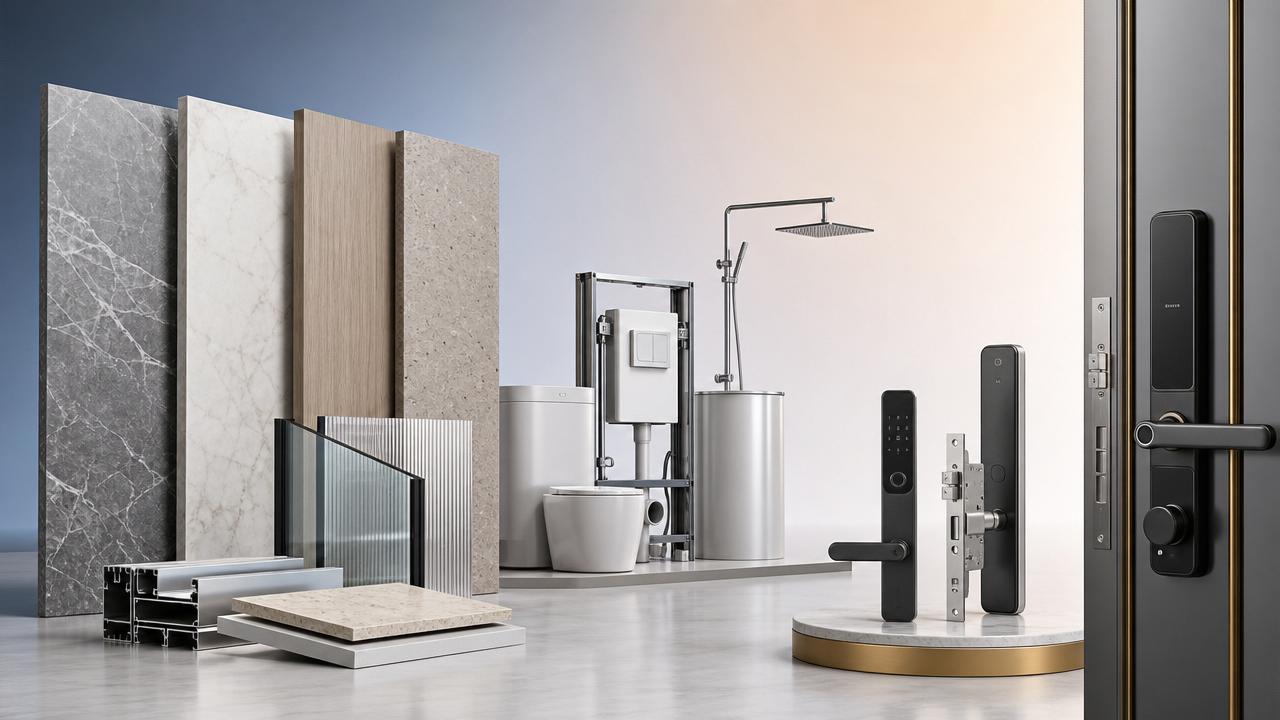
In practice, the most dependable commercial building solutions combine physical materials, technical systems, and informed specification strategy. In GIAM’s market lens, three categories repeatedly shape project confidence: core building materials, sanitary spaces, and smart kitchen and bath systems. These are also the categories where performance failures can quickly affect user satisfaction, operating cost, and brand perception.
1. Core materials that reduce operational risk
Flooring, wall finishes, sealants, doors, partitions, and moisture-resistant substrates are often treated as standard line items. Yet these components influence maintenance labor, hygiene outcomes, and replacement cycles. In high-traffic spaces such as retail corridors, transport hubs, and office lobbies, specification errors can show visible wear in 12 to 18 months instead of the expected 5 to 8 years.
A reliable material strategy should consider abrasion level, moisture exposure, cleaning chemicals, repair access, and replacement batch consistency. For multi-site operators, consistency matters because a fragmented specification can multiply spare inventory and service complexity across 20, 50, or 100 locations.
2. Sanitary systems built for hygiene and water control
Sanitary spaces now carry stronger business impact than before. In offices, hotels, hospitals, schools, and public venues, users expect visible hygiene standards and lower touchpoints. Reliable commercial building solutions in this category commonly include anti-bacterial surfaces, leak-resistant fittings, easy-clean geometries, and water-saving devices calibrated to actual occupancy levels.
Water performance should not be measured only by nominal flow reduction. The more useful approach is to match fixtures to pressure range, duty cycle, and maintenance skill level. For example, a solution intended for 8 to 12 daily uses per room is different from one designed for 200-plus uses in a transit restroom. Wrong matching usually leads to complaints, premature replacement, or excess servicing.
3. Smart kitchen and bath integration
Smart systems have moved beyond novelty. In premium commercial projects, smart locks, sensor-based faucets, occupancy-linked controls, and usage monitoring tools help support safety, efficiency, and service planning. The value is strongest when digital features simplify operations rather than add another disconnected platform.
For commercial applications, the most useful smart functions are usually those that shorten response time by 30 to 60 minutes per incident, identify abnormal water use before damage spreads, or reduce manual inspection frequency from daily to weekly in selected zones. Reliability depends on interoperability, clear alert logic, and local maintenance support.
Typical performance checkpoints before specification approval
- Confirm material compatibility with cleaning regime and usage density.
- Review compliance documentation for local or export market standards.
- Validate lead time, alternate supply options, and spare part availability.
- Check whether smart components integrate with existing access or facility systems.
- Estimate 3-year and 5-year maintenance burden, not just installation cost.
The following matrix helps compare solution priorities across the three categories most relevant to GIAM’s intelligence coverage.
Across all three categories, the strongest commercial building solutions are the ones that support measurable outcomes: fewer failures, lower service interruption, better compliance readiness, and clearer lifecycle planning.
How Business Decision-Makers Should Evaluate and Select Solutions
Selecting reliable commercial building solutions requires a structured process, particularly when projects involve multiple regions, phased delivery, or mixed commercial functions. Executive teams often lose value when technical review, procurement timing, and operational requirements are handled separately. A stronger method is to combine them into one decision framework.
Build a 4-part evaluation model
A practical B2B review model can be organized into 4 areas: performance fit, compliance fit, supply fit, and lifecycle fit. Performance fit asks whether the solution can handle real traffic, water demand, hygiene pressure, or smart integration needs. Compliance fit checks whether documentation, material declarations, and installation parameters align with the target market. Supply fit addresses lead times, substitutions, logistics risk, and tariff sensitivity. Lifecycle fit estimates maintenance cost, replacement frequency, and service burden over 36 to 60 months.
Account for risk before contract award
Many costly errors emerge before the purchase order is signed. A product may be technically acceptable but poorly suited to local service conditions. Another may fit the design intent but carry a 10-week lead time incompatible with the construction program. Reliable commercial building solutions are therefore selected through early-stage risk review, not last-minute substitution.
This is one reason intelligence platforms matter. GIAM’s commercial insights model helps manufacturers and buyers read structural demand trends, especially in premium materials and smart kitchen categories driven by urbanization and upgraded living standards. For decision-makers, this supports faster comparison of product viability across regional project pipelines.
Common procurement mistakes to avoid
- Choosing solely on lowest initial unit price without a 3-year service estimate
- Ignoring spare part continuity for imported fittings or digital components
- Approving smart systems without checking software and hardware compatibility
- Overlooking installation tolerances that can delay handover by 1 to 3 weeks
- Using one specification across low-use and high-use zones with very different demand profiles
The table below presents a straightforward procurement checklist that can be used by developers, contractors, or facility-led buying teams.
A disciplined evaluation process turns commercial building solutions into business assets rather than procurement variables. It also improves communication between design teams, operators, and finance stakeholders who often define value differently.
Implementation, Maintenance, and the Long-Term Value of Intelligence-Led Decisions
Even well-chosen commercial building solutions can underdeliver if implementation is rushed or post-installation support is weak. Reliability is protected through disciplined execution: clear submittals, coordinated installation sequencing, commissioning checks, and documented maintenance routines. In most commercial projects, these four steps determine whether a solution performs for 7 years or starts failing in year 2.
Why implementation planning affects reliability
A typical rollout should include 4 to 6 control points: design verification, sample approval, site readiness check, installation inspection, commissioning, and user handover. This is especially important for wet areas, sanitary spaces, and smart kitchen or bath applications, where poor sequencing can compromise sealing, sensor calibration, or access for future service.
For example, a high-performance fixture can lose value if local installers are not briefed on pressure conditions or replacement access. Similarly, anti-bacterial materials can be undermined by incompatible cleaning chemicals. The lesson is simple: product quality and implementation quality must be treated as one package.
Maintenance planning as a financial decision
Decision-makers should view maintenance not as a post-project obligation but as a financial planning tool. A component that needs quarterly intervention may be acceptable in a flagship site with dedicated technical staff, but not across a regional portfolio of 40 branches. Reliable commercial building solutions should match the maintenance capacity of the organization, including labor skill, inspection frequency, spare stock strategy, and reporting discipline.
Questions that protect long-term value
- Can the solution be serviced within standard site operating hours?
- Are spare parts available within a practical 7- to 15-day window?
- Does the supplier provide clear maintenance thresholds and replacement guidance?
- Can usage data or inspection records support preventive action instead of reactive repair?
This is where GIAM’s role becomes strategic rather than informational alone. By combining sector news, evolutionary trend analysis, and commercial insight into premium materials and smart space demand, GIAM helps stakeholders connect project choices with broader shifts in regulation, urbanization, and carbon-conscious design. That perspective is valuable when planning not just one building, but a repeatable portfolio standard.
Reliable commercial building solutions today are defined by how well they connect safety, efficiency, compliance, and intelligent living expectations. For enterprise decision-makers, the strongest choices are those backed by structured evaluation, realistic lifecycle thinking, and up-to-date market intelligence. If your organization is reviewing materials, sanitary systems, or smart kitchen and bath specifications for upcoming commercial projects, now is the right time to refine the decision framework. Contact GIAM to explore tailored insights, compare solution pathways, and learn more about commercial building solutions that support durable performance and long-term value.
Industry Briefing
Get the top 5 industry headlines delivered to your inbox every morning.