Where Commercial Space Management Often Loses Money Quietly
Many losses in commercial space management do not appear as dramatic failures. They build slowly through weak layouts, delayed maintenance, procurement errors, and assets that never reach full productivity.
In today’s property environment, commercial space management is no longer only about occupancy, appearance, or rent collection. It is a discipline tied directly to margin protection, lifecycle cost control, energy performance, and investment resilience.
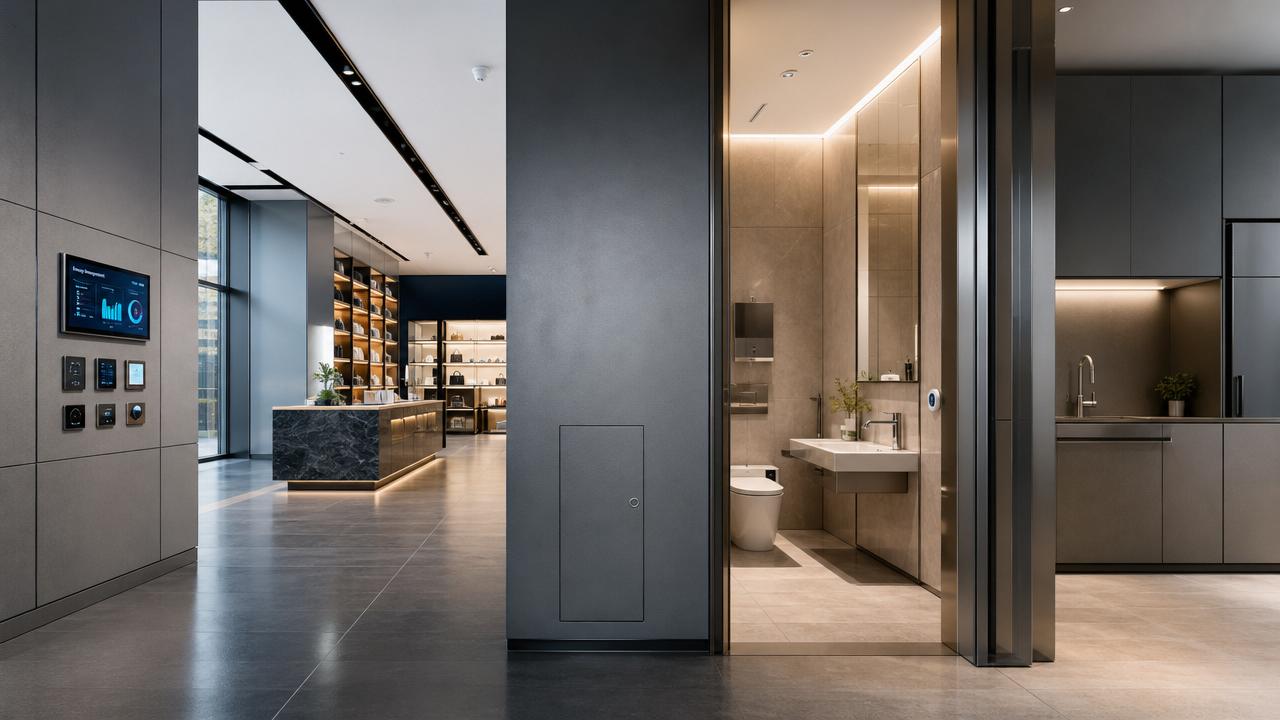
As building systems become smarter and user expectations rise, hidden inefficiencies spread across fit-out decisions, sanitary spaces, water systems, kitchen zones, materials, and digital controls. GIAM closely tracks these shifts across global building materials and intelligent interior systems.
Commercial space management is entering a quieter, more expensive phase
The cost profile of commercial properties has changed. Energy volatility, stricter standards, hygiene expectations, and shorter redesign cycles now expose weak commercial space management faster than before.
Older operating models focused on visible costs. Today, the larger losses often sit inside underperforming systems, fragmented vendor decisions, and spaces designed without measurable operational logic.
This matters across retail, hospitality, office, mixed-use, healthcare-adjacent, and service environments. Every square meter carries capital cost, utility burden, maintenance exposure, and revenue potential.
The strongest trend signals show where money leaks first
Recent sector signals suggest that commercial space management loses money most often in routine decisions that seem minor at the time but compound over years.
- Higher utility costs expose inefficient layouts and outdated fixtures.
- Smart systems generate data, but many sites do not use it for action.
- Sanitary and kitchen spaces now influence brand trust, not only compliance.
- Material selection affects maintenance frequency more than initial budgets suggest.
- Shorter tenant cycles make rigid fit-outs financially weaker.
These signals are especially relevant where buildings combine heavy usage, frequent cleaning, water consumption, and changing user flow. In such settings, weak commercial space management creates quiet but persistent cash drain.
Why commercial space management often loses money quietly
The hidden losses usually come from several connected drivers rather than one obvious failure. The table below summarizes the most common causes and their financial effect.
Layout decisions can reduce value before operations begin
Space planning errors are expensive because they lock in waste. Excess corridor area, awkward service routes, and poorly placed sanitary zones reduce functional density and create unnecessary labor friction.
In commercial space management, design should be measured against flow, service access, cleaning time, and conversion flexibility. A beautiful plan can still perform badly if it increases routine movement and delays turnover.
Maintenance blind spots create compounding losses
Leaks behind walls, worn seals, clogged drainage, loose hardware, and poor ventilation often look manageable. Yet these issues raise humidity, damage finishes, and shorten equipment life.
GIAM’s market observation shows that sanitary spaces and kitchen-adjacent areas deserve special attention. They concentrate water, heat, hygiene exposure, and material stress, making them common origins of hidden loss.
Procurement focused only on purchase price weakens lifecycle returns
Commercial space management often suffers when products are chosen for short-term budget relief. Low-cost hardware, unsuitable tiles, poor coatings, or inefficient fittings can multiply service interruptions later.
A cheaper component may increase cleaning labor, water use, replacement frequency, or user complaints. The real cost is rarely visible in the initial invoice.
The impact spreads across every operational layer
When commercial space management loses money quietly, the effect is broader than facilities cost. It reaches revenue timing, service continuity, brand perception, and the ability to adapt space for new demand.
- Operating budgets become less predictable.
- Downtime interrupts customer-facing activity.
- Energy and water performance fall behind regulatory direction.
- Asset valuation weakens when lifecycle risk rises.
- Refit costs increase because earlier systems lacked flexibility.
This is why commercial space management now overlaps with capital planning. Space is not a passive container. It is an active financial system shaped by materials, utilities, traffic patterns, and operational intelligence.
The next wave of advantage will come from better spatial intelligence
Forward-looking operators are shifting from reactive fixes to measurable space performance. That means connecting design, materials, smart controls, maintenance, and procurement into one commercial space management logic.
GIAM follows this shift through its Strategic Intelligence Center, where material science, hydraulic design insight, and industrial economics help decode future building decisions.
Three areas are rising quickly:
- Antibacterial and durable surfaces that reduce cleaning pressure and replacement cycles.
- Water-saving systems that improve utility efficiency without harming user experience.
- Integrated smart locks, sensors, and controls that convert occupancy data into action.
These are not isolated product trends. They are part of a larger commercial space management transition toward resilient, lower-friction, lower-waste operating environments.
What deserves close attention right now
The most useful review points are practical and measurable. They help reveal whether commercial space management is preserving value or quietly destroying it.
- Compare planned space use with actual movement and occupancy data.
- Audit sanitary spaces for leakage, drainage, moisture, and cleaning burden.
- Measure lifecycle cost, not only purchase price, for fit-out materials.
- Review whether installed smart systems produce decisions, not just dashboards.
- Check if kitchen and bath systems align with water-saving goals and service intensity.
- Test how easily the space can be reconfigured for future use cases.
A stronger response begins with structured judgment, not bigger spending
Improving commercial space management does not always require major capital expansion. It often starts with better sequencing, better data, and better alignment between physical assets and operating goals.
The best commercial space management strategy treats hidden loss as a design-and-operations issue together. That is where durable savings and stronger asset performance usually emerge.
The practical next step is to make hidden loss visible
Start with a focused review of the spaces carrying the highest daily stress. These usually include entrances, restrooms, shared service corridors, kitchen areas, and utility-heavy back-of-house zones.
Map where commercial space management is losing money through preventable friction. Then rank actions by speed of recovery, lifecycle impact, and alignment with future building standards.
For organizations tracking global material shifts, sanitary innovation, and smart kitchen and bath evolution, GIAM provides the intelligence needed to connect construction fundamentals with smarter spatial decisions.
When hidden inefficiencies are identified early, commercial space management becomes more than cost control. It becomes a source of stronger resilience, better user experience, and more profitable space investment.
Industry Briefing
Get the top 5 industry headlines delivered to your inbox every morning.