
Saudi Rule Tightens for Imported Digital Locks
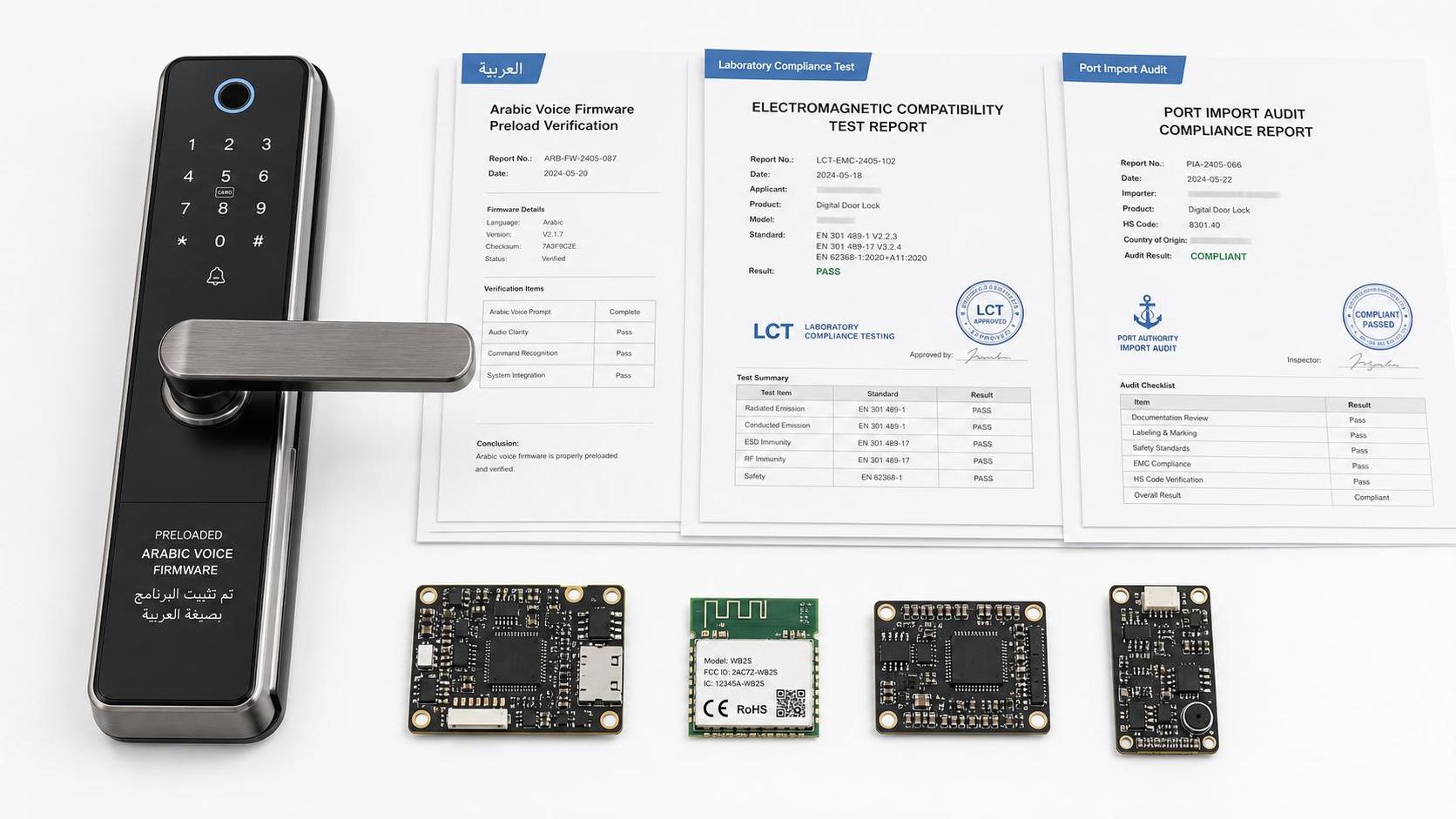
On July 1, 2026, the Saudi market for imported digital locks entered a stricter compliance phase after SASO moved to require Arabic voice-guidance firmware as a condition tied to import declaration and port acceptance. This development deserves close attention from lock manufacturers, exporters, importers, testing service providers, and supply chain teams because the requirement is linked not only to product configuration, but also to laboratory documentation and immediate customs-facing execution.
What the SASO notice requires from July 2026
According to the information provided, the Saudi Standards, Metrology and Quality Organization (SASO) released Technical Notice No. SASO/TC/2026/042 through the SASO Portal on June 28, 2026. The notice states that from July 1, 2026, all imported Digital Locks declared for entry must come pre-installed with Arabic voice interaction firmware that complies with SASO TR 2870:2026 Annex D.
The same notice also requires a test report issued by a SASO-recognized laboratory covering voice-command response latency and false-trigger rate. The provided information further states that products not pre-installed with the required firmware will be refused at Jeddah Port.
Where the immediate pressure will be felt
Product makers and exporters face a configuration compliance issue
From an industry perspective, manufacturers and export-oriented suppliers may be affected first because the requirement applies to the product before import entry. The main pressure point is no longer limited to hardware shipment readiness; it extends to firmware pre-installation, model-level compliance review, and shipment documentation consistency.
What deserves closer attention is whether the exported unit configuration for Saudi-bound goods fully matches the declared compliance status. Any mismatch between product firmware status and submitted documents could become a practical delivery risk.
Importers and local trading entities face port acceptance risk
Importers and trading companies may be affected at the customs and arrival stage. Based on the notice summary provided, non-preinstalled products risk rejection at Jeddah Port, which means import-side businesses need to pay attention to pre-shipment verification, declaration readiness, and supplier document completeness before cargo arrival.
For these parties, the impact is operational rather than theoretical. The issue is not only whether the product can be sold later, but whether it can clear the first gate of entry.
Testing and compliance service providers become part of the delivery timeline
Analysis shows that recognized laboratory testing now becomes part of the import preparation chain for affected digital locks. Because the required report must address response latency and false-trigger rate, compliance service providers and internal regulatory teams may need to treat testing lead time as part of shipment planning rather than as a post-development formality.
The practical implication is that certification scheduling, report issuance, and document acceptance may directly influence delivery timing for Saudi-bound orders.
What companies should review now
Check whether Saudi-bound SKUs are already preloaded correctly
Companies shipping digital locks to Saudi Arabia should first confirm which product variants are declared for that market and whether those units are already pre-installed with Arabic voice interaction firmware aligned with SASO TR 2870:2026 Annex D. This is a product status check, not just a paperwork check.
Confirm laboratory recognition and report scope
Another immediate point is document validity. The provided information specifies that the report must come from a SASO-recognized laboratory and must cover voice-command response latency and false-trigger rate. Businesses should therefore focus on whether the testing body meets the recognition condition and whether the issued report covers the exact required items.
Align shipment timing with compliance completion
Observably, the short interval between the June 28 notice and the July 1 enforcement date makes timing a core business concern. Export, logistics, and order-management teams should pay close attention to cargo already scheduled, goods awaiting dispatch, and products in transit that may be exposed to execution risk if compliance was not completed beforehand.
Keep customer and channel communication fact-based
For sales teams, distributors, and procurement-facing staff, communication should stay tightly linked to confirmed requirements: pre-installed Arabic voice-guidance firmware, compliance with SASO TR 2870:2026 Annex D, and a report from a SASO-recognized laboratory covering the named performance items. That helps avoid overpromising on timelines or assuming broader policy implications that have not been confirmed in the source information provided.
How this should be read at this stage
Analysis shows that this is more than a routine paperwork adjustment, because the requirement reaches into product firmware and measurable voice-performance testing, while also carrying a direct port-rejection consequence for noncompliant imports. That gives the notice immediate operational significance.
At the same time, it is more appropriate to understand this as a confirmed market-access requirement for the affected product category rather than as a broad conclusion about all smart access products or wider Saudi electronics regulation. The current signal is clear for imported digital locks, while any broader regulatory read-through would still require further verified information.
Why the notice matters beyond the headline
The practical industry meaning of this update is that compliance for imported digital locks into Saudi Arabia is being defined not only by physical product standards, but also by localized firmware readiness and test-backed voice interaction performance. For affected businesses, the near-term issue is execution: product setup, recognized testing, documentation, and shipment control must now work together.
At this stage, the development is best understood as an immediate compliance change with direct import consequences, and also as a policy signal worth continued monitoring for anyone active in Saudi-bound smart lock trade.
Basis of this article and points to keep watching
This article is based on the user-provided news title, event date, and event summary concerning SASO Technical Notice No. SASO/TC/2026/042. For this type of industry update, relevant source categories typically include official notices, company disclosures, industry association information, authoritative media reporting, and standards-related documents.
No specific official source link was provided in the input, so the exact official link still needs to be continuously verified. Follow-up attention should remain on any further SASO wording, implementation clarifications, or additional execution guidance related to imported digital locks, testing documentation, and port enforcement.
Industry Briefing
Get the top 5 industry headlines delivered to your inbox every morning.