How material science is changing stain-resistant surfaces
Material science is redefining stain-resistant surfaces for technical evaluators who must balance durability, hygiene, cost, and design performance. From nano-engineered coatings to advanced composite structures, new innovations are improving resistance to oils, moisture, chemicals, and daily wear. This article explores how emerging material technologies are reshaping surface standards across architectural and interior applications.
For technical evaluators, the key question is no longer whether stain resistance can be improved, but how to distinguish genuine performance gains from marketing claims. In today’s architectural and interior applications, stain-resistant surfaces are being enhanced through advances in surface chemistry, microstructure engineering, composite design, and manufacturing precision. The most important shift is that modern solutions are not relying on a single topcoat alone; they are increasingly built into the material system itself.
The practical implication is significant. Better stain resistance can reduce maintenance cycles, support hygiene goals, preserve visual quality, and improve lifecycle value in kitchens, bathrooms, hospitality projects, healthcare environments, and commercial interiors. However, performance varies widely depending on the type of staining agent, exposure frequency, substrate type, and cleaning protocol. That is why technical evaluation must focus on measurable mechanisms and realistic use conditions rather than appearance-based assumptions.
What technical evaluators are really trying to assess in stain-resistant surfaces
When professionals search for how material science is changing stain-resistant surfaces, their intent is usually practical and comparative. They want to know which innovations actually improve performance, which materials hold up over time, what trade-offs exist, and how to compare options for specification, procurement, or quality review. They are rarely looking for abstract theory alone. They need decision-grade insight that connects materials engineering to real project outcomes.
In most cases, the core concerns are consistent. Evaluators want to understand resistance to oils, pigments, soap residues, food acids, hard water marks, dyes, and cleaning chemicals. They also need to know whether the stain resistance is superficial or integral, whether it declines after abrasion or UV exposure, and whether the material remains safe, repairable, and visually stable after repeated maintenance. A surface that performs well on day one but quickly loses its protection is often a poor technical choice.
This is why the most useful evaluation framework includes four dimensions: stain repellency, stain removability, durability of the protective mechanism, and compatibility with the intended environment. A premium result is not simply a surface that prevents every mark. In many high-use settings, the better question is whether staining substances can be removed quickly without damaging finish quality or requiring aggressive cleaning. Material science is increasingly improving both repellency and recoverability, which is a more realistic performance target.
How material science improves stain resistance at the surface level
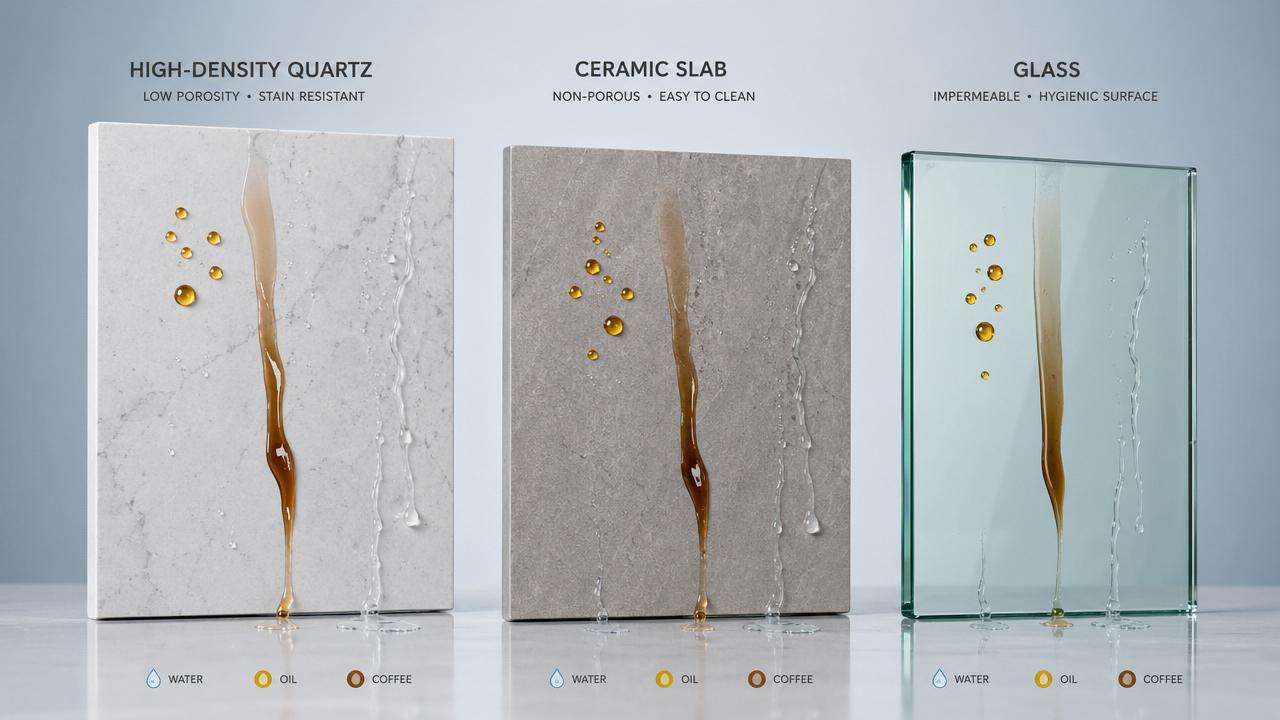
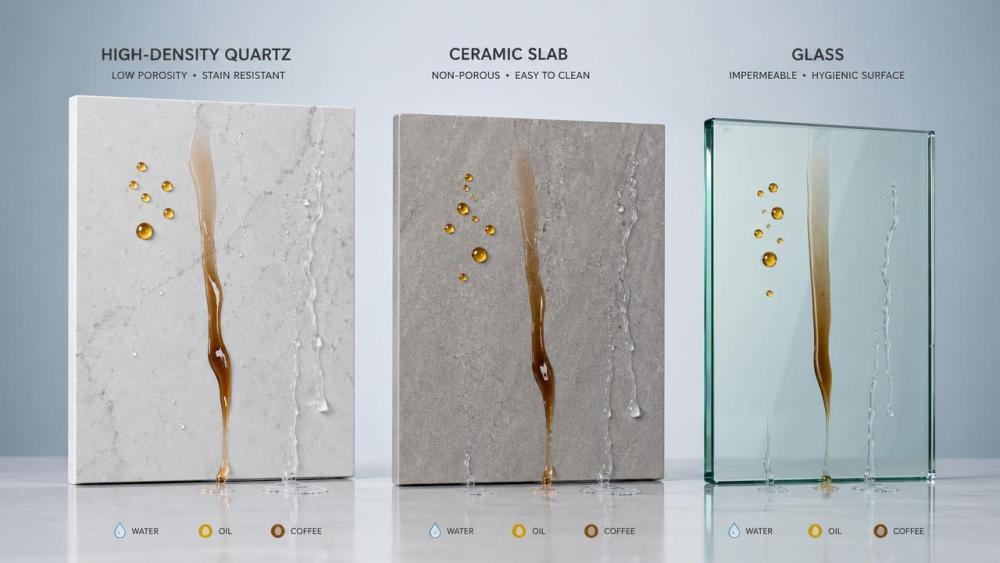
One major area of progress is surface energy engineering. Materials scientists can design surfaces with lower surface energy so that oils, water, and contaminants are less likely to spread and bond. This principle is widely used in advanced coatings, engineered ceramics, treated glass, quartz-based surfaces, and some polymer composites. If a liquid remains beaded rather than flattened, it has less contact area, which often reduces stain formation and simplifies cleaning.
Another important development is micro- and nano-scale texturing. Surface topography can be engineered to influence wetting behavior, adhesion, and contamination retention. In some cases, textured structures mimic natural models such as lotus leaves, where water droplets roll off and carry away dirt. In built environments, however, the technical challenge is balancing this effect with durability. A nano-structured coating may perform well in controlled conditions, but if the feature geometry is easily damaged by abrasion, its real-world value declines rapidly.
Chemical functionalization also plays a growing role. Fluorinated compounds, silicone-based technologies, inorganic hybrid coatings, and sol-gel derived treatments can modify how surfaces interact with contaminants. Increasingly, the industry is moving toward systems that reduce dependence on legacy chemistries with environmental concerns while maintaining strong repellency. For evaluators, this means performance claims should be reviewed together with regulatory compliance, VOC profile, and long-term chemical stability.
Why the substrate matters as much as the coating
A common evaluation mistake is to judge stain resistance mainly by the final finish layer. In reality, the substrate often determines whether protection remains stable over time. Dense porcelain, sintered stone, vitrified ceramic, engineered quartz, compact laminate, solid surface materials, stainless steel, treated aluminum, and high-performance polymers all interact differently with coatings, sealers, and contaminants. A high-quality coating over a porous or dimensionally unstable base may still fail under service conditions.
Porosity is especially important. Materials with open pores or microcracks can absorb pigments, oils, or moisture beneath the visible surface, making stains harder to remove even if the top layer initially repels contamination. This is one reason dense engineered materials have gained attention in premium kitchen, bath, and commercial applications. Material science has enabled lower porosity and more controlled internal structure, reducing pathways for stain penetration and helping maintain visual consistency after repeated use.
Thermal and mechanical compatibility also matter. If the coating and substrate expand differently with heat, humidity, or cleaning cycles, micro-failures can develop at the interface. Once microscopic breakdown begins, contaminants can lodge in damaged areas and performance declines. Technical evaluators should therefore view stain resistance as a system property: surface chemistry, microstructure, substrate density, bonding integrity, and fabrication quality all contribute to the final result.
Which new material technologies are making the biggest difference
Several material categories are driving meaningful improvement. Advanced ceramics and sintered surfaces are notable because they combine high density, strong chemical resistance, and low water absorption. These materials perform well against many common staining agents found in kitchens, sanitary spaces, and commercial interiors. Their resistance is not only a result of surface finishing; it is also tied to the engineered mineral structure created during manufacturing.
Engineered quartz and solid surface products have also evolved. Better resin systems, more controlled particle distribution, and improved finishing methods can reduce susceptibility to staining while preserving color and design flexibility. In some product families, antimicrobial features and stain-resistant behavior are being combined, especially for sanitary and healthcare-oriented spaces. Evaluators should still examine heat sensitivity, repair protocols, and chemical compatibility, since stain performance does not automatically guarantee resistance to all forms of damage.
Protective thin films and hybrid coatings are another key area. These may include ceramic-like top layers, UV-cured treatments, plasma-enhanced films, and nanocomposite barriers designed to resist both moisture and chemical attack. In metals and glass, such technologies can dramatically improve cleanability and reduce visible residue from fingerprints or hard water. For technical use, the critical issue is whether the coating can withstand abrasion, repeated cleaning agents, and installation-related handling without losing function.
How to evaluate stain resistance beyond marketing claims
Marketing language often uses broad phrases such as stain-proof, easy-clean, or nano-protected without explaining test conditions. Technical evaluators should ask more specific questions. What staining agents were used in testing? How long was the exposure? Was the surface cleaned immediately, after a delay, or after curing? Were acidic, oily, and highly pigmented substances all included? Were the results measured visually, instrumentally, or both? These details determine whether a claim is meaningful for actual project use.
A useful evaluation protocol should include realistic contaminants relevant to the application. In residential kitchens, that may include coffee, wine, turmeric, cooking oil, tomato sauce, and vinegar. In bathrooms, soap scum, cosmetics, hard water deposits, disinfectants, and hair dye may be more relevant. In commercial or healthcare settings, stronger chemicals, repeated sanitation cycles, and high-frequency touch contamination should be considered. Performance under the right test set is far more informative than a generic laboratory pass result.
Durability testing is equally important. Abrasion, scratch exposure, UV aging, thermal cycling, and repeated cleaning can all reduce stain-resistant performance over time. Evaluators should review whether the product retains its resistance after wear simulation, not just before it. If a surface depends on a very thin treatment layer, then wear-through risk becomes central. Asking for long-cycle data, maintenance instructions, and failure mode information can reveal whether a surface is suitable for demanding installations.
Trade-offs: what better stain resistance may cost or compromise
Improved stain resistance is valuable, but it does not come without trade-offs. Some highly repellent coatings may be more difficult to repair after damage. Some dense engineered materials perform well against staining but may involve higher fabrication costs, heavier logistics, or more demanding installation requirements. Others may resist household stains yet remain vulnerable to thermal shock, impact edge damage, or specific industrial chemicals. Good technical evaluation means understanding performance in context, not chasing a single metric.
Aesthetic trade-offs can also appear. Matte, textured, ultra-gloss, and natural-look finishes can differ substantially in how they show fingerprints, residue, and maintenance marks. In some cases, a surface with excellent laboratory stain resistance may still reveal smudges more visibly, creating a perception of poor cleanliness. This is especially relevant in premium commercial spaces where appearance stability is as important as chemical resistance. The best specification often balances cleanability with visual masking characteristics.
Sustainability and compliance issues should not be ignored either. As regulations evolve, evaluators increasingly need to assess whether stain-resistant technologies align with environmental goals, indoor air quality standards, and restricted-substance frameworks. Material science is progressing toward lower-emission, longer-life, and more resource-efficient solutions, but the maturity level varies by product type. A technically attractive surface may become less attractive if its chemistry creates compliance or reputational risk later.
Where stain-resistant innovation is having the greatest impact
Architectural and interior applications are seeing the strongest gains in spaces where hygiene, appearance retention, and maintenance efficiency intersect. Kitchens remain a major area because worktops, backsplashes, cabinet faces, and sink surrounds are exposed to oils, pigments, acids, and water every day. Material science is helping manufacturers deliver surfaces that maintain color integrity and reduce the labor needed to remove common cooking-related stains.
Bathrooms and sanitary spaces are equally important. Hard water, soap residue, cosmetic products, and cleaning chemicals create a different challenge profile than kitchen staining. Here, stain-resistant surfaces are often evaluated together with antimicrobial performance, moisture resistance, and long-term gloss or texture stability. For hospitality, residential towers, and healthcare projects, these combined properties can significantly influence maintenance budgets and perceived quality over time.
Commercial interiors are another growth area, especially in high-touch zones such as reception desks, lift surrounds, partitions, washroom surfaces, food-service counters, and shared amenity spaces. In these environments, stain resistance contributes not only to aesthetics but also to operational consistency. Surfaces that clean faster and remain presentable under heavy use can improve lifecycle economics, reduce downtime, and support premium brand perception in public-facing projects.
What technical evaluators should look for when specifying next-generation surfaces
The first step is to define the real exposure profile. Stain resistance should be matched to the substances, cleaning routines, traffic intensity, and visual expectations of the project. A residential vanity top, an airport restroom partition, and a healthcare work surface do not require the same material solution. Precise use-case mapping helps avoid overspecification in low-risk areas and underperformance in critical ones.
The second step is to request evidence that links material science to service durability. Look for test data, but also ask how the performance was achieved. Is the protection integral to the material body, chemically bonded to the surface, or dependent on a renewable sealer? What happens after abrasion, joint finishing, edge processing, or aggressive cleaning? These questions help distinguish robust engineering from short-lived enhancement.
The third step is to evaluate total lifecycle value. The right surface is not always the one with the strongest headline claim. It is the one that delivers acceptable stain resistance together with durability, repairability, compliance, fabrication practicality, and cost control. For technical evaluators working across building materials, sanitary spaces, and smart kitchen and bath systems, this broader view is essential to making defensible, future-ready material decisions.
Conclusion
Material science is changing stain-resistant surfaces by moving performance from simple coatings toward integrated material systems built on surface chemistry, dense microstructures, hybrid films, and advanced manufacturing control. For technical evaluators, this is good news, but it also raises the bar for assessment. Surface claims must be tested against substrate behavior, wear durability, maintenance realities, and regulatory context.
The most valuable insight is that stain resistance should be understood as a functional lifecycle characteristic, not a one-time finish property. The best-performing solutions are those that remain resistant or easy to clean after repeated use, cleaning, and environmental exposure. In practical terms, that means evaluating repellency, removability, durability, and application fit together.
As architectural and interior environments demand higher hygiene, lower maintenance, and longer-lasting aesthetics, material science will continue to reshape the benchmark for stain-resistant performance. Technical evaluators who focus on mechanisms, evidence, and real-world use conditions will be best positioned to identify surfaces that deliver not only cleaner appearances, but stronger long-term value.
Industry Briefing
Get the top 5 industry headlines delivered to your inbox every morning.