Material science applications improving fire-safe panels
For quality control and safety managers, material science applications are reshaping how fire-safe panels perform under real-world pressure. From heat-resistant cores to low-smoke surface technologies, the latest advances help reduce risk, improve compliance, and strengthen product reliability. Understanding these innovations is essential for selecting panels that meet stricter safety standards while supporting long-term building performance.
Why fire-safe panels are entering a new phase of performance demand
Across residential, commercial, healthcare, hospitality, and public infrastructure projects, expectations for panel safety are no longer limited to basic flame resistance. The market now expects multi-dimensional performance: delayed ignition, lower heat release, reduced smoke toxicity, structural integrity under thermal stress, moisture durability, and compatibility with modern interior design. This shift is pushing material science applications from a supporting technical topic into a central decision factor in panel development and specification.
The broader construction and interior systems sector is also being shaped by tighter building codes, insurance scrutiny, sustainability targets, and more demanding lifecycle evaluations. Fire-safe wall panels, ceiling panels, decorative boards, and composite partitions are increasingly judged not only by certification results in controlled testing, but by how reliably they perform after transport, installation, aging, cleaning, humidity exposure, and daily impact. In this environment, advanced material science applications help bridge the gap between laboratory compliance and long-term building safety.
The trend signals behind rising interest in material science applications
Several trend signals explain why fire-safe panel innovation is accelerating. First, developers and designers want lighter systems without sacrificing fire performance. Second, interior products must deliver aesthetics, hygiene, and acoustic value in addition to safety. Third, compliance pathways are becoming more detailed, often requiring proof of system-level behavior rather than isolated material claims. These changes make material science applications more important in every stage from formulation to assembly.
A second signal is the growing focus on smoke behavior. In many fire events, smoke inhalation and toxic gas release create greater danger than direct flame. As a result, demand is increasing for low-smoke panels, halogen-free flame-retardant systems, mineral-based core structures, and coatings that char predictably instead of feeding combustion. This is where material science applications show practical value, because the chemistry and microstructure of each layer directly influence ignition, flame spread, smoke generation, and post-fire residue.
What is driving the shift in fire-safe panel technology
At the technical level, the shift is being powered by deeper knowledge of filler dispersion, resin behavior, interface bonding, pore structure, and thermal decomposition pathways. Instead of relying on one flame-retardant ingredient, modern material science applications increasingly use multi-layer strategies. A panel may combine a mineral-rich core, an intumescent intermediate barrier, and a wear-resistant decorative face engineered to slow heat penetration while preserving appearance.
Where material science applications are improving real fire-safe panel performance
Heat-resistant core design is becoming more precise
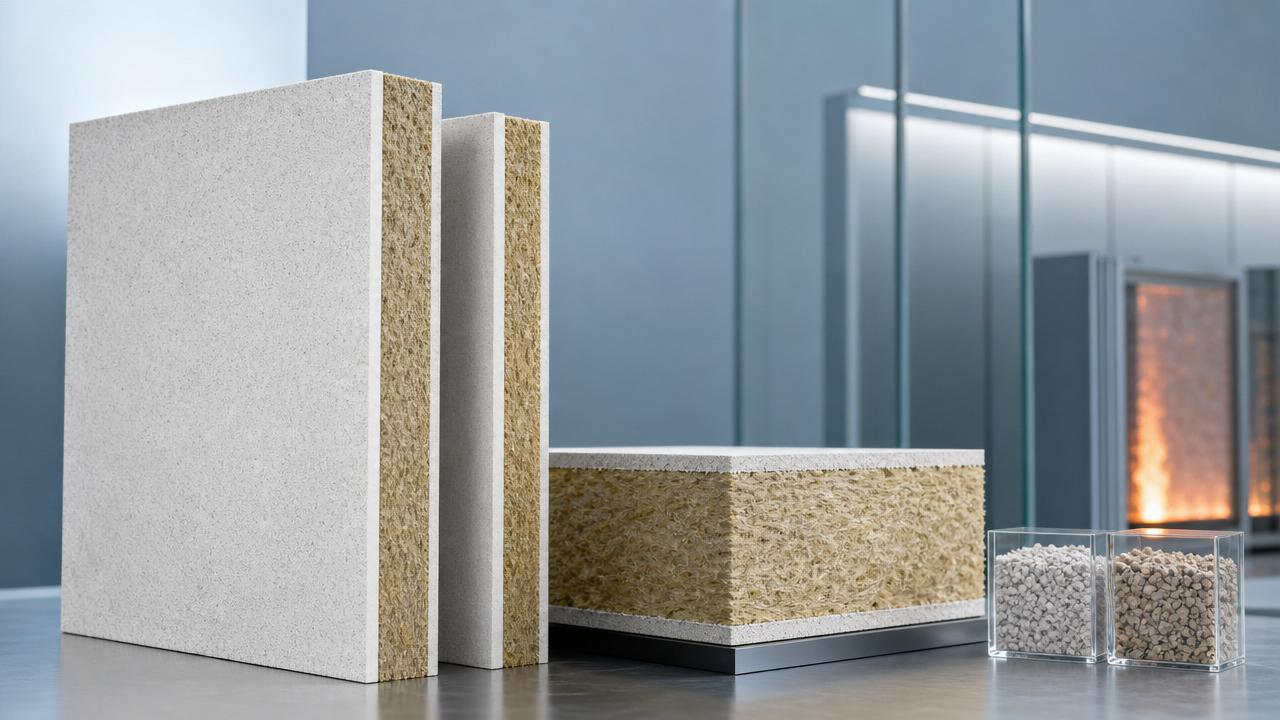
One of the most important material science applications is the development of more stable core materials. Magnesium-based boards, calcium silicate structures, gypsum-enhanced matrices, mineral wool composites, and engineered ceramic-like fillers are being refined to resist heat transfer and reduce structural collapse. Better particle distribution and binder selection help these cores maintain cohesion when exposed to elevated temperatures, which can delay failure and support safer evacuation timelines.
Surface systems are targeting smoke and toxicity reduction
Decorative layers once created trade-offs between design and safety, but newer material science applications are changing that balance. Low-smoke laminates, halogen-free coatings, and intumescent finishes can now contribute to fire-safe panel performance instead of undermining it. The best systems are engineered so that under heat they form a protective char layer, reducing oxygen access and limiting the release of harmful combustion products.
Adhesives and interfaces are receiving more attention
A panel is only as reliable as the bond between its layers. In many failures, delamination begins before visible flame spread becomes critical. This is why material science applications now focus heavily on high-temperature adhesive stability, interfacial compatibility, and moisture-resistant bonding. Improved adhesion chemistry helps maintain panel integrity during both fire exposure and normal service conditions, especially in kitchens, corridors, transport hubs, and wet-area interiors.
How these changes affect product quality, compliance, and project reliability
The impact of advanced material science applications extends well beyond product development. For quality assurance, they create new checkpoints: consistency of filler loading, coating thickness control, thermal aging behavior, and bond-line stability all become measurable risk indicators. For certification planning, they support clearer alignment between material selection and required fire classifications. For project delivery, they reduce the likelihood of mismatched performance between specified samples and installed systems.
These changes also influence supply chain evaluation. Fire-safe panels can no longer be assessed only by a single test report or surface appearance. Reliable sourcing increasingly depends on understanding formulation stability, process repeatability, and whether the same material science applications are consistently maintained across production batches. In sectors such as healthcare, education, modular construction, and high-density mixed-use buildings, this consistency can directly affect operational risk.
- Better thermal stability reduces unexpected panel deformation under heat.
- Lower smoke output supports safer evacuation and clearer compliance pathways.
- More durable bonding improves service life in humid or high-cleaning environments.
- Multi-functional surfaces help combine fire safety with hygiene and design goals.
What deserves close attention when reviewing fire-safe panels
As material science applications become more sophisticated, evaluation should also become more disciplined. Fire performance claims need to be reviewed as part of a complete construction context, not as isolated marketing statements. Panel composition, joint details, substrate compatibility, installation method, and aging resistance all influence the final outcome.
- Core composition: Check whether the heat-resistant layer is mineral-based, composite, or polymer-modified, and how that affects structural stability.
- Smoke behavior: Review not only flame spread data but also smoke density and potential toxicity characteristics.
- Layer compatibility: Verify that coatings, laminates, adhesives, and core materials are engineered to perform together.
- Durability under service conditions: Consider moisture, cleaning chemicals, impact, and temperature cycling.
- Test relevance: Confirm whether the reported results reflect the actual panel assembly and intended application area.
A practical way to judge the next wave of material science applications
Looking ahead, the most valuable material science applications will likely be those that combine fire safety with broader building priorities: lower carbon footprints, healthier interiors, modular assembly, and digital traceability. Fire-safe panels are no longer stand-alone products. They are part of integrated building systems where safety, sustainability, and aesthetic performance must coexist without compromise.
A practical next step is to review panel specifications through a material-performance lens rather than a label-only lens. Compare core technologies, smoke behavior, adhesive stability, and real-service durability before final selection. For organizations tracking building materials, sanitary environments, and smart space evolution, this approach creates a stronger foundation for safer, more resilient, and more future-ready interior systems. In that context, understanding material science applications is not optional; it is a necessary part of informed building decisions.
Industry Briefing
Get the top 5 industry headlines delivered to your inbox every morning.