Why does material science in smart architecture matter?
Material science in smart architecture is no longer a behind-the-scenes discipline; it is a critical factor in safety, energy performance, hygiene, durability, and intelligent user experience. For technical evaluators, understanding how advanced surfaces, antibacterial composites, water-saving systems, and sensor-integrated materials behave under real project conditions is essential to making reliable specification decisions. This article examines why material science in smart architecture matters and how it supports greener buildings, smarter spaces, and stronger long-term value across residential and commercial environments.
For B2B decision teams, the challenge is not only selecting attractive finishes or connected devices. It is verifying whether materials, sanitary systems, smart kitchen platforms, and building components can perform consistently for 10–20 years under moisture, wear, cleaning chemicals, thermal variation, and digital integration demands.
Material Performance as the Foundation of Smart Spaces
Material science in smart architecture begins with a practical question: what happens to a surface, seal, sensor, valve, tile, or composite panel after thousands of daily interactions? In commercial washrooms, hospitality kitchens, healthcare bathrooms, and residential apartments, this question affects safety, hygiene, maintenance budgets, and occupant satisfaction.
A smart building may use 30–80 categories of interior and architectural materials, from ceramic slabs and waterproof membranes to touchless faucets, antibacterial coatings, acoustic panels, smart locks, and appliance housings. Each category has different stress conditions, testing methods, and procurement risks.
Why technical evaluators need a material-first view
Technical evaluators often compare drawings, samples, datasheets, and mock-up results within 2–6 weeks. A material-first view helps them connect physical properties with operational outcomes before a building enters long-term use.
- Safety: slip resistance, impact tolerance, fire behavior, electrical insulation, and water tightness.
- Energy performance: thermal conductivity, solar control, airtightness, and heat retention.
- Hygiene: antibacterial surfaces, cleanability, moisture control, and mold resistance.
- Durability: abrasion resistance, corrosion performance, UV stability, and lifecycle maintenance.
- Connectivity: sensor compatibility, embedded electronics protection, and stable signal performance.
In this context, material science in smart architecture is not a laboratory concept. It is a specification discipline that helps teams reduce change orders, avoid premature replacement, and match materials to actual project exposure.
Key evaluation dimensions
The following table translates common material categories into technical evaluation points. It is useful for comparing premium building materials, sanitary spaces, and smart kitchen and bath systems during early specification review.
The main conclusion is straightforward: material science in smart architecture gives evaluators measurable criteria. It turns vague quality expectations into testable properties, comparison tables, and acceptance checkpoints.
How Materials Shape Energy, Carbon, and Lifecycle Value
Energy-saving codes, carbon reduction targets, and procurement policies increasingly influence building material choices. Material science in smart architecture supports these goals by connecting embodied impact, operational efficiency, and maintenance intervals into one lifecycle view.
A low-cost component can become expensive if it fails after 3 years instead of 10 years. Conversely, a higher-grade material may justify its price when it reduces cleaning chemicals, water consumption, replacement downtime, or energy leakage across a full asset cycle.
Energy performance is material-dependent
Smart thermostats and building management systems cannot fully compensate for poor insulation, thermal bridging, or unstable glazing performance. Intelligent control must be paired with materials that regulate heat, moisture, light, and airflow.
For example, facade panels, interior partitions, pipe insulation, sealing systems, and sanitary hot-water networks may influence energy behavior across 4 major pathways: heat transfer, air leakage, water temperature retention, and equipment workload.
- Define target performance values before selecting finishes or smart devices.
- Compare material data under expected temperature, humidity, and cleaning conditions.
- Review installation tolerances, usually within millimeter-level control for waterproofing and alignment.
- Assess maintenance frequency, with high-use spaces often needing monthly or quarterly inspection.
Lifecycle cost is more than purchase price
Technical teams should evaluate at least 5 lifecycle factors: procurement cost, installation complexity, repair frequency, cleaning demand, and end-of-life handling. These factors often reveal differences hidden in standard quotation comparisons.
Material science in smart architecture also improves carbon decisions. Recycled content, lower-emission binders, durable coatings, modular replacement, and water-saving fixtures can support greener buildings without sacrificing operational reliability.
Smart Kitchens, Baths, and Sanitary Spaces Need Tested Compatibility
Kitchens, bathrooms, and sanitary spaces are among the most demanding zones in residential and commercial environments. They combine moisture, temperature variation, cleaning chemicals, electronics, human touchpoints, and mechanical wear within compact areas.
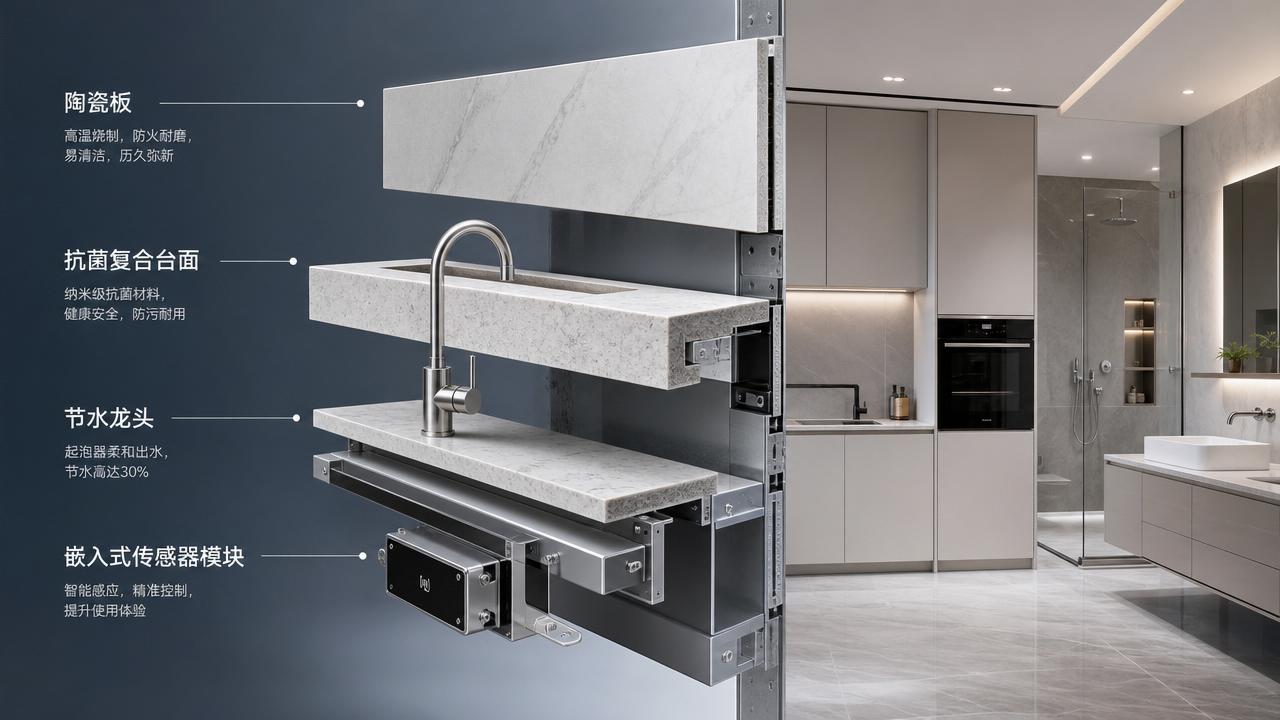
Material science in smart architecture becomes especially important here because connected products interact with surfaces and infrastructure. A touchless faucet depends on sensor protection, water quality, valve durability, power management, and basin geometry.
Common pain points in technical evaluation
Many project failures come from compatibility gaps rather than one defective product. Evaluators should investigate how materials and smart systems behave as an integrated package, not as isolated catalogue items.
- Moisture ingress around sensors, concealed valves, control panels, and smart mirrors.
- Surface staining from hard water, detergents, disinfectants, or food residues.
- Noise transfer from pumps, drainage systems, cabinet panels, or appliance vibration.
- Signal instability caused by metal substrates, thick stone, dense ceramics, or poor device placement.
- Maintenance access limitations when smart components are hidden behind fixed finishes.
A robust assessment should include at least 6 checks: waterproofing, cleanability, electrical safety, hydraulic pressure, replaceability, and digital control reliability. These checks are central to material science in smart architecture.
The next table outlines how evaluators can connect smart spatial systems with material performance indicators during specification meetings, supplier interviews, or sample-room validation.
The table shows that smart performance depends on physical endurance. For technical evaluators, this is why material science in smart architecture should be reviewed before procurement, not after installation problems appear.
Selection Criteria for Reliable Specification Decisions
A reliable specification process should separate marketing claims from verifiable performance. Material science in smart architecture gives evaluators a structured method to compare samples, suppliers, standards, and long-term service assumptions.
In complex projects, 3 stakeholder groups usually influence the final decision: design consultants, engineering teams, and procurement managers. Each group uses different language, so the specification file must connect aesthetics, performance, cost, and risk.
Six practical criteria for comparison
- Performance evidence: request test reports, installation manuals, and maintenance guidance.
- Environmental suitability: check temperature, humidity, UV exposure, and chemical conditions.
- System compatibility: confirm connections between materials, sensors, water systems, and controls.
- Installation tolerance: define acceptable deviation, leveling, sealing, and joint requirements.
- Serviceability: confirm spare parts, access panels, and replacement procedures.
- Lifecycle value: evaluate replacement cycle, maintenance labor, energy impact, and waste reduction.
These 6 criteria help reduce subjective decisions. They also make supplier discussions more efficient because every claim can be linked to a test condition, operating scenario, or measurable acceptance point.
Red flags evaluators should not ignore
A product should be reviewed carefully if its datasheet lacks operating ranges, cleaning instructions, or environmental limits. Another warning sign is a premium surface that has not been tested with the project’s actual disinfectants.
For connected devices, evaluators should ask whether firmware updates, battery replacement, and sensor calibration can be managed without damaging surrounding materials. Material science in smart architecture must include both physical and digital maintainability.
Implementation Framework: From Intelligence to On-Site Validation
GIAM’s industry intelligence perspective is valuable because smart spatial decisions depend on fast-changing inputs: building codes, trade policies, tariff changes, material innovation, water-saving technology, and evolving urban demand for premium interiors.
A practical implementation framework should move through 5 stages. Each stage reduces uncertainty and creates evidence for specification, procurement, installation, and post-occupancy review.
Five-stage implementation workflow
- Define use conditions, including traffic level, moisture exposure, cleaning frequency, and connected functions.
- Screen materials against project requirements, regulatory expectations, and sustainability targets.
- Build a mock-up or sample room for 7–15 days of inspection and stakeholder feedback.
- Confirm installation method, interface details, spare parts, and service responsibilities.
- Track early operation for 30–90 days to identify cleaning, leakage, sensor, or user-experience issues.
This workflow is especially useful for hotels, offices, apartments, hospitals, schools, and retail facilities where failure costs include downtime, tenant complaints, and brand damage.
Where intelligence platforms add value
GIAM connects material science architects, hydraulic design experts, and industrial economists to support stronger decisions. This multidisciplinary view helps evaluators understand not only what performs well, but also what is commercially realistic.
Through sector news, evolutionary trend analysis, and commercial insights, technical teams can monitor emerging antibacterial materials, water-saving systems, smart locks, and premium kitchen appliances before finalizing project specifications.
For manufacturers, material science in smart architecture also supports product positioning. Verified durability, lower water use, greener materials, and easier service access can strengthen competitiveness in project bidding and premium space procurement.
Frequently Asked Questions for Technical Evaluators
Technical evaluators often need concise answers during supplier shortlisting, tender review, or design coordination. The following questions address common concerns in material science in smart architecture.
How early should material science be considered?
It should be considered during concept and schematic design, not only during procurement. Early review can prevent 2–4 rounds of redesign when materials, waterproofing, sensors, or plumbing layouts conflict.
Are smart materials always more expensive?
Not always. Some advanced materials carry a higher purchase price, but they may reduce cleaning labor, water waste, energy leakage, or replacement frequency. Lifecycle evaluation is more reliable than unit price comparison alone.
What tests are most useful before approval?
Useful checks include abrasion, slip resistance, water tightness, chemical resistance, corrosion exposure, sensor response, valve cycling, and mock-up installation review. The correct mix depends on the project’s exposure conditions.
How does this apply to both residential and commercial projects?
Residential projects prioritize comfort, hygiene, aesthetics, and appliance integration. Commercial projects add heavier traffic, faster maintenance access, clearer warranty controls, and stricter operating continuity requirements.
Building Industrial Foundations and Leading Spatial Intelligence
Material science in smart architecture matters because it links construction fundamentals with intelligent living. It helps technical evaluators judge whether a material, system, or connected product can perform safely, efficiently, and maintainably in real spaces.
For building material manufacturers, sanitary system suppliers, smart kitchen and bath brands, and project decision teams, the value lies in better evidence. Strong specifications reduce uncertainty across design, procurement, installation, operation, and future upgrades.
GIAM supports this decision environment through high-authority intelligence stitching across core building materials, sanitary spaces, and smart living systems. Its Strategic Intelligence Center helps teams interpret trends, compare risks, and identify sustainable opportunities.
If your team is evaluating green materials, water-saving systems, antibacterial surfaces, smart locks, or intelligent kitchen and bath solutions, explore GIAM’s insights to strengthen specification decisions. Contact us to learn more solutions or request a tailored intelligence consultation.
Industry Briefing
Get the top 5 industry headlines delivered to your inbox every morning.