
Healthcare Bathing System ROI: Labor, Water, and Maintenance Costs
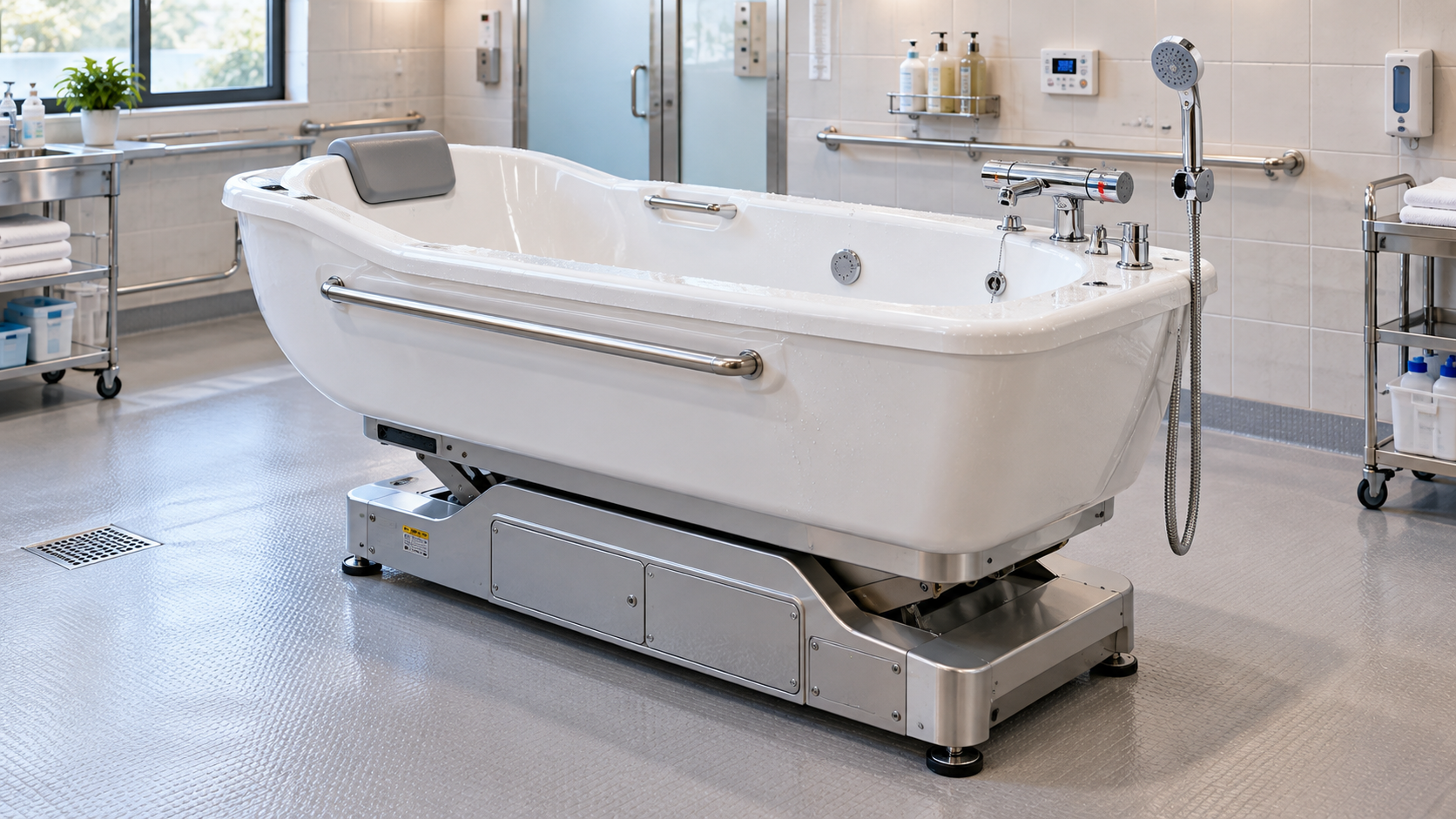
A healthcare bathing system earns its investment through measurable reductions in operating costs, supported by installation costs and service requirements that the facility can sustain. Purchase price alone cannot establish healthcare bathing system ROI. The calculation must connect assisted bathing activity with staff time, water and energy consumption, cleaning requirements, maintenance, and the cost of keeping care available during equipment failures.
Start with the cost per completed bath under the current arrangement, then compare it with the proposed system under equivalent care conditions. A credible payback estimate separates cash savings from released staff capacity and includes the full cost of bringing the equipment into service. Patient handling, hygiene, and temperature control remain acceptance requirements throughout the comparison.
Establish a comparison that reflects actual bathing activity
Define the equipment and workflow being replaced. An accessible shower, a height-adjustable bath, and an integrated transfer-and-bathing system involve different transfer movements, cleaning tasks, and utility demands. Comparing their purchase prices without accounting for those differences produces an unreliable ranking.
The baseline should represent completed care episodes, including preparation and recovery of the bathing space. Record transfer preparation, patient positioning, bathing, drying, cleaning, disinfection, and equipment reset. Include time spent locating compatible accessories or waiting for a shared transfer device when those delays occur in the existing workflow.
Use observations across different shifts and levels of assistance. A demonstration involving a cooperative patient and an unobstructed room does not establish performance for patients with limited mobility, cognitive impairment, or complex transfer needs. Preserve those differences in the operating model instead of combining every bath into one unexplained average.
Annual volume also needs a defensible basis. Use recorded bathing activity, adjusted for expected occupancy and the share of patients suitable for the proposed equipment. Installed capacity is not the same as usable demand. A system assigned only a small portion of bathing activity has fewer opportunities to recover its fixed costs.
Labor savings depend on person-minutes and staffing consequences
Elapsed bath time and labor consumption measure different things. A shorter appointment involving additional staff can consume more labor than a longer appointment with fewer staff. Calculate person-minutes by adding the time contributed by each staff member throughout the care episode.
For each patient group, the calculation is:
Annual labor value = annual completed baths × reduction in person-minutes per bath ÷ 60 × fully loaded hourly labor cost.
The hourly cost should reflect the relevant staffing mix and employment costs. If different roles participate in the transfer and bathing stages, value their time separately. Applying the highest wage rate to every minute exaggerates the result.
Released time becomes a cash saving only when it changes expenditure, such as overtime, agency hours, or a staffing requirement that can actually be reduced. When staffing remains unchanged, record the benefit as available care capacity. That capacity has operational value, but it should not automatically appear as cash available to repay the investment.
Transfer assistance requires particular care. Powered adjustment or improved access does not, by itself, justify reducing the number of staff involved. Patient assessment, handling procedures, room geometry, and equipment instructions determine the assistance required. Any financial model built around fewer staff must first establish that the revised workflow is acceptable.
Time observation should continue beyond the bathing stage. A faster bath followed by more demanding disinfection can leave total labor unchanged. Conversely, easier positioning and simpler room reset can create value even when direct washing time changes little.
Measure water and energy across the complete cycle
Water consumption should include filling, washing, rinsing, cleaning, and any prescribed flushing. A stated tub capacity or shower flow rate captures only part of that demand. For a shower, flow rate must be paired with actual running time. For a bath, usable fill volume and refill frequency matter more than maximum vessel capacity.
Record water consumption at comparable operating conditions. Different inlet pressures, temperature settings, bathing routines, and cleaning procedures can overwhelm the apparent difference between two systems. Where measurement is unavailable, keep assumptions visible and require them to be tested during a site trial.
Annual water and sewer cost = annual completed baths × total water volume per bath × applicable combined volumetric tariff.
Keep units consistent. Fixed utility charges belong in the savings calculation only if the investment changes them. Where sewer billing follows metered water use, the avoided cost differs from a site with a separate charging arrangement.
Hot-water energy needs a separate calculation. It depends on the volume heated, the temperature rise, and the efficiency of the heating and distribution system. Mixed water delivered at the outlet is not equivalent to an equal volume drawn directly from hot-water storage.
Include equipment electricity where relevant, such as pumps, powered lifting, controls, and standby operation. Metered whole-cycle consumption provides stronger evidence than the rated power of an individual component. Building hot-water circulation losses should be allocated consistently; a bathing equipment replacement does not necessarily reduce those losses.
Lower consumption must remain compatible with the required cleaning process and safe water operation. Savings based on omitted rinsing, shortened disinfection contact time, or unsupported changes to flushing procedures should be excluded.
Maintenance costs reveal whether savings will persist
Maintenance costs depend on component access, service intervals, local water conditions, parts availability, and the work included in the service agreement. A low annual service quotation can conceal substantial exclusions.
Material compatibility deserves attention because repeated exposure to an unsuitable chemical can damage surfaces, seals, or other components. Compare the required cleaning method with the facility’s approved products before assigning consumable costs. A change in chemistry can also affect storage, dispensing, training, and cleaning time.
Downtime has a cost only through its consequences, which should be modeled explicitly. An unavailable system might require bathing elsewhere, longer transfers, additional staff time, or a temporary rental. Avoid assigning an arbitrary revenue loss to every unavailable hour when the facility can maintain care through existing alternatives.
A service response commitment also needs careful interpretation. Time to acknowledge a fault, time to attend the site, and time to restore operation are different measures. Availability of a replacement component can determine the actual disruption even when attendance is prompt.
Include the cost of making the system usable
The installed investment should include equipment, delivery, access arrangements, assembly, commissioning, and any necessary removal of existing equipment. Building work can materially change the ranking between proposals that initially appear close in price.
Confirm floor loading, drainage position, water supply capacity, electrical provision, and clear space for transfers and servicing. A system that fits within the room’s dimensions can still obstruct a transfer route or prevent maintenance access. Site surveys should establish these constraints before installation allowances become contractual assumptions.
Training requires both an initial allowance and a practical plan for staff turnover. Include paid training time, competency assessment where required by facility procedures, and any temporary reduction in throughput during introduction. Costs associated with room closure or temporary bathing arrangements belong in the installation budget when they arise from the project.
For a replacement project, distinguish costs incurred under either option from costs caused by the proposed investment. If existing equipment already requires replacement, the relevant comparison may be the additional investment above a suitable alternative. Comparing that premium against all savings from retiring the old system would overstate the return.
Turn operating evidence into payback and lifecycle cost
Build annual operating costs for each option using the same bathing volumes, labor rates, utility tariffs, and costing boundaries. Include labor, water, energy, chemicals, routine maintenance, expected repairs, and the operational consequences of downtime. Show released staff capacity separately from cash expenditure.
Annual net cash savings = baseline annual cash operating cost − proposed annual cash operating cost.
Simple payback = additional installed investment ÷ annual net cash savings.
Simple payback is useful when annual savings are reasonably stable and positive. It does not show the timing of major repairs, the value of savings after payback, or the effect of different equipment lives. If savings vary substantially by year, calculate cumulative cash flow rather than dividing by a single annual figure.
A lifecycle comparison should use a common evaluation period and discount future costs using the organization’s approved financial assumptions. Include scheduled replacements during that period and any supported residual value or disposal cost. Comparing alternatives over different periods without adjustment can favor the option with costs falling just outside its chosen horizon.
Avoid counting the same benefit twice. Reduced cleaning time belongs within total labor savings; it should not reappear as a separate productivity saving. Similarly, additional bathing capacity creates financial value only where demand, staffing, space, and funding allow that capacity to be used.
Make uncertain assumptions visible before award
Use a small set of scenarios to test the assumptions most likely to change the investment result. Useful variables include completed bathing volume, person-minutes saved, the portion of released time that reduces expenditure, repair costs, and installation scope. Adjust them within ranges supported by site evidence or clearly identified quotation uncertainty.
The break-even bathing volume is especially useful when utilization is uncertain. It shows how many completed baths are needed for operating savings to cover the additional investment within the chosen period. Where per-bath cash savings are negligible or negative, increased utilization will not create the expected payback.
Supplier savings claims should translate into observable acceptance measures: water consumed per complete cycle, staff person-minutes under defined assistance conditions, cleaning and reset time, and the maintenance scope included in the quoted price. Record the trial conditions so that an attractive result can be compared with normal operation.
Keep safety and care-quality acceptance separate from the financial score. Claims about reduced injuries, infections, or other clinical outcomes require appropriate evidence before receiving a monetary value. The final investment case should make clear which savings are measured, which remain assumptions, and which operational improvements have value without reducing cash expenditure.
Industry Briefing
Get the top 5 industry headlines delivered to your inbox every morning.