Indonesia Tightens Fire Safety for Bathroom Cabinets
Indonesia Tightens Fire Safety for Bathroom Cabinets — On October 1, 2026, new fire safety requirements for bathroom cabinets will enter mandatory enforcement in Indonesia, following a technical bulletin jointly issued by the Central Bureau of Statistics (BPS) and the Directorate General of Energy Efficiency and Fire Safety on May 9, 2026. The revision significantly raises the bar for thermal radiation penetration resistance — a critical parameter in fire exposure testing — and is expected to reshape import compliance strategies, manufacturing specifications, and supply chain risk management for exporters, particularly from China.
Event Overview
On May 9, 2026, Indonesia’s Central Bureau of Statistics (BPS) and the Directorate General of Energy Efficiency and Fire Safety published Technical Bulletin No. BP-05/2026. It revises fire safety requirements for bathroom cabinets — including bathtubs’配套 cabinet units and smart cabinets — by introducing a stricter limit on thermal radiation penetration: ≤15 kW/m² (down from the previous ≤25 kW/m²). The test method is updated to align with SNI IEC 60695-10-2:2026. Enforcement begins October 1, 2026. Current market data indicates over 40% of bathroom cabinets imported from China do not meet the revised threshold.
Industries Affected
Direct Trading Enterprises: Exporters and importers handling bathroom cabinets destined for the Indonesian market face immediate compliance risk. Non-compliant shipments post-October 2026 may be rejected at customs or subjected to retesting, delays, or penalties. Since certification is product-specific and tied to physical test reports, existing stock without updated SNI IEC 60695-10-2:2026 validation cannot be cleared under the new regime — even if previously certified under older standards.
Raw Material Procurement Enterprises: Suppliers of substrates (e.g., MDF, particleboard, laminated composites), fire-retardant coatings, and edge-bandings must now verify material-level thermal radiation performance — not just flame spread or ignition resistance. Procurement teams will need documented third-party test data aligned with SNI IEC 60695-10-2:2026, as upstream material non-conformance directly compromises final assembly certification.
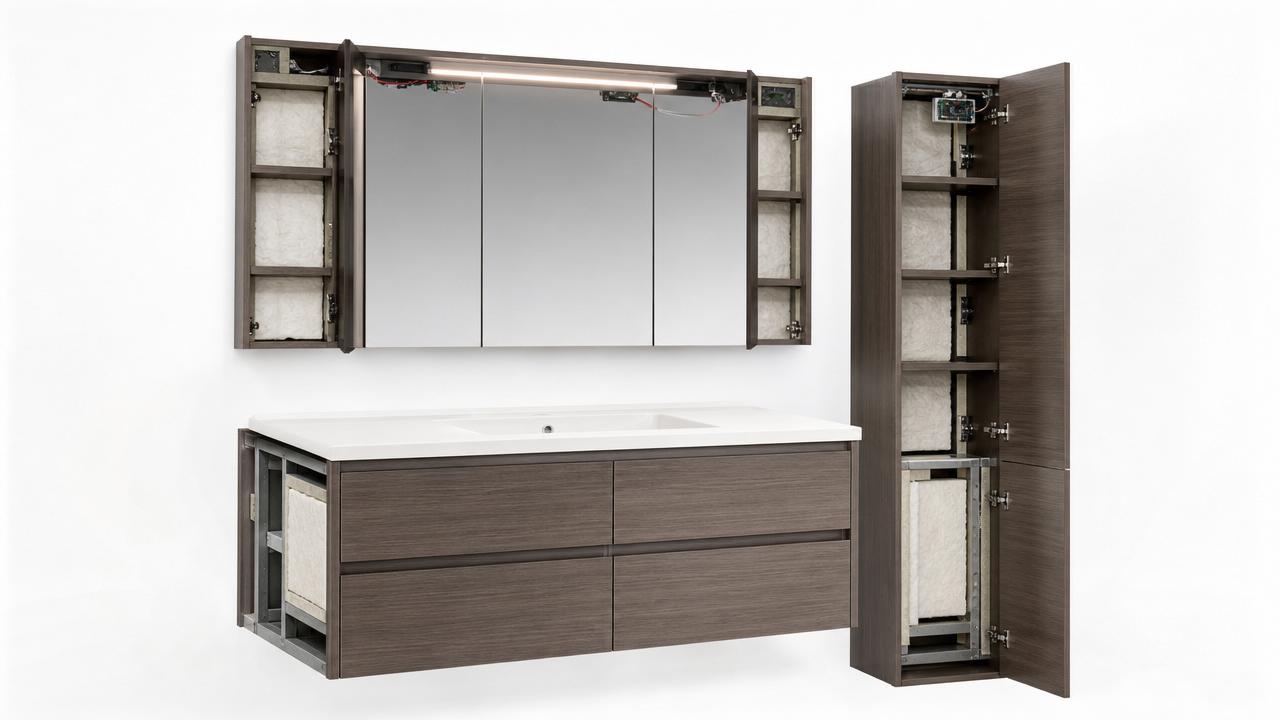
Manufacturing Enterprises: Cabinet fabricators must revise design tolerances, joint sealing methods, and internal compartmentalization to suppress radiant heat transfer during fire exposure. Structural modifications — such as adding ceramic fiber barriers behind back panels or optimizing ventilation cutouts — may be required. Crucially, production-line quality control must now include pre-shipment thermal radiation screening for representative samples, not only end-product certification.
Supply Chain Service Providers: Certification consultants, testing laboratories, and logistics coordinators supporting Indonesian market access must update their service scope. Labs accredited for SNI IEC 60695-10-2:2026 testing remain limited regionally; lead times for compliant reports are projected to extend beyond 8 weeks. Consultants advising on conformity assessment pathways must now integrate thermal radiation performance into gap analyses — a dimension previously outside standard fire safety audits for cabinetry.
Key Focus Areas and Recommended Actions
Verify Existing Product Certifications Against SNI IEC 60695-10-2:2026
Do not assume legacy SNI or IEC 60695-10-2:2013 certifications remain valid. Manufacturers and traders must obtain new test reports referencing the 2026 edition — including full documentation of test setup, irradiance source calibration, and measurement geometry per Clause 7.2 of the standard.
Conduct Thermal Radiation Gap Testing Before Mass Production
Given that over 40% of current Chinese exports fail the ≤15 kW/m² threshold, pilot batch testing using calibrated cone calorimeters is strongly advised. Focus on worst-case configurations: fully loaded cabinets with mirrored backs, integrated lighting, and concealed electronics — all of which can amplify localized radiant flux.
Update Technical Documentation for SDO Submission
Indonesian Standardization Agency (BSN) requires submission of a Systematic Documentation of Origin (SDO) for each model variant. This now must include traceable thermal radiation test reports, material safety data sheets (MSDS) confirming fire-retardant additive stability at ≥650°C, and assembly process records verifying consistent application of shielding layers.
Editorial Perspective / Industry Observation
Observably, this revision signals a strategic shift in Indonesia’s approach to fire safety regulation — moving from prescriptive, component-level criteria toward performance-based, system-level evaluation. The ≤15 kW/m² limit targets radiant heat transfer specifically, reflecting growing concern over flashover risks in compact bathroom environments where occupants have limited egress time. Analysis shows that while the change appears incremental numerically, its implementation demands cross-functional coordination across R&D, procurement, and QA — making it functionally more disruptive than earlier SNI updates focused solely on flame propagation.
From an industry perspective, this is less a ‘certification refresh’ and more a de facto redesign trigger. It also underscores how emerging markets are increasingly adopting EU-influenced fire performance benchmarks — albeit with local calibration — rather than relying on legacy ASTM or ISO baselines. Current more relevant benchmarking may now involve EN 13501-1’s radiant panel test methodology, despite formal alignment remaining with IEC standards.
Conclusion
This regulatory update marks a material step in Indonesia’s maturation of building product safety governance. For global suppliers, it reinforces that compliance is no longer about static document submission but continuous technical adaptation. A rational interpretation is that the 2026 deadline functions as both a compliance checkpoint and a market filter — accelerating consolidation among manufacturers capable of integrating fire performance engineering into core product development, rather than treating it as a late-stage certification hurdle.
Source Attribution
Official sources: Technical Bulletin No. BP-05/2026, issued jointly by Badan Pusat Statistik (BPS) and Direktorat Jenderal Konservasi Energi dan Pengembangan Energi Baru Terbarukan (DG KEPEB), Ministry of Energy and Mineral Resources, Republic of Indonesia, dated May 9, 2026. Enforcement date: October 1, 2026.
— Note: BSN’s official implementation guidance (e.g., transitional arrangements for pending shipments, recognition of overseas test reports) remains pending publication and warrants ongoing monitoring.
Industry Briefing
Get the top 5 industry headlines delivered to your inbox every morning.